83/365: National Chocolate Covered Raisin Day

No need to be raisin a fuss today, especially if you like chocolate and shriveled-up dry fruit. March 24 is National Chocolate Covered Raisin Day!

Raisins were an accidental discovery. People had been eating grapes for centuries, but sometime around 1500 B.C. a lazy farmhand in the Middle East left grapes to dry on the vine too long, and they shriveled up. Turns out this was a good thing, as they discovered the dried grapes were sweet, delicious, and easy to store. Raisin comes from the Latin word racemus, meaning “a bunch of grapes.” Phoenicians and Armenians traded raisins with the Romans and Greeks, who were so enamored of the fruit they decorated places of worship with raisins, and handed them out as prizes in sporting contests. Gotta admit, they’re a lot tastier than gold medals given in the Olympics! Vineyards were developed in Spain and Greece, and the Crusaders introduced them to Europe in the 11th century. They were believed to have great medicinal properties and soon became so popular that two jars of raisins could be traded for a slave in ancient Rome! In America, the San Joaquin Valley became known as “raisin valley” with the introduction of the Thompson seedless grape, and is the world’s largest producer of raisins today.

Chocolate covered raisins were first introduced around 1927, when the Blumenthal Brothers Chocolate Company in Philadelphia rolled out Raisenets. They quickly became a popular treat with moviegoers, who liked the contrast between the sweet and creamy chocolate covered raisins and hot, salty popcorn. To this day they are frequently sold in concession stands, but cost a lot more than the nickel a box proprietors charged back in the 1930s.

Given their history, Tara and I decided to celebrate chocolate covered raisins by (ahem) sneaking some into the movies. (Don’t worry, we paid for the popcorn). Eaten together, they were pretty tasty!
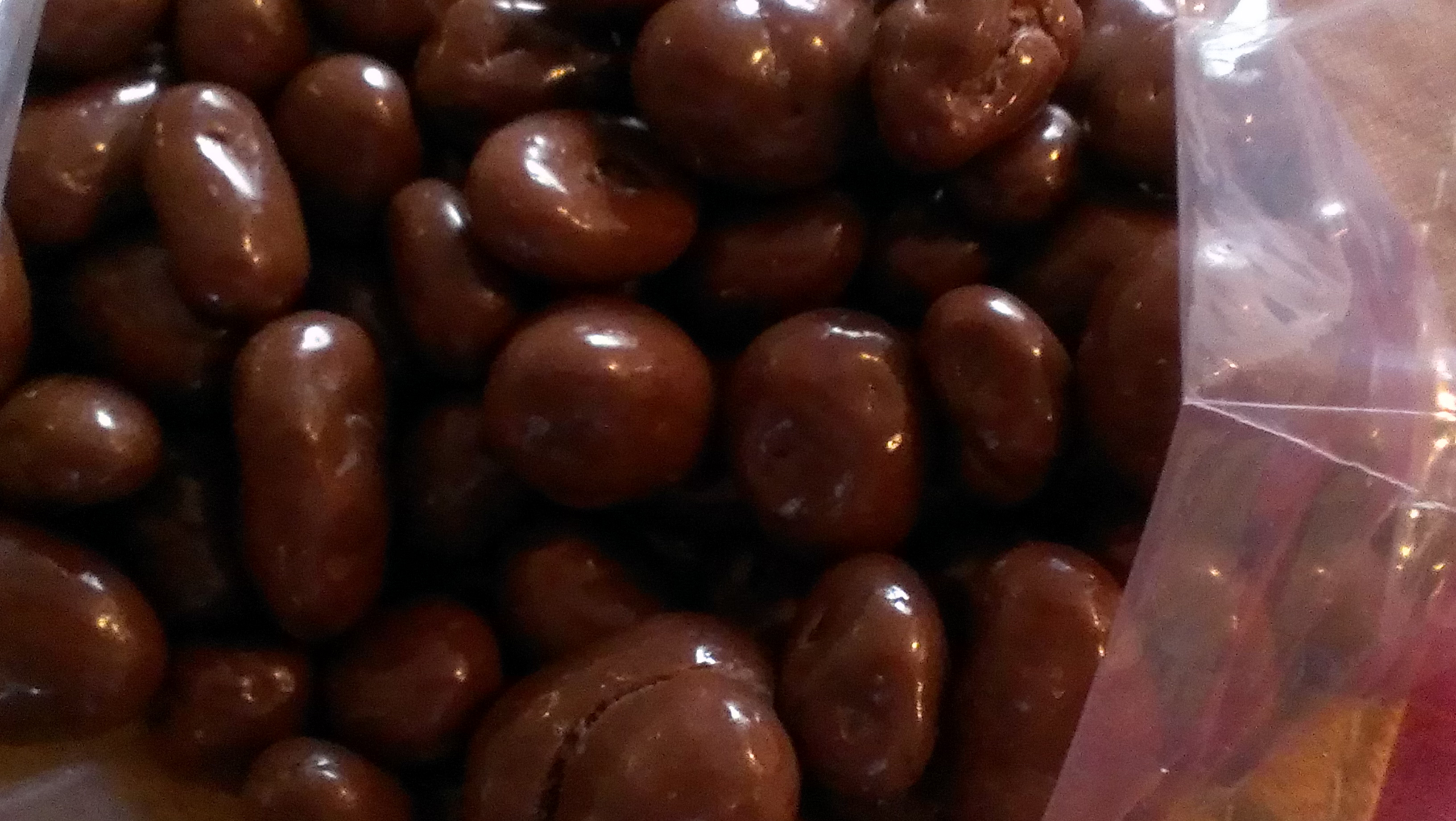
Chocolate Covered Raisins

Categories: Candy, Fruit | Tags: , , , , | 3 Comments

82/365: National Melba Toast Day*

Feeling all warm and toasty inside? Perfect! It’s National Melba Toast Day!

It’s also National Chips and Dip Day, and as tempting as it is to celebrate that one, Melba Toast seems more exotic. Besides, we’ve got a story to finish here! Remember our old friend, Auguste Escoffier? Famed French chef who created both Pears Helene and Peach Melba? Well, the Melba is no coincidence. If you’ll recall the story posted way back on January 13, Escoffier was enamored with opera singer Dame Nellie Melba, and attempted to woo her with a fancy dessert served in an ice sculpture, only that backfired when she was afraid the cold would wreak havoc with her vocal cords. The French are a romantic lot though, and ol’ Auguste was bound and determined to woo his lady, so he tried again five years later. It was 1897, and the famous soprano (Ms. Melba, not Tony) had taken ill. Some say she got what she deserved; Nellie was quite the diva, and had the kind of personality only a mother (or a famous French chef) would find endearing. When Escoffier learned that her diet at the time consisted largely of toast, and (DIVA ALERT!) she would complain that it was never sliced thin enough, he took a piece of toast, sliced it in half, and toasted it again. The result? A super thin and crispy toast, which he consequently named…Toast Marie! It’s no wonder this guy never did get his girl. Marie was the wife of his boss Cesar Ritz. Talk about kissing ass! But Cesar said “yo dude, you got the hots for this honey, so name it after her – chicks dig that shit.” Or something to that effect. So, Toast Marie became Melba Toast. Sadly, the two never did hook up. Although, it should be noted, this was probably a good thing, as Auguste’s wife Delphine might have disapproved.

Ironic that there is no Delphine Toast…

So, what became of them? Nellie got better, toured the world, raised all kinds of money for charity during World War I, was the first Australian to appear on the cover of Time Magazine (1927), and her face now appears on the Australian hundred dollar bill. As for Escoffier, in 1898 both he and Cesar Ritz abruptly left the Savoy Hotel amidst a scandal; £3400 of wine and spirits went missing, and while the duo were suspected of making off with the booze, this was never proven. They did alright, though – Ritz opened both the  Ritz Hotel in Paris and the Carlton Hotel in London, and hired Escoffier to run his kitchens. Auguste managed the hotels until his retirement in 1920, and passed away in 1935, a few years after Dame Nellie Melba.

Nellie Melba: the face that launched two desserts.

Nellie Melba: the face that launched two desserts.

And thus concludes our trilogy on Auguste Escoffier and the desserts he created for famous women.

I had only ever tried Melba Toast once or twice in my life, and in fact, had no idea where to find it in the grocery store. I checked the baby food aisle first, having remembered seeing it there years ago, which makes sense considering that Melba Toast used to be given to infants who were teething, but maybe times have changed as it was not there. Tara finally found it in the cracker aisle sandwiched between Cheez-Its and graham crackers. I guess that makes sense. We ate ours with a variety of toppings – peanut butter, cheese, Nutella – as an afternoon snack. It was pretty good – like a really crisp cracker. I liked mine with cheese best, while Tara preferred the Nutella-covered one.

Melba Toast

Categories: Bread | Tags: , , , , | 5 Comments

81/365: National Coq Au Vin Day*

Today’s food holiday will give you something to crow about! It’s National Coq Au Vin Day, which translates to “rooster in wine.” Cock-a-doodle-do enjoy this tasty French dish!

Coq au vin is a rustic French dish that originated in the Burgundy region and was popular with peasants because the ingredients were plentiful and cheap. Though usually prepared with chicken nowadays – at least in America, where common sense and decency rule and we don’t consider snails a delicacy (oh, those wacky French!) – French commoners did, in fact, use rooster in the recipe because they were dirt poor and couldn’t afford younger, more tender hens.  It was made with red wine because the acids in the alcohol would help tenderize the meat of the rooster (older birds who were all clucked out and could no longer reproduce were put out of their misery this way). Considered a classic, country-style casserole ideally suited to colder winter months – the definition of comfort food – coq au vin was popularized in the U.S. by Julia Child, who featured a recipe in her popular 1961 cookbook Mastering The Art of French Cooking and prepared it often on her television show The French Chef. It became one of her signature dishes, as closely associated with the likable old broad as her husky, distinctive voice. (Don’t get me wrong, I have nothing against Julia Child. I remember watching her and Justin Wilson, the Cajun chef, often while growing up. And Yan Can Cook. It’s no wonder I’m addicted to modern cooking shows like Top Chef, Chopped, and Master Chef).

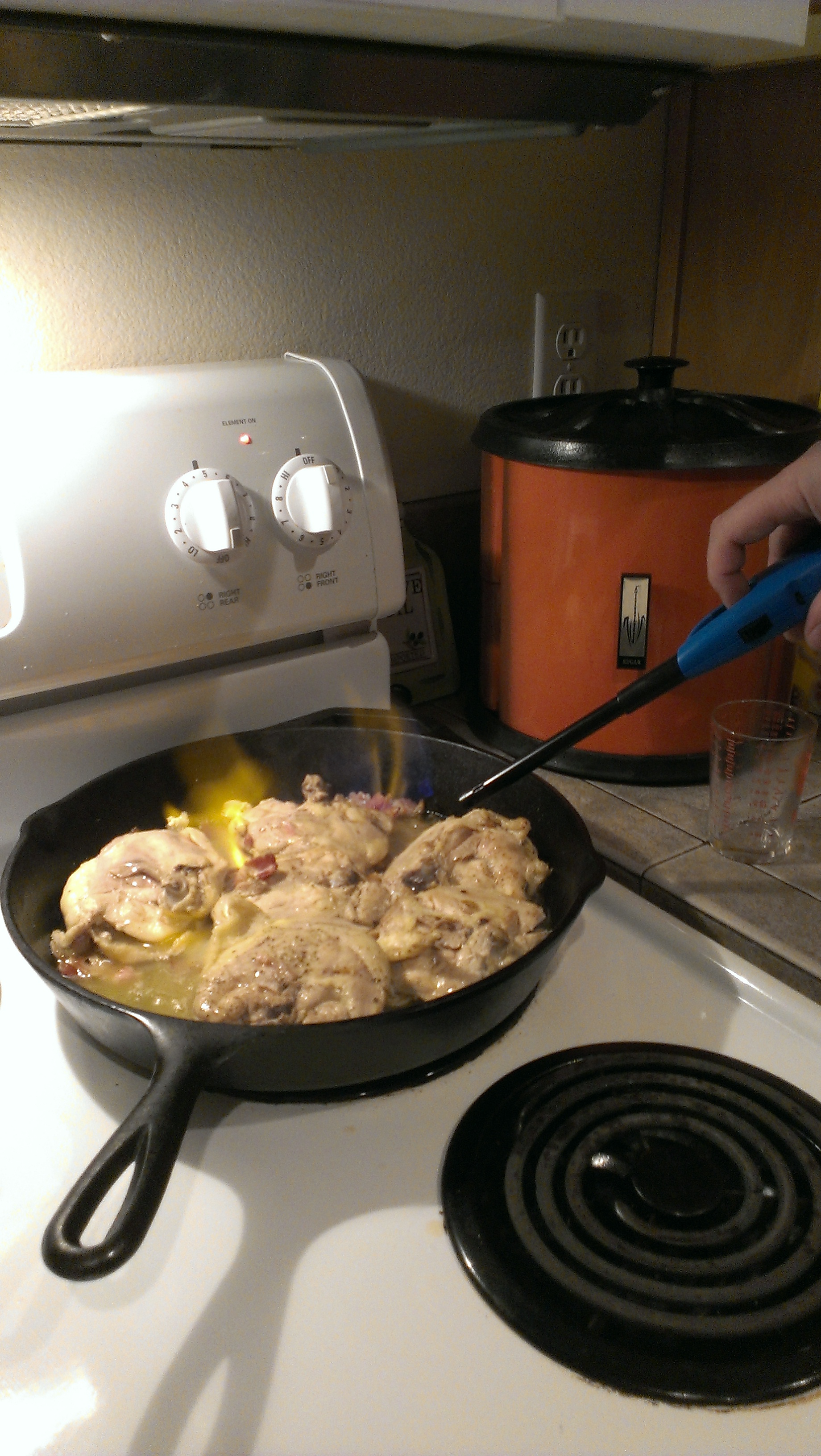
Julia told me to set the brandy on fire. So I did.

Julia told me to set the brandy on fire. So I did.

Fresh out of cock – (must. bite. tongue) –  we opted to make our coq au vin using chicken instead. And decided, since the inspiration for this blog was Julie & Julia, to replicate Julie Powell’s idea for one night by preparing Julia Childs’ classic recipe for coq au vin, found here. Sometimes we are chided for “taking the easy way out” and buying the foods we celebrate from the grocery store or restaurants, but I call fowl on that. First off, we do in fact prepare many of these meals from scratch. Secondly, who cares if we don’t? That was never the intention of this challenge. We are busy with work and kids and, you know, planning a wedding. I think we’re doing extremely well under the circumstances! I just had to get that out there. Most of you have been extremely supportive, and Tara and I appreciate that. I should also mention that today is National Water Day. Now, if we had decided to celebrate that, I too would be screaming “cop out!”

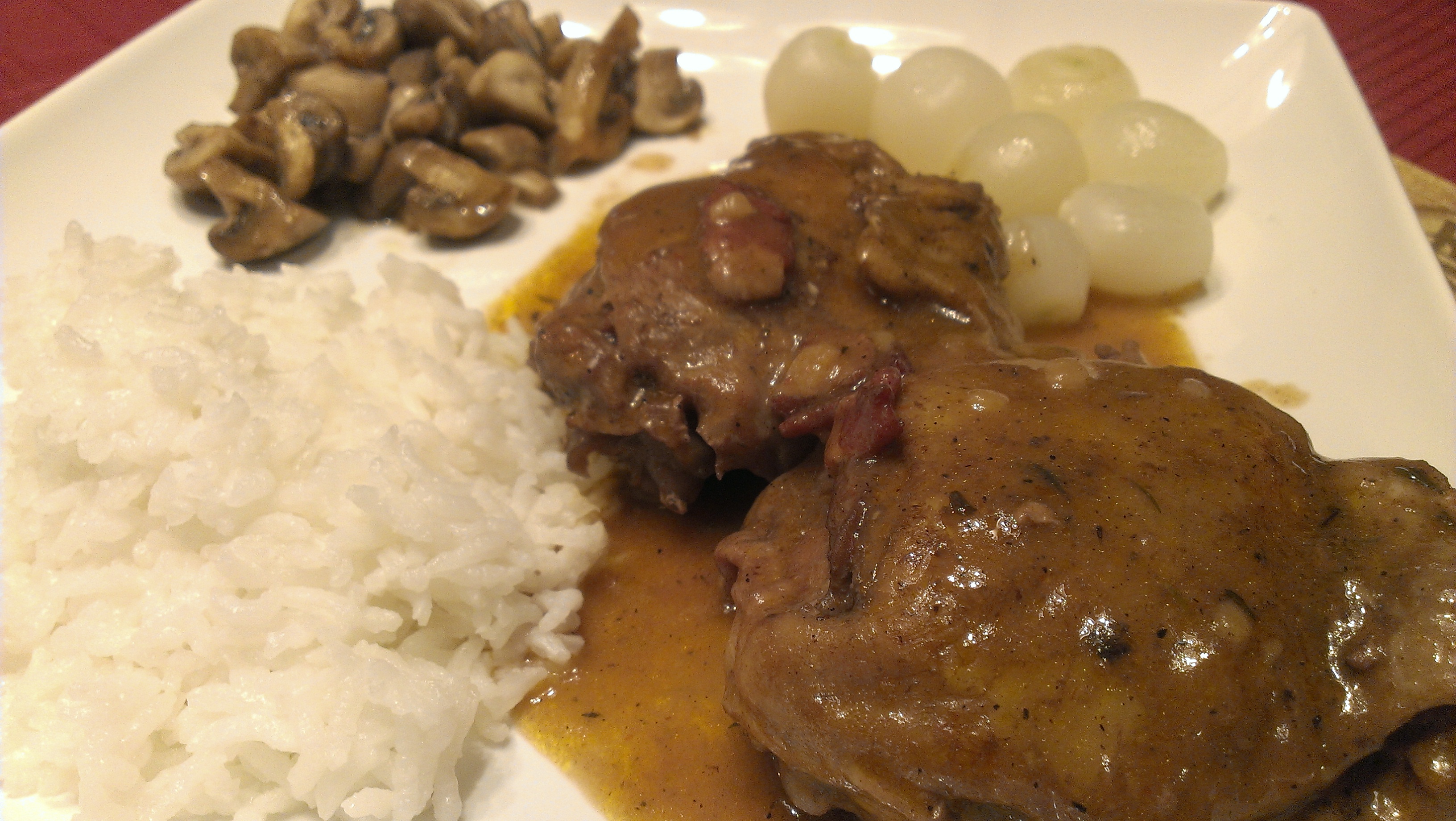
As for Julia Childs’ coq au vin? There was a lot of prep work involved, and very precise cooking instructions with multiple steps, as you might imagine. This meant a very late dinner for us – approaching 9 PM. Luckily, it’s a Friday night, so who cares? And it tasted absolutely DELICIOUS. I can’t emphasize that enough. The sauce was rich and hearty and packed with flavor. This was an amazing dinner!

That Julia Child was onto something. This was incredible!

That Julia Child was onto something. This was incredible!

Categories: Poultry | Tags: , , , , , , , , | 6 Comments

80/365: National French Bread Day*

Bonsoir! Today’s food holiday is c’est bien. It’ll please even the crustiest of individuals and fill their hearts with loaf. It’s National French Bread Day!

It’s also National California Strawberry Day. No offense to Californians, but your strawberries pale in comparison to the ones grown in the Pacific Northwest. Unfortunately, we have to wait until June until those are ripe. So, French bread it was!

By law, French bread must contain four specific ingredients: flour, water, yeast, and salt. The French, you have to understand, love their bread, and even went to war over it. The storming of the Bastille in 1789 was more about bread for the commoners than freeing enemies of the crown; mass starvation gave way to anger and led to the French Revolution. Think about that the next time McDonald’s screws up your order and forgets to give you your six-piece chicken McNuggets. Afraid that history might repeat itself, when Napoleon ruled he passed laws establishing standards for French bread. The classic baguette is long and slender, but it wasn’t always so; wide, flat loaves were popular until the 1920s, when the French passed a labor law prohibiting bakers from working between the hours of 10 PM and 4 AM. (Boy, the French sure have a fondness for silly laws, don’t they)? “Sacré bleu!” they declared in unison. In order to get around this loophole, French bakers started making their loaves of bread long and thin, no more than 2.5″ in diameter, in order to speed up baking time. It’s got a soft, chewy interior and a crispy, golden brown crust and is cooked in a steam oven, which leads to a light and airy loaf that is, to borrow a phrase, c’est magnifique! French bread in other countries doesn’t adhere to such particular standards. In America, loaves are typically fatter, and available in whole wheat, multigrain, and sourdough varieties.

Since Tara and I can’t afford a trip to Paris at the moment, we had to settle for an American-style loaf of French bread instead. Not that either of us was complaining; French bread is quite tasty even if it is made contrary to Napoleon’s original desires. We served it two ways: with bruschetta as an appetizer, and sliced with a smear of butter to go along with grilled steaks.

French bread with bruschetta.

French bread with bruschetta.

Categories: Bread | Tags: , , , , , | Leave a comment

79/365: National Ravioli Day

Today’s food holiday is a very fulfilling one: we honor one of my personal favorite types of pasta. It’s National Ravioli Day!

Ravioli is any filled or sealed pasta, so technically tortellini is a type of ravioli. Which means we’ve already celebrated this holiday! But ravioli are so good, I don’t mind doing it again. Wontons, pierogis, and dumplings are also variations of ravioli. Burritos are not, unless you make yours with pasta, which would be…hmm…actually, a brilliant idea! Ravioli are traditionally filled with either meat or cheese, and simmered in sauce or broth.

Haute cuisine to a kid!

Haute cuisine to a kid!

The earliest reference to ravioli is found in a manuscript by Tuscan merchant Francesco di Marco Datin, dated sometime in the 14th century. Francesco included a recipe for ravioli made with chopped blanched green herbs mixed with beaten egg and fresh cheese, and served with – this is the weird part – Newman’s Own Sock It To ‘Em Sockarooni pasta sauce. Oops, I mean, served in broth. That makes more sense! Actually, tomato-based sauces didn’t even exist in Italy for another couple of centuries, when they were imported from the New World. Italian cuisine without tomato sauce? That’s hard to fathom. Ravioli are traditionally made at home and stuffed with ingredients like ricotta, spinach, and nutmeg, but they are also prepackaged for lazy-ass people who can’t roll out pasta dough convenience. The first canned ravioli was produced during World War I, and let’s face it, what kid hasn’t enjoyed a bowl of Chef Boyardee Ravioli while growing up? In fact, Tara professes a fondness for this stuff even today.

Fortunately, we did not run out and heat up a can of Chef Boyardee Ravioli for today’s challenge, though we also didn’t make our own fresh pasta from scratch (though that is a goal of mine). We were at Costco over the weekend, and picked up a package of Jarlsberg & Portobello Mushroom ravioli, so I cooked those up for lunch, and served them with a mushroom alfredo sauce. Good stuff!

Ravioli

Categories: Pasta | Tags: , , , , | 2 Comments

78/365: National Poultry Day

You’re a chicken if you don’t celebrate today’s food holiday, and you’d better duck or I’ll goose you, ya turkey! No need to cry fowl. In case you hadn’t guessed, March 19th is National Poultry Day.

And also, 5 Puns For The Price Of 1 Day.

Chicken is the most popular type of poultry, and accounts for 20% of the world’s protein. Descended from the Red Jungle Fowl, a small Southeast Asian pheasant, chickens (and ducks, geese, and pigeons) were first domesticated in China 3000 years ago. Surprisingly, they weren’t bred for their meat or eggs, but were used instead for cockfighting, a popular sport that spread throughout Asia and Europe. Little did they know how delicious those birds taste smothered in sweet ‘n sour sauce! Eventually, humans became too “civilized” to allow cockfighting to continue, and Colonel Harlan Sanders needed to go in a different direction to revive his fledgling Kentucky Fried Goat franchise, so a new use for poultry was discovered. Europe sent chickens to America and we gave them turkeys (by turkeys I mean large birds that are popular at Thanksgiving, not Ashton Kutcher films). Poultry became popular during World War II when other livestock were scarce, and new storage and distribution methods were developed. While chicken reigns supreme, turkey and duck are also popular, and there is even a trendy meal involving all three: the infamous turducken. Popularized, of course, by John Madden.

Had we thought of this sooner, we would have looked for a turducken. What better way to celebrate National Poultry Day, right? The possibilities were nearly endless already. There are hundreds of chicken and turkey recipes out there. Finally, we decided on chicken tacos, just because it had been awhile since we’d had Mexican food. What can I say? They were muy bien!

Poultry

Categories: Poultry | Tags: , , , , , , | 5 Comments

77/365: National Oatmeal Cookie Day

Feeling your oats? Then you’ll like today’s food holiday. March 18 is National Oatmeal Cookie Day!

Oddly, April 30 is also designated as National Oatmeal Cookie Day on some calendars. Turns out oatmeal cookies are honored on both days. We’d rather not celebrate the same food twice, and April 30 is also dedicated to raisins, so oatmeal cookies are on the menu today.

Not very long ago, oats weren’t considered fit for human consumption. They were seen as food for horses. Kilt-wearing, bagpipe-playing, Loch Ness Monster-harboring Scots were the first to incorporate oats into their own diets. In a friendly little bit o’ UK rivalry, the English used to say, “A grain which in England is generally given to horses, but in Scotland supports the people.” The Scots fired back,“England is noted for the excellence of her horses; Scotland for the excellence of her men.” This was proven true on the battlefield: when Rome invaded England they had no trouble dispatching the British army, but Scottish soldiers – who were fond of carrying around oatcakes for nourishment – put up a real fight. Lest you think that’s a coincidence, health studies show that a diet consisting of oats lowers cholesterol and contains large amounts of fiber, vitamin E, selenium, copper, manganese, iron, magnesium, and protein. Oats are good for you (though you may set off an airport metal detector if you consume too many pre-flight). Oatcakes were more like a pancake back then, but eventually evolved into cookies in the 19th century. The first known recipe for oatmeal cookies appears in Fannie Farmer’s 1896 Boston Cooking School cookbook.

Raisins are a common ingredient in oatmeal cookies, but Tara uses Craisins instead. Plus white chocolate. She whipped us up a batch this evening, and my mouth was watering while they were still baking in the oven. I love these cookies! Here’s the recipe:

3/4 cup butter flavored shortening
1 1/4 cup brown sugar
1 egg
1/3 cup milk
1 1/2 tsp. vanilla
3 cups uncooked oats (quick or old-fashioned)
1 cup flour
1/2 tsp. baking soda
1/2 tsp. salt
1/4 tsp. cinnamon
1 cup Craisins
1 cup white chocolate chips

Heat oven to 375 F and lightly grease a cookie sheet. Meanwhile, combine shortening, brown sugar, egg, milk and vanilla in large bowl. Beat until well blended. Combine oats, flour, baking soda, salt and cinnamon. Mix into creamed mixture at low speed just until blended. Stir in Craisins/white chocolate chips. Drop 2 inches apart and bake for 10-12 minutes.

Oatmeal Cookies

Categories: Desserts | Tags: , , , , | 7 Comments

76/365: National Corned Beef and Cabbage Day

You’ll be green with envy if you don’t celebrate today’s food holiday: corned beef and cabbage. ‘Tis the perfect way to honor St. Patrick’s Day, lads and lasses (while also perpetuating stereotypes). So, dig in!

Green beer is part of the experience, too.

Green beer is part of the experience, too.

Ironically, corned beef and cabbage is more of an American delicacy. Something we think the Irish ate when, in reality, they were more into bacon. The Irish produced a salted beef around the Middle Ages (the English later named it “corned beef” because large kernels of salt were added to the meat while it slowly cooked), but it was expensive and considered a delicacy. Most of Ireland’s cows were raised for their dairy products – milk, butter, and cheese – and were only slaughtered once they could no longer be milked. Pigs  were the primary livestock animals in the land o’ clovers and leprechauns. So, when Irish immigrants in New York discovered that corned beef was cheap and readily available, they took up the beef moo-vement. It wasn’t until the 1920s that corned beef and cabbage became synonymous with St. Patrick’s Day, and that was the work of Irish Americans and their newfound love of cow meat. Much like Cinco de Mayo is an Americanized version of a Mexican holiday, St. Paddy’s Day isn’t associated with corned beef and cabbage in Ireland. They’re more likely to eat a hearty potato soup or a thick stew with cabbage and leeks today. Or frosted Lucky Charms. (They’re magically delicious).

'Tis true.

‘Tis true.

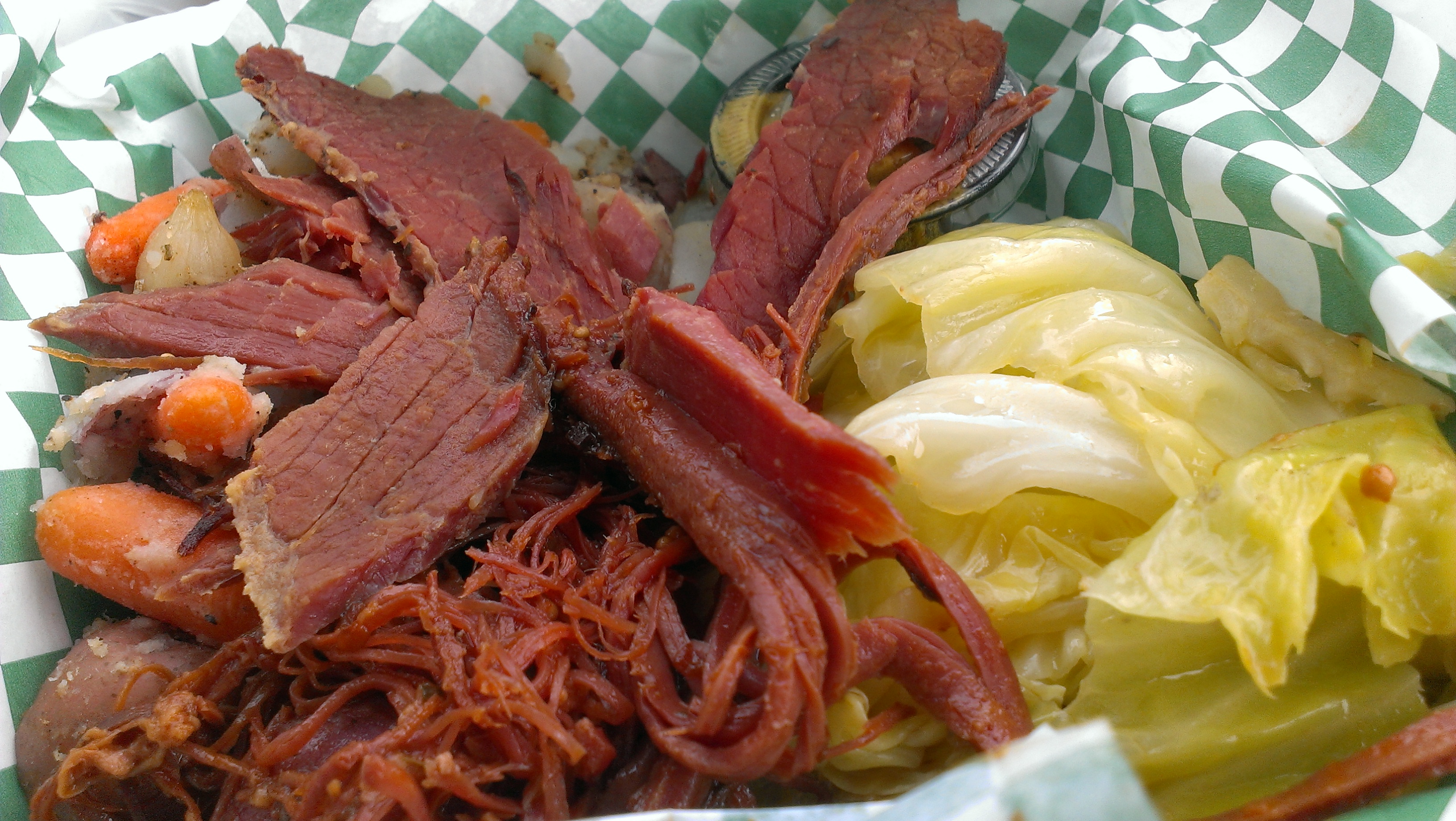
Last year I made corned beef and cabbage on St. Patrick’s Day, which means this is the rare food holiday where I happened to eat the same exact thing 365 days earlier. However. It was a lot of work, and we were really busy today, so we came up with the brilliant idea of heading downtown to our favorite local watering hole, which happens to be an Irish pub called Shanahan’s. I already knew they had excellent corned beef; we were there for brunch a couple of weeks ago, and the hash was amazing. They have an onsite smoker that imparts the best flavor to their meats. Shout out to Shanny’s! But, we quickly learned a lesson: an Irish pub is the worst possible place to go on St. Patrick’s Day. The place was overflowing with noisy, green-clothed drunken revelers, so much so that there wasn’t a vacant table or barstool within a one-mile radius. Standing room only. No problem, I figured I’d just order the food “to go,” which I did. After standing around surrounded by shoving, pushing, green-clothed drunken revelers for a good ten minutes while trying to catch a server’s attention. Finally I did, and the food came out just a few minutes later. I will say this: all that trouble was worth it. The corned beef and cabbage was absolutely delicious. And in the comfort of our own home, we were able to wash it down with green beer (Tara) and green gin ‘n tonic (me).

As they say in Ireland…or maybe they don’t, but I’m going to toss it out there anyway…erin go bragh!

IMAG0634

Categories: Beef | Tags: , , , , , | 9 Comments

75/365: National Artichoke Hearts Day

Today we celebrate the innards of perhaps the oddest-looking vegetable on the planet, the artichoke. Covered in spiky leaves, it’s hard to believe that beneath all those layers lies a soft, edible, fleshy center, but ’tis true. Happy National Artichoke Hearts Day!

Artichokes originated in the Mediterranean region, and are actually a flower with an edible bud (the “heart”) surrounded by a “choke” or beard of florets. The ancient Greeks called them kaktos and were the first to cultivate them. It was a brave man (with pricked fingers) who first decided that such an odd-looking plant might actually taste a-peeling. From Greece they spread to Rome, and throughout Italy. They made their way to the U.S. in the 19th century, where French immigrants introduced them to Louisiana, and Spanish immigrants brought them to California. Nowadays, almost all artichokes are grown in Monterey County, California, Louisianans abandoning the crop in favor of beignets, which flourish in the rich, moist Southern soil. Artichokes are sold whole, or you can skip the trouble of peeling them and buy a jar of artichoke hearts instead. Often, these are marinated.

I love artichoke hearts (and the leaves, boiled and dipped in mayonnaise; Tara introduced these to me last year, and they are surprisingly good). She also makes a really good artichoke dip, but today turned out to be crazy busy. We were on the go for hours, after a very late night that technically bled into this morning. It’s little things like that, that can wreak havoc with this challenge. Another obstacle: teenagers. We plan ahead as much as possible, which means we’ll set aside ingredients days in advance. Imagine our surprise yesterday morning when we discovered the slivered almonds we’d purchased for the Pears Helene were gone. As in digested, days ago, by my son. This necessitated a last-minute scramble, before work, because we had to make the recipe for lunch. Had we not done so, seeing as how we returned home after midnight, we technically would have failed in our mission. It’s countless little things like that that bedevil us, but we soldier on, and are more determined than ever to be successful! I actually came to a realization last Monday, after successfully preparing Oatmeal Nut Waffles on a busy morning before work: if I could do that, then nothing will stop us. We’ve got this thing in the bag.

Err…in another 9.5 months, anyway…

Because one of our stops happened to be Costco, and because I am a fan of their spinach and artichoke parmesan dip, we grabbed a container of that to honor the holiday. Heated it up in the microwave and served it with homemade pita chips. Yummy stuff!

Artichoke Dip

Real quick, because I never get a chance to add to these posts, I wanted to give a shout out to Mattie’s Bar and Grill in Elko, NV.  I’ve spent many an evening there with friends and they have THE BEST artichoke dip I’ve ever had.  Super rich, cheesy, and just a tiny bit of  spicy bite…makes my  mouth water just thinking about it!  So, if you ever find yourself traveling along the I-80 corridor through northern Nevada, do yourself a favor and stop in for a taste.

Categories: Vegetables | Tags: , , , | 2 Comments

74/365: National Pears Helene Day

Today we celebrate a dessert with all kinds of weird grammar symbols in the name. It’s National Pears Hélène Day! Seriously, what are those weird slash mark thingies over the letter e? And, for that matter, what is Pears Hélène?

An old-fashioned dessert that is rarely seen anymore, that’s what. The dish was created by esteemed French chef and restaurateur Georges Auguste Escoffier, the same fella responsible for Peach Melba, in 1864. (The guy was all over the food map, inventing dishes left and right. We’ll be talking about him again when we celebrate Melba toast). The dessert was inspired by the opera La Belle Hélène, a historical reconstruction of the love triangle between Helen of Troy (“the face that launched a thousand ships and a Brad Pitt movie”), Paris, and Menelas. Escoffier decided that pears poached in sugar syrup and served with vanilla ice cream, chocolate sauce, and crystallized violets would perfectly represent the opera. Over the years the dessert was simplified, with sliced pears replacing the poached ones and slivered almonds standing in for the crystallized violets. Whew! I’d have hated to try and find that ingredient.

Pears Hélène looked, and sounded, complicated when I first read about it, but in reality the simplified version is pretty easy. If we didn’t have plans tonight I might have considered poaching a whole pear, but we decided instead to go the simple route. Sliced pears, vanilla ice cream, chocolate sauce, and slivered almonds. A little bowl at lunchtime. It was decent, though I’m sure using a real poached pear instead of a generic brand of pear halves in lite syrup would have upped the wow quotient.

IMAG0614

Categories: Desserts | Tags: , , , , , | 11 Comments

Create a free website or blog at WordPress.com.