93/365: National Chocolate Mousse Day

You’ll be foaming at the mouth in anticipation of today’s food holiday. April 3 is National Chocolate Mousse Day!

A moose is the largest member of the deer family, and found primarily in Alaska, Canada, and Russia. Males have distinctive leaf-shaped antlers. Dipped in chocolate, they are a decadent treat.

Wait. I’ve just been informed that this is chocolate mousse day. My bad.

mousse (hey, anybody could make that mistake!) is a light, airy dessert made with whipped egg whites. Its history is unclear; all we know is that Conquistadors brought chocolate to Spain in 1529, and when Spanish princess Anne of Austria married French king Louis XIII in 1615, she packed lots of chocolate in her carry-on bag. French chefs began experimenting with the sweet treat, and by the 19th century had combined mousse (which literally means foam) with chocolate to form mousse au chocolat. Chocolate mousse first appeared in the U.S. during a food exposition in Madison Square Garden in 1892. Five years later, a recipe appeared in a housekeeper’s column in the Boston Daily Globe. These versions were more pudding-like in consistency, however. It wasn’t until the invention of the electric mixer in the 1930s that the fluffy, airy mousses (meese?) we know and love today came about. The secret is in whipping those egg whites to a frothy perfection, something difficult to achieve by hand.

Tara stepped up to the plate and offered to make a chocolate mousse from scratch. I was excited because I wanted to hang the antlers on the wall (see above faux pas), but I was pretty happy for the other kind of mousse, too.


Chocolate Mousse


Since Julia Childs’ Coq au Vin recipe was such a success, it was easy to choose her Chocolate Mousse recipe from the dozens that came up when I searched online.  Also like her Coq au Vin, there were several steps (and lots of dirty bowls) that included using a double boiler to melt the chocolate and whip the sugar and egg yolks, cooling said sugar and yolks in a bowl of ice, and whipping egg whites with first a pinch of salt, then some sugar, and finally a splash of vanilla.  I’m not the type of baker to lay out all my ingredients before hand so there was a lot of back and forth to various cupboards for bowls, measuring spoons, and ingredients.  Normally this isn’t a big deal in a kitchen our size, but when Mark is sharing counter space while making meatballs for his Italian Wedding Soup…well, let’s just say I had to politely shove him out of my way a few times.  Move, babe!  The egg whites are going to break!  I have to stir the chocolate!

Frantic shoving aside, the mousse turned out great.  Rum and coffee helped keep the chocolate rich and not too sweet.  Magnifique!

Categories: Desserts | Tags: , , , , , | 3 Comments

92/365: National Peanut Butter & Jelly Day

Whenever you find yourself in a sticky jam, relax and have a peanut butter and jelly sandwich. This childhood favorite is tasty, nutritious, and evokes fond memories for many of us. We are happy to celebrate National PB&J Day today!

Once upon a time, all you could get was a J sandwich: jelly has been around since the 15th century, while peanut butter didn’t make an appearance until late in the 19th century. In 1884, Marcellus Edson of Toronto filed a patent for a peanut paste “with a consistency like that of butter, lard, or ointment.” Dr. Ambrose Stroud of St. Louis decided that this peanut paste would be a great way of providing protein to elderly patients without teeth, and developed a machine that produced a more palatable version of peanut butter, which he patented in 1903. In the early 1900s, peanut butter was considered a delicacy, and could only be found in upscale tearooms in New York City, a favorite of the upper class (and those lucky toothless bastards in Missouri). Peanut butter was paired with many different ingredients early on, including cheese, pimento, celery, and watercress; in 1901, Julia Davis Chandler published a recipe for a PB&J sandwich, and a classic combination was born. By the 1920s, the price of peanut butter had dropped enough that it was no longer relegated to the filthy stinkin’ rich – even average citizens with teeth could enjoy the sticky treat. It became a favorite of children everywhere, and during World War II, both peanut butter and jelly were on the official military rations list.

I remember the first time I tried a peanut butter and jelly sandwich. We were living in Hawaii, and I was 4 or 5 years old. The lady who owned the house where we lived took a liking to me and my brother, and made us PB&J sandwiches one day. This was a novelty to me: for some reason, my mom was more into bologna or tuna. I thought this sandwich was creamy, sweet, and delicious, and it became the first of many for me. Then again, everybody loves peanut butter and jelly sandwiches! Right?

Not happy that today is National PB&J Day.

Not happy that today is National PB&J Day.

Ahh, Tara. One of the few people I know who is not enamored with peanut butter and jelly. To “celebrate,” she had peanut butter on a celery stick and toast with jelly.

As for me? I was always partial to chunky peanut butter and grape jelly, spread between two slices of white bread. So that was my lunch!

PB&J

Categories: Fruit, Nuts | Tags: , , , , , , | 4 Comments

91/365: National Sourdough Bread Day

The yeast you can do is help us celebrate today’s food holiday: April 1st is National Sourdough Bread Day, and that’s no joke!

Today also marks a quarter of a year for our project. We’re 25% finished! Woo-hoo! Which means we still have 75% to go, of course, and that’s a sobering thought. But we’ll just keep taking this one day at a time, and we shall persevere. Mark my words.

Sourdough dates back to ancient Egypt, around the year 1500 BC. It is the oldest form of leavened bread, and was discovered by accident when somebody left the bread dough out too long, enabling wild yeasts in the air to settle into the mix, causing it to ferment. I’m not naming names, but that Tut character was always a bit flaky, if you ask me. By the way, a leavening agent is any substance added to dough to make it foam, causing it to lighten and soften. Once the Egyptians learned that they could make a starter – a mixture of flour, water, and sugar left out for a few days until it begins to ferment – and keep it going indefinitely, sourdough became the bread of choice for hundreds of years, until beer and then cultured yeast were substituted. Sourdough starters are often passed down through families, and can be kept “alive” for decades if cared for properly. All you’ve got to do is add equal parts of flour and water to the refrigerated starter dough every couple of weeks. Talk about leftovers that never disappear! Pioneers in the West relied on sourdough starter as a ready source of fresh bread while on their adventures panning for gold in Alaska and California. In fact, legend has it that Alaskan miners slept with their starters to keep them from freezing. Legend also has it they slept with their dogs because women were scarce, but that’s a story for another blog. Sourdough became synonymous with the California gold rush in 1849, and has been associated with San Francisco ever since.

I love sourdough bread, and usually pick that as my toast choice when dining out for breakfast. Tara can’t resist the sourdough pancakes from the Original Pancake House. You might say we both love the power of sour! We decided to honor San Francisco’s rich sourdough history by making clam chowder in sourdough bread bowls for dinner. These are a great invention: sturdy enough to withstand a thick soup, and delicious enough to eat afterwards! Which means fewer dishes to wash, too. Dinner was great!

Sourdough Bread Bowl

Categories: Bread | Tags: , , , , , , | 3 Comments

90/365: National Tater Day, National Oranges & Lemons Day*

If whoever created these food holidays had a sense of humor, then the last day of March would be dedicated to lamb. (You know – “in like a lion, out like a lamb” and all). But alas, it is National Tater Day. Not to be confused with National Potato Day (October 27). Oh, and it’s also National Oranges and Lemons Day. And National Clams on the Half Shell Day. And on top of all that, it’s Easter, too. Sheesh! (I mean, Happy Easter). After learning about the clamming accident that has led to supply shortages, we decided to focus our efforts on both potatoes and oranges and lemons, Knocking them all out in one sitting.

Potatoes grew wild throughout the Americas, and were first domesticated in Peru sometime between 8000-5000 B.C. A well-kept secret at first, when the Spanish conquest decimated the Inca Empire, the Spanish brought potatoes to Europe in the 16th century. Over the next couple of hundred years they spread around the world, becoming a staple crop in many countries. Plentiful and easy to grow, the potato is responsible for an estimated 25% of the world’s population growth during this time. Some of this population gain was wiped out in 1845, when the Irish Potato Famine devastated that country, wiping out the entire crop and leading to approximately one million deaths, and causing a mass exodus from the land o’ leprechauns.

Oranges and lemons are two of the most popular citrus fruits. I feel bad leaving out limes and grapefruit, but rules is rules, man. There’s a popular English nursery rhyme about oranges and lemons that goes,

Oranges and lemons,
Say the bells of St. Clement’s.

You owe me five farthings,
Say the bells of St. Martin’s.

When will you pay me?
Say the bells of Old Bailey.

When I grow rich,
Say the bells of Shoreditch.

When will that be?
Say the bells of Stepney.

I do not know,
Says the great bell of Bow.

Here comes a candle to light you to bed,
And here comes a chopper to chop off your head!

Yikes! That’s supposed to help a kid fall asleep? How will that work, with the threat of decapitation looming? Seems like something the brothers Grimm might conjure up. It is believed that oranges originated somewhere in Asia around 2500 B.C. In Europe, oranges and other citrus fruits were grown largely for medicinal purposes; Vitamin C is still considered an excellent cold remedy to this day. Lemons came from the same region, and are a cross between the sour orange and the citron. Christopher Columbus brought lemon seeds along on his voyages, introducing them throughout the New World. Today, they – and oranges – grow exceptionally well in Florida and California.

We celebrated both food holidays with a delicious breakfast (using the taters and oranges) and later, iced tea and sweet tea vodka with fresh lemons. Everything was great!

Taters, oranges, and lemons. That's two food holidays in one!

Taters, oranges, and lemons. That’s two food holidays in one!

Categories: Fruit, Vegetables | Tags: , , , , , , , , | Leave a comment

89/365: National Turkey Neck Soup Day

You’ll want to gobble up a bowl of delicious, hot soup today. March 30th is National Turkey Neck Soup Day! Which, let’s face it, is kind of bizarre. Turkey soup I could see. But turkey neck soup?! Sounds like something only Cousin Eddie would appreciate. Save-Neck-For-Me-Navy-Shirt

Few foods are as quintessentially American as turkey. Not only is it synonymous with Thanksgiving, but every signature on the Constitution, the Declaration of Independence, and other important documents dreamed up by the Founding Fathers was inscribed using a turkey feather quill. By the way, ever wonder why turkeys are referred to as Tom? Benjamin Franklin jokingly called them that because Thomas Jefferson chose the bald eagle over the turkey to represent the new nation’s symbol. I guess Jefferson really ruffled Ben’s feathers.

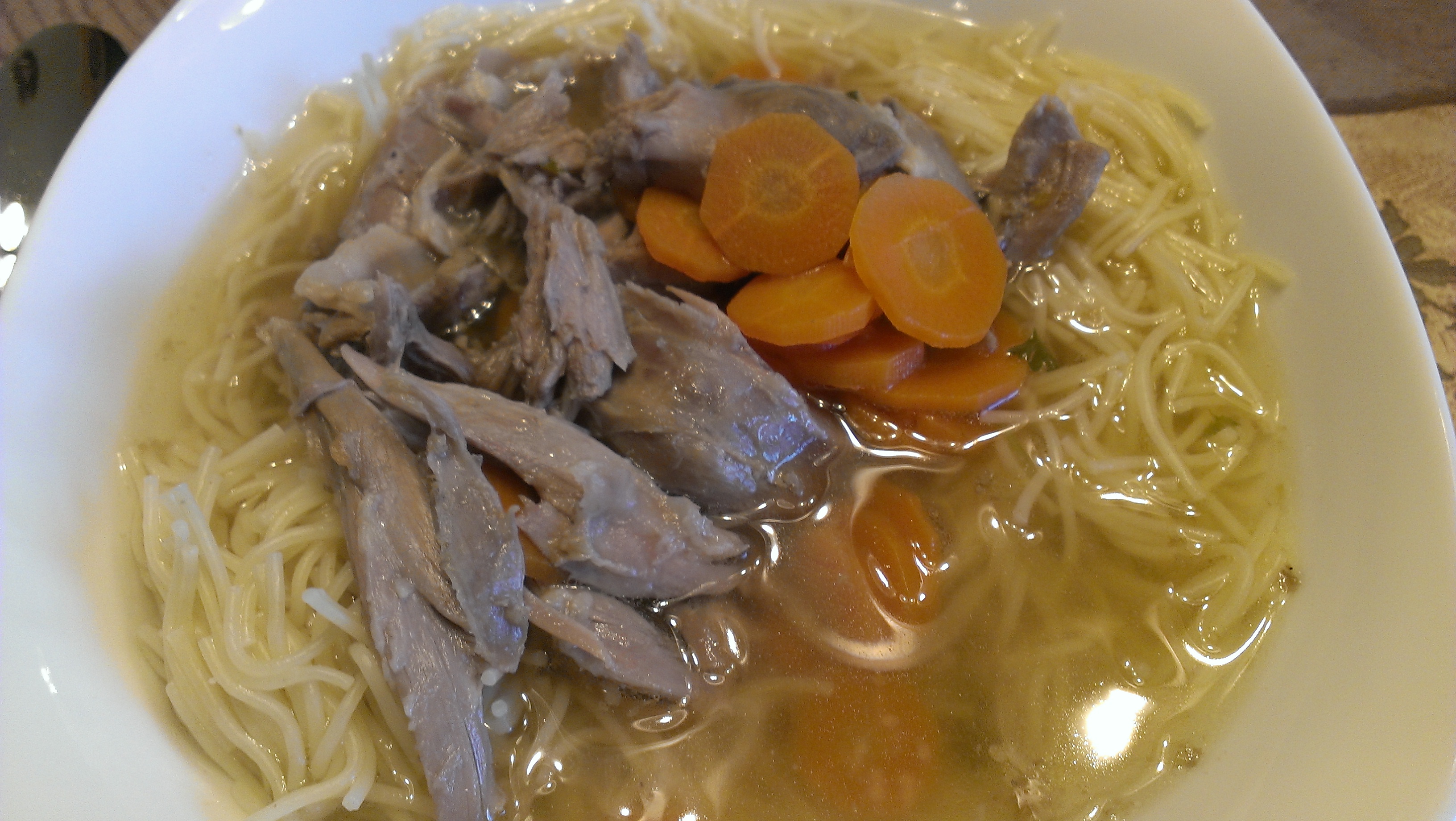
The turkey neck may not be the most popular part of the bird, but the meat it contains is pretty tasty – as long as you cook it for awhile. It is tough at first, but after several hours simmering in broth, it becomes quite tender and flavorful. Making a turkey neck soup was a breeze. We had some wonderful leftover homemade chicken stock which we used as a base, along with the requisite turkey necks (surprisingly easy to find – thanks, mom!), some carrots, celery, onions, garlic, bell peppers, fresh parsley, salt, and pepper. It made for a delicious lunch!

Turkey Neck Soup

Categories: Poultry, Soup | Tags: , , , , | 7 Comments

88/365: National Lemon Chiffon Cake Day

Paula Deen must hate today’s food holiday. Not because we celebrate a cake…but because that cake is made without butter. Gasp! What a travesty! Happy National Lemon Chiffon Cake Day.

A chiffon cake is very light and airy and is made with eggs, sugar, flour, baking powder, and – instead of butter – vegetable oil. This is considered a “foam ” cake, similar to angel food, and gets it’s fluffy texture from beating egg whites until they’re stiff. Traditionally you’ll want to use a baseball bat, but if one isn’t available, a mixer will suffice. Since no butter means no flavor less flavor less rich flavor, chiffon cakes are typically served with flavorful sauces, such as chocolate or fruit filling. Hence, lemons.

California insurance agent-turned-caterer Harry Baker invented the chiffon cake in 1927. You might say he traded in policies for pastriesDeductibles for delectables. Commissions for…well, you get the picture. The point is, Baker became a baker. A smart one, too: he took regular ol’ sponge cake and added cooking oil to turn it into chiffon. And because he was running a successful catering company, he kept his recipe secret for twenty years, until finally selling it to General Mills. In 1948, a pamphlet was released by Betty Crocker, containing 14 different chiffon cake recipes. It became popular seemingly overnight, and soon became synonymous with weddings. Which means, many chiffon cakes over the years have ended up smeared across the faces of brides and grooms. Oh, the inhumanity.

We tried to take the easy way out today, searching high and low for a lemon chiffon cake in a couple of different grocery stores, but had no luck. We could have bought a cake from the local bakery, but $18 was a bit steep, so Tara decided to make one herself. It turned out fantastic! Tall and fluffy and lemony.

Lemon Chiffon Cake

Categories: Desserts, Pastry | Tags: , , , , , | 4 Comments

87/365: National Something on a Stick Day*

Today is one of the weirder food holidays we’ve celebrated. It also gives us a lot of freedom. It’s National Something on a Stick Day.

That “something” really translates to “anything you can spear.” Some of the obvious choices include corn dogs, lollipops, shish kebabs, and Popsicles. But really, if you can poke a stick in it and eat it that way, you’re golden. We thought about doing something really difficult – spaghetti on a stick perhaps, or to really make it tough, soup on a stick. But in the end, we settled for something simpler.

It is also, I should point out, National Black Forest Cake Day. As delicious as that sounded, tomorrow is dedicated to lemon chiffon cake, and we weren’t in the mood for back-to-back cakes.

IMAG0672

People have been eating food on sticks for as long as fire has existed. Big, meaty hunks of mastadon have given way to hot dogs and marshmallows over the centuries, but there are few things more appealing than cooking your own food over an open fire in the great outdoors, and then wolfing it down without any namby-pamby utensils. The protocol is simple: hold food over fire, cook until black on the outside and cold in the middle, take a bite and burn the roof of your mouth, blow on it a little, wait a minute, take another bite. And be sure to wipe your fingers on your pants afterwards. Napkins? We don’t need no stinkin’ napkins! There’s a great and humorous look at the history of food on a stick here. I’d never heard of Uncyclopedia before, but it had me laughing. It’s like Wikipedia-meets-The-Onion.

Tara and I met up for lunch at New Season’s, a grocery store known for their free food samples – many of which are available to nosh on using toothpicks. A-ha! Sure enough, we found cheese samples to impale. Later on, we had dinner at my parents’ house, and because they support this blog, my mom made sure to serve something on a stick herself. In this case, lollipops. Thanks for your support, guys!

Categories: Too Weird to Categorize | Tags: , , , , , | 6 Comments

86/365: National Spanish Paella Day

Spain is the birthplace of bullfighting, foam parties, and today’s food holiday. It’s National Paella Day!

Paella – Spanish for “pan” – was invented by Spanish peasants, who would gather the cheapest ingredients they could find, throw them together in a big pan, and cook them over an open fire. Traditionally, this included chicken, duck, rabbit, and snails. When the meal was ready, laborers would gather ’round the pan and eat from it directly using long, wooden spoons. After awhile, the Spanish were like, “Wait a minute…why are we eating snails when there’s a bounty of seafood available off the coast? What are we, French?!” The recipe evolved to include rice, beans, spices, tomato, and seafood. Mixed paella – incorporating both meat and seafood, along with fresh vegetables, and flavored with saffron – became the norm, and is considered  Spain’s signature dish. It is a popular custom to cook great, big pans of paella at festivals and other public gatherings in Spain. Chefs use enormous paelleras (specialized paella pans) to cook and feed the masses.

They're going to have leftovers for days!

Paella was one of those dishes that looked intimidating when we skimmed over the food holidays before kicking off this challenge. My only experience with the dish was a quick reference to it in a Seinfeld episode. The exchange was brief but memorable.

GEORGE: Ok, fine. It’s going to be very interesting, very interesting if they don’t show up tonight. You know my mother made all this Paella.

JERRY: What is that anyway?

GEORGE: It’s a Spanish dish. It’s a mélange of fish, and meat with rice. Very tasty.

So, with that basic bit of information to go on, I researched recipes – and discovered you can add just about anything to a paella. There were hundreds of recipes to choose from, but I decided to freestyle-it and adapt my own recipe from one I found. The essential ingredients were the same: rice, saffron, chicken, and seafood. From there I could get creative, and that’s exactly what I did. After work I stopped by the grocery store and bought shrimp and scallops. I couldn’t get clams though, and the reason is bizarre and sad. The seafood monger told me their clam supplier in Alaska suffered a tragedy recently: a boat sank killing every crew member but one, and the lone survivor refused to go out clamming anymore (smart dude) – so Fred Meyer is fresh out of clams.

A moment of silence for the lost clammers, please.

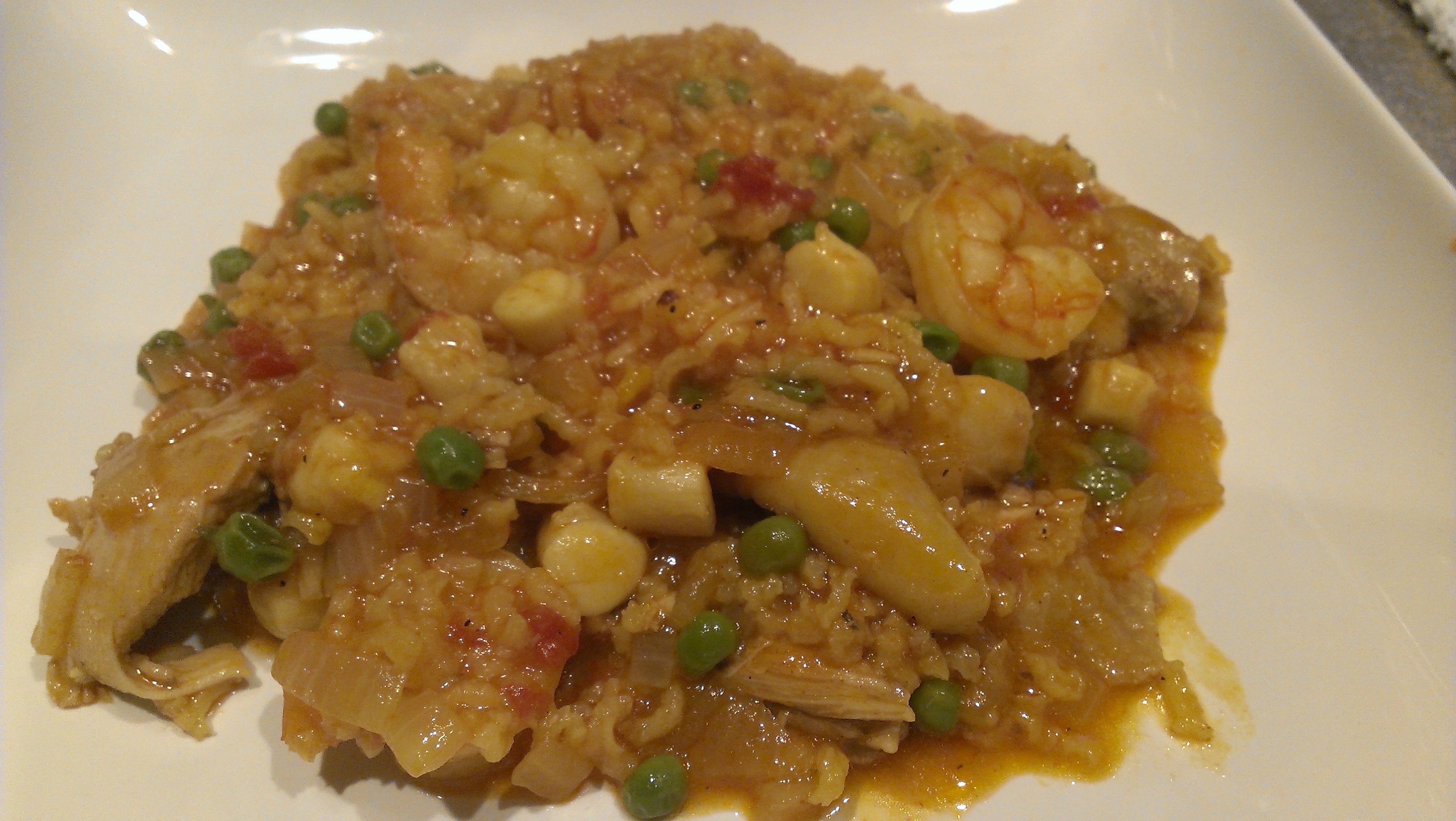
As for the paella? It sure looks good in this picture. There was a lot of work involved, and I think it could have benefited from a few changes – more seasoning, the addition of some chorizo, etc. But all in all, it wasn’t bad. Just a lot of work for a Wednesday evening. And one of our more expensive dishes: the tiny jar of saffron alone cost $10. Plus the seafood, chicken, etc….
Spanish Paella
Categories: Poultry, Seafood | Tags: , , , | 6 Comments

85/365: National Spinach Day

I’ll POP you in the EYE if you aren’t strong enough to celebrate today’s food holiday. March 26 is National Spinach Day!

Spinach originated in Persia (modern-day Iran) in ancient times. Indian traders brought it to India and China, where it was known as “Persian green.” It is still called this today, though I’d feel funny walking into a public market and asking for Persian green. I might get arrested or something. It made its way next to Sicily, and became so popular in the Mediterranean it was christened the “captain of leafy greens” in Spain, an honorary title that really pissed off kale. It was introduced to Europe in the 14th century, and was such a hit with Catherine de’ Medici, the Queen of France in 1533, that she insisted on eating it with every meal. Nowadays, spinach dishes are known as “Florentine” reflecting Catherine’s birthplace of Florence, Italy. In the U.S., spinach gained popularity in the 1930s thanks to Popeye the Sailor Man, who was portrayed as gaining strength anytime he ate spinach. This was actually based on a misunderstanding; in the 1870s German scientist Emil von Wolff misplaced a decimal point when measuring the iron content of spinach, making it appear that spinach contained ten times the amount of iron it really did. “Oh well,” von Wolff said later, nonapologetic. “I yam what I yam.”

Spinach is one of those vegetables that a lot of kids wrinkle their noses over, but growing up I loved the stuff. Or rather, the canned stuff. Heated up and sprinkled with salt? That was a childhood fave! I remember the first time I tried “real” spinach. I was like, what on earth is THIS?! It resembled lettuce more than anything from a can. Disappointed though I was, I still liked it.

How to make green eggs.

How to make green eggs.

There was no eating spinach from a can today, though. Tara has a great way of preparing it, and I’ll let her talk about that.

A gal I work with mentioned she makes ‘green eggs and ham’ for her daughters a few times a week.  Rather than dye the eggs with green food coloring, she blends baby spinach with eggs and scrambles them up.  Served with crumbled turkey bacon and a little bit of shredded cheese, it’s an often requsted favorite of her youngsters.  Since I had just bought a Magic Bullet and there was fresh spinach leftover from Mark’s last batch of Italian Wedding Soup (something he SHOULD be making today…hint, hint, babe) I wanted to try the green eggs for myself.  I’m glad I did because they really are delicious and nutritious.  After blending the spinach and eggs for a few minutes, the mixture will be very frothy.  This is a good thing because it makes for light and fluffy eggs and the spinach flavor is very subtle.  Paired with a whole wheat english muffin and some orange slices, it’s an easy, healthy breakfast I can throw together quickly, even when we’re running late.  Sorry about leaving all those dirty dishes, sweetie!

No problem, darling. That’s why they invented dishwashers!

I do love Tara’s green eggs, and have become addicted to them myself. This is also a fun, great way to sneak a serving of vegetables onto a kid’s plate…they’ll never even taste the spinach. And if they balk, tell them it’ll make ’em big and strong. Just like Popeye.

IMAG0663

Categories: Vegetables | Tags: , , , , | 5 Comments

84/365: National Waffle Day & National Pecan Day*

March 25th is set aside to honor not one, not two, but three separate food holidays. While we’d love to tackle all three, it is a work day, and we have other pressing demands. However, as Meatloaf (the singer, not the food) famously said, “two out of three ain’t bad.” So today we’ll celebrate National Waffle Day and National Pecan Day, but skip National Lobster Newburg Day. Besides, that’s a dish similar to National Lobster Thermidor Day, which we already celebrated in January.

In the Rules section of this blog, I even mentioned today specifically: When there are multiple selections on a given day, we only have to try one. However, if we can incorporate more than one, we will. Using the March 25th example, if it’s Pecan Day and Waffle Day, we’ll make Pecan Waffles!

I guess we’re making Pecan Waffles, then!

I already talked about the history of waffles earlier this month, but I didn’t mention Cornelius Swarthout. He is credited with filing the first patent for the modern waffle iron in 1869. His patent (you can take a look at it here – it’s surprisingly detailed and complex) took a cast-iron skillet and added a hinged lid, with a divider for individual waffles. 42 years later, the electric waffle iron was invented by Thomas Steckbeck of General Electric, with a built-in thermometer to prevent the waffles from burning. But perhaps the most interesting waffle-inspired invention of all belongs to Bill Bowerman, track and field coach at the University of Oregon in the 1960s. Bowerman used his wife’s waffle iron to develop a sole for running shoes that was light and grippable. Hopefully he told her this before she made breakfast! Flush with success at the U of O, Bowerman started an athletic footwear distribution company with Phil Knight called Blue Ribbon Sports, which they renamed Nike. His Waffle Trainer (real name) shoe helped catapult Nike to international success in 1974.

Pecan is a species of hickory tree and is the only nut native to North America (other than Phil Spector). It comes from an Algonquin word meaning “a nut requiring a stone to crack.” Doesn’t get much more literal than that, folks. Like other nuts-that-aren’t-nuts (I’m thinking of you, almond), the pecan isn’t a true nut either, but rather the seed of a fruit. Potato, po-tah-to. Native Americans valued pecans as a food source because they provide 2-5 times more calories per unit weight than wild game, and can be eaten as is. Pecans that fall to the ground are still edible the following year, which I guess makes them nature’s leftovers. They were quite popular with Colonial Americans; Thomas Jefferson planted pecan trees at his home in Monticello, and after giving some to George Washington, he in turn planted pecan trees at his home in Mount Vernon. The U.S. grows 80-95% of the world’s pecan crop, with Georgia and Texas the top two pecan-producing states.

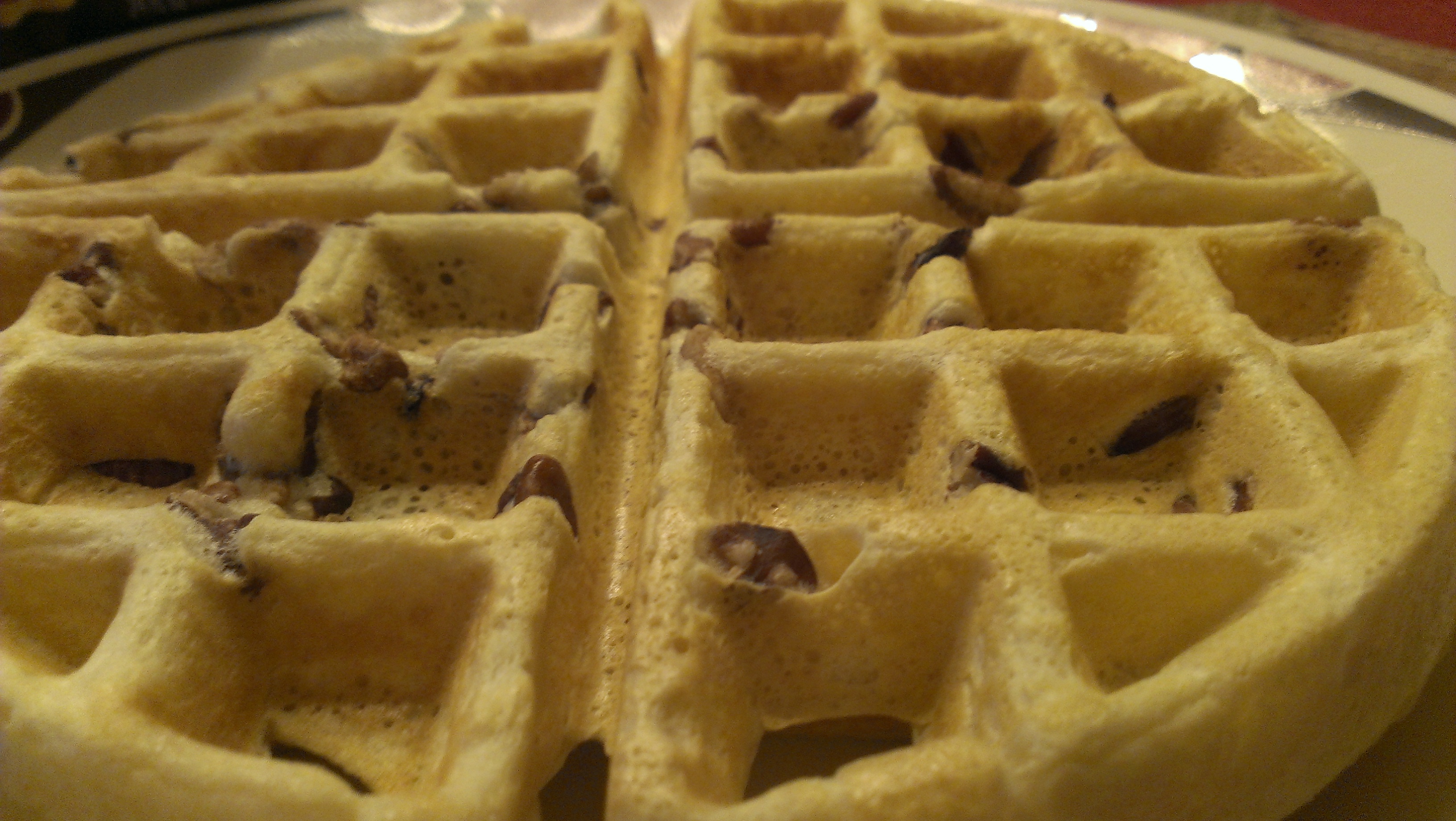
We had breakfast for dinner tonight, which allowed us plenty of time to make some tasty pecan waffles. Just a sprinkling of pecans in the batter, and the result was scrumptious!

That’s how you kill two birds with one stone, folks.

Pecan Waffles

Categories: Breakfast, Nuts | Tags: , , , , , , | 4 Comments

Create a free website or blog at WordPress.com.