293/365: National Brandied Fruit Day

Those who like to mix their alcohol with fresh fruit will find today’s food holiday intoxicating. October 20 is National Brandied Fruit Day!

Brandied fruit is a simpler and more convenient way of preserving food than canning: it requires little more than fruit, brandy, and sugar. Alcohol kills bacteria, allowing you to skip the sometimes rigorous steps involved in canning. The downside, as stated, is that – as with pickling – it takes time for the flavors to meld. Luckily we plan our food holidays in advance, but unfortunately, not a month in advance, so we were unable to make our own brandied fruit. Too bad – this would have been fun! But at least we were able to order a jar online. It’s not as easy to find as you might think! Why use brandy (derived from the Dutch word brandewijn, which means “burnt wine”) to preserve fruit rather than, say, vodka or wine? The truth is, any high-proof spirit will work, but brandy is popular thanks to its flavor. Rumtopf, an early version of brandied fruit, originated in Germany; folks would fill a stoneware jar with fruit, top it with rum, and let the whole thing distill, until it turned into a tasty “rum pot.” An early recipe published by the Ladies Guild of St. Paul’s Episcopal Church in East Randolph, New York, in 1907 states, Take one cup of brandy, one of sugar and one fruit to begin. Whatever fruit you choose, lay it in jar, first, then sugar, and lastly brandy; continue to add different fruits as they appear in season, one cup of each. You do not need any more brandy; as the juice will be extracted from the fruit and increase the amount. Commence with strawberries, and all kinds of fruit as they ripen. It is not to be cooked. Little has changed in the ensuing century.

As stated, I was bummed when I discovered we didn’t have enough time to make our own brandied fruit. This is one holiday that should have been on our radar even sooner. But not to fear, Dundee Fruit Company came to the rescue! As an added bonus they’re local, located about an hour south of where we live, in the Willamette Valley. This didn’t prevent us from paying almost $10 in shipping on a $9.95 product…sigh…but we didn’t have much choice in the matter. We ordered brandied marionberries, one of their top sellers. Marionberries are native to Oregon, and are a cross between a raspberry and blackberry. And they’re delicious!

We served them over vanilla ice cream. Delicious though they may be, when they’re brandied, they are strong. Whew! Can’t say we loved this, which bums me out given the cost. But it was alright.

National Brandied Fruit Day

Categories: Alcohol, Fruit | Tags: , , , , , , | 4 Comments

292/365: National Seafood Bisque Day*

It would be shellfish of me not to remind you about today’s food holiday. October 19 is National Seafood Bisque Day!

Alternatively, you could celebrate National Oatmeal Muffin Day. No offense to oatmeal or muffins, but why would you? A rich, hearty, and delicious seafood bisque sounds about a million times more appealing, especially as the weather is turning colder. Besides, this will enable us to use up the last of our crab from the wedding.

A bisque is a smooth, creamy soup based on a strained broth made with crustacean shells – typically shrimp, crab, or lobster. The name of this French classic is believed to have come from the Bay of Biscay, though bis cuites (“twice cooked”) also applies to the preparation of a typical bisque, in which the crustaceans are generally sauteed in their shells first, before being simmered in a broth of wine and other ingredients and then strained. Cream is then added, and the soup is thickened with a roux, though in the past rice was commonly used, or even the pulverized crustacean shells themselves. When cooking a bisque, Julia Childs instructs, “Do not wash anything off until the soup is done because you will be using the same utensils repeatedly and you don’t want any marvelous tidbits of flavor losing themselves down the drain.” Marvelous tidbits of flavor, come baaaack!!!

We’ve been very fortunate with the timing of many of these food holidays. I guess we picked a good year to take on this project, because it seems the toughest challenges have fallen on either Friday nights when we could go out, or weekends, when we are able to invest the time in cooking a tricky meal from scratch. I know this has been the case with Peking duck, escargot, and rum punch, among others, and today is no exception. Besides the Dungeness crab from our wedding, Tara added shrimp and  made a wonderful seafood bisque that was hot, creamy, and loaded with delicious flavor.

National Seafood Bisque Day

Categories: Seafood, Soup | Tags: , , , , , | 3 Comments

291/365: National Chocolate Cupcake Day

Today’s a sweet holiday if you’re a party of one. October 18 is National Chocolate Cupcake Day!

Cupcakes are miniature cakes designed to serve one person. In other words, they’re a marvel of modern baking! They are baked in thin paper cups or an aluminum muffin pan. Cupcakes were first mentioned in 1796 in Amelia Simmons’ American Cookery cookbook; one recipe called for “a cake to be baked in small cups.” They were originally baked in individual ramekins or molds, such as tea cups, from where they took their name. In England, they were (and still are) called fairy cakes due to their diminutive size (they tend to be smaller than American cupcakes). Australians refer to them as patty cakes. Cupcakes have been popular for decades, but in the past few years have become especially trendy thanks to Americans’ thirst for nostalgia, and their appearance on the popular television show Sex And The City. Which I’ve never seen, because I’m a guy, even though it’s got the word “sex” in the title. I’ll just trust that cupcakes played a role and move right along.

To celebrate, we picked up some two-bite miniature chocolate cupcakes from WinCo. They made a perfect after dinner palate cleanser!

National Chocolate Cupcake Day

Categories: Desserts, Pastry | Tags: , , , , | 3 Comments

290/365: National Four Prunes Day/National Pasta Day*

You can count on a good meal if you celebrate today’s food holiday. October 17 is National Four Prunes Day!

What an odd holiday this one is. Why four prunes? Why not three or five? Why not Eat A Prune? We’ve always been very specific in the rules of this challenge, stating that we need only take a single bite in order for it to count (though most times we eat the whole thing). But if we have to eat four prunes, does that mean we’re stuck with four bites? Or do we literally have to eat four prunes each? Or four prunes together? To simplify matters we considered celebrating the other food holiday today, National Pasta Day. But we just had a National Noodle Day, so…

(As it turns out, we ended up celebrating both food holidays today. Tara and I met up for lunch at The Old Spaghetti Factory. She got ravioli, I ordered spaghetti with Italian sausage. But the focus of the blog today is on prunes).

Actually, further research shows the reason for four prunes. As this blog post (and other scientific articles) states, doctors recommend eating four prunes a day to slow the aging process of the body and brain. Ahh. I’m all about living longer, so bring on the prunes!

Prunes get a bad rap due to their high fiber content. In other words, they make you poop! Because of this, they have been rebranded “dried plums” in recent years, which makes sense seeing that they are dried plums. But I think this is silly. There’s nothing wrong with the name prune, and if it’s associated with constipation relief, so be it. They are considered nutritional superstars, and are high in antioxidants, vitamin A, potassium, and iron. Prunes are native to Western Asia, but eventually spread through Europe and the Balkan Islands. They were introduced to North America by Louis Pellier, a Frenchman whose mining operation during the Gold Rush of 1848 was a bust. After finding no gold in them thar hills, Pellier purchased a plot of farmland in the Santa Clara Valley and planted plum trees in 1856. The plum industry took off, and by the mid 1880s, Pellier and others were looking for ways to expand business. Dried plums were a hit in Europe and were being imported at the rate of 22,000 tons a year, so focus shifted to growing them here. And the rest is high fiber history.

I love prunes. In school, my classmates would always give me their stewed prunes at lunch. I could never figure out why they’d pass on such a delicious and sweet part of the meal! I also enjoyed drinking prune juice because I liked the flavor. I guess I’m odd that way. The bottom line is, celebrating this holiday was a breeze. For me, anyway. I had my four prunes for breakfast. Tara was less enthused, but also took part. She liked them more than she thought she would.

National 4 Prunes Day

Categories: Fruit, Pasta | Tags: , , , , | 4 Comments

289/365: National Liqueur Day*

I cordial-ly invite you to embrace the spirit of today’s food holiday and raise a toast to October 16. It’s National Liqueur Day!

It’s also World Food Day, a holiday celebrated around the world to celebrate the anniversary of the founding of the Food and Agriculture Administration on this date in 1945. More than 150 countries participate in order to raise awareness of poverty and hunger. Since 1981, it has adopted a different theme every year, used to highlight areas where action is needed, and to provide a common focus. Themes over the years have included Food Security (1983), Trees For Life (1991), and Youth Against Hunger (1999). This year’s theme is Sustainable Food Systems for Food Security and Nutrition. Eat My Words is doing its part by mentioning this important global movement, and encouraging you to learn more by visiting this website.

Of course, this is a blog devoted to food holidays, so we’d be miss in not also taking the time to celebrate National Liqueur Day. Many people confuse liquor and liqueur; while both are alcoholic beverages, liqueurs are sweetened and infused with various flavors. Making liqueur is a four-step process that involves:

  • Distillation: The flavoring ingredients and the spirit are blended and distilled;
  • Infusion: Hot water is infused with the flavoring items and mixed with the alcohol;
  • Maceration: The seasoning ingredients are dropped directly into the alcohol, to infuse it with additional flavor;
  • Percolation: Alcohol gets passed directly through the flavoring agents in order to take on their essential flavor.

There are four categories of liqueurs: generic liqueurs (such as triple sec); proprietary liqueurs, made from secret recipes by specific manufacturers (e.g. Peach Schnapps); cream liqueurs, homogenized with cream; and creme liqueurs, which are thick and syrupy.

I have to admit, we weren’t real original tonight. We made margaritas with Grand Marnier – an orange and cognac liqueur. Which is exactly how we celebrated National Grand Marnier Day earlier in the year. But we had plenty leftover, and we were making tacos anyway, so it made sense. They were just as tasty this time, too!

National Liqueur Day

Categories: Alcohol | Tags: , , , , | 9 Comments

288/365: National Chicken Cacciatore Day

You won’t have to hunt high and low to find a delicious meal today: it’s simmering right there on your stove if you’re celebrating today’s food holiday. October 15 is National Chicken Cacciatore Day!

This classic Italian dish, meaning “to hunt” or “hunter style,” originated during the Renaissance period in central Italy, when only the wealthy could afford to cook with poultry. Cacciatore is traditionally made with braised chicken or rabbit, and usually includes tomatoes, onions, herbs, bell peppers, and wine (red if you’re in southern Italy, white if you hail from the north). Though we’re not the least bit Italian, chicken cacciatore has long been a family favorite. My parents, who are from Trenton, New Jersey (with a large Italian population), served it at their wedding; my mom’s recipe (taken from a now-defunct eatery called the Italian-American Sportsman’s Club) was a little less traditional since it contained no tomatoes but did have plenty of mushrooms (a popular addition when cooked in the autumn months), and was served with rice. It’s what I grew up with, and is delicious. But a few years ago I wanted to try a more authentic version, so I looked up Emeril Lagasse’s recipe, and have been hooked ever since. During my bachelor days, this is the dish I made to impress the ladies. In fact, the first time I cooked for Tara when visiting her in Ely, I made chicken cacciatore and served it by candlelight. There’s something about this meal that is sexy, hearty, and inviting.

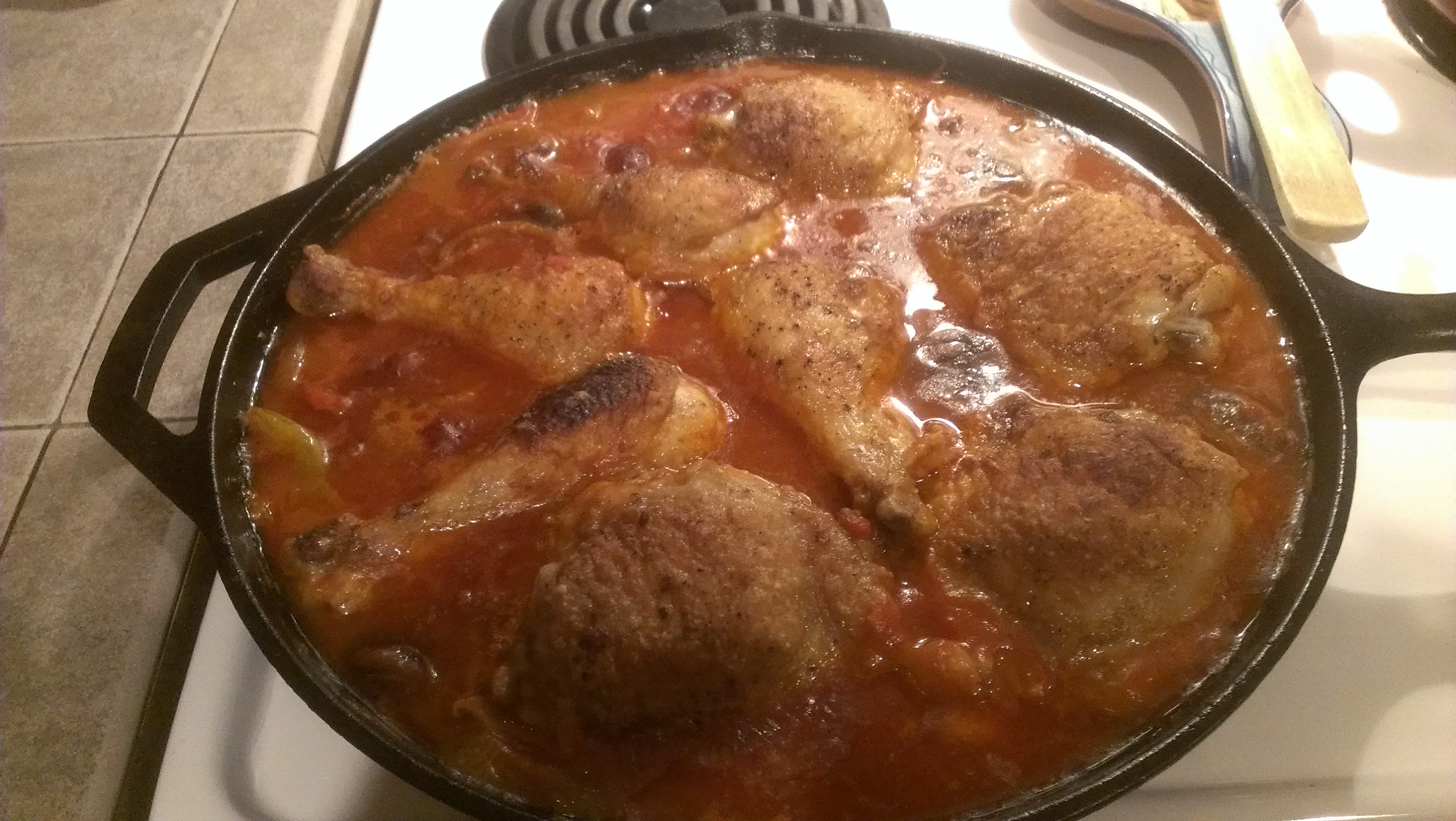
I had every intention of making this version tonight, but came down with Tara’s cold and was in no mood to cook. So she gamely stepped up to the plate and asked if she could make dinner tonight, using a new (read: unproven) recipe. I’ll admit I was a little skeptical. After all, Emeril’s recipe is really good. But I was too busy hacking up a lung to argue much, and I let her take the reins. It turned out delicious!

National Chicken Cacciatore Day

Categories: Poultry | 4 Comments

287/365: National Chocolate Covered Insect Day

Today’s food holiday is going to bug you, and I mean that quite literally. October 14 is National Chocolate Covered Insect Day!

No, they weren't actually LIVE. Scared me for a sec, though.

No, they weren’t actually LIVE. Scared me for a sec, though.

No, this is not an episode of Survivor or Fear Factor. It’s a real holiday, created by some demented nut job aspiring individual to honor edible insects. If you’re the squeamish type, relax; most insects are not only edible, but they are quite nutritious, and considered a delicacy in many parts of the world. They are cheap, plentiful, and chock full of protein; in places where pasta bolognese is hard to come by, insects are a coveted food source. Some of the more popular edible bugs include ants, spiders, termites, grubs, lice, mealworms, scorpions, crickets, grasshoppers, and beetles. The United Nations reports that more than 1,400 insect species are eaten by over 300 ethnic groups in 113 countries around the world, especially in less developed nations. In all, 80% of the world’s population regularly consumes insects. If it makes you feel any better, you’ve probably inadvertently eaten insects several times in your life!

No? Not feeling better?

When we first began this food challenge, I knew the day would come where we’d have to eat bugs. There is no other food holiday on October 14*, so it’s not like we’ve got options. Tara knew this, too – and still agreed to the challenge. As the day drew closer, I became increasingly excited; of all the interesting foods we’ve consumed this year, none has been as unusual as chocolate covered insects! Since it’s rare to find them on grocery store shelves, some planning ahead was necessary. Fortunately, there are a number of places online that sell edible insects. We chose Fluker Farms, because they had reasonable prices and a good selection. I opted for a four-pack of chocolate covered crickets, and my parents insisted we include them in this challenge. Considering they cringe at the slightest sign of spiciness, I was quite surprised (and pleased) when they insisted we break bread…err, break crickets…together.

There's a cricket in there.

There’s a cricket in there.

*Actually, I recently discovered that some sites list today as National Dessert Day. No way are we taking the easy way out now, though! I’m ready for this. Besides, chocolate covered insects are dessert, right?

I should also point out that today is our one-month wedding anniversary. I can’t help but laugh over the fact that our celebration included eating bugs.

Following our beef stroganoff, we unwrapped our chocolate covered crickets and eagerly bit into them. Honestly, we couldn’t even tell there were bugs in there. The consistency was similar to a Hershey’s crisp bar – no dangling legs or antennae hanging from our lips afterwards. Which is kind of a shame, really. I say, if you’re going to eat a bug, EAT a bug!

We were duly rewarded for our efforts.

We were duly rewarded for our efforts.

Categories: Too Weird to Categorize | Tags: , , , , , , , | 4 Comments

286/365: National Yorkshire Pudding Day

You’ll want to pop over to the oven and bake up a fresh batch of today’s celebrated food. October 13th is National Yorkshire Pudding Day!

We’ve already celebrated this holiday twice. Sort of. American popovers are basically identical to Yorkshire pudding, and we’ve made them with blueberries and cherries. Both times, they were delicious. But the dish is native to England, so this is our chance to pay homage to our friends across the pond. The first recipe appeared in The Whole Duty of a Woman, published in 1737; this feminist manifesto was a guide for women, teaching them how to behave around men, among other topics. Because women belonged in the kitchen, recipes were included, such as a “dripping pudding” featuring a pancake-like batter. Ten years later Hannah Glasse – sort of a Victorian era Martha Stewart, if you will – published her own recipe in The Art of Cookery Made Plain and Simple, renaming the dish Yorkshire pudding. It became a British staple, traditionally served alongside a Sunday roast, where it was used to scoop up gravy for the meat. In 2008, the Royal Society of Chemistry declared, “A Yorkshire pudding isn’t a Yorkshire pudding if it is less than four inches tall.” Many a London housewife has since been surprised by a ruler-yielding intruder in the kitchen who hands out citations for those puddings that don’t rise to tall enough heights.

I wanted to celebrate with a whole ode to the English Sunday roast. It was too perfect not to, considering that this holiday actually happens to land on a Sunday this year, so that’s exactly what we did. Roast beef, mashed potatoes, salad…and Yorkshire pudding for scooping up the gravy. I’ve gotta hand it to those Brits: they’re onto something. The Yorkshire pudding was bloody good, mate!

National Yorkshire Pudding Day

Categories: Pastry | Tags: , , , , , , | 2 Comments

285/365: National Gumbo Day

You might come to roux this day if you miss out on the food du jour. October 12 is National Gumbo Day!

Gumbo is a thick stew that contains a rich stock, meat and/or shellfish, a thickener, rice, and vegetables. It is as synonymous with Louisiana as jazz, the bayou, and Mardi Gras, and is the official cuisine of that state. No wonder: it originated in southern Louisiana in the 18th century, when slaves arrived from West Africa. They brought with them recipes featuring ki ngombo, or okra, many of them stews served with meat and shrimp. By 1764 they were mixing these stews with rice to make a hearty meal. Most gumbos are thickened with a roux, a mixture of flour and oil that is a staple of French cooking. The local Choctaw indians utilized filé powder, made with ground sassafras leaves, as a thickening agent in place of (or in addition to) a roux. Interestingly, the Choctaw word for sassafras is kombo, leading many to speculate that the dish actually originated with Native American tribes in the region. Whether it is Creole, Cajun, Indian, or African in origin is open for debate. Over the years, German immigrants introduced sausage to the recipe; fishermen supplied oysters, shrimp, and crab; and Canary Islanders brought a fondness for strongly seasoned foods to the table, introducing cayenne pepper. Virtually anything could be added to a pot of simmering gumbo: there are even references to owl, squirrel, and muskrat. The first written record of gumbo dates to 1803, where it was served at a gubernatorial reception in New Orleans. The dish’s popularity was limited to the Gulf Coast region until the 1970s, when Louisiana Senator Alan Ellender began cooking gumbo for his colleagues, including 5 separate U.S. presidents. When he passed away in 1972, the Senate added Louisiana Creole Gumbo to its cafeteria menu in honor of Ellender. Popular Louisiana chefs such as Paul Prudhomme and Emeril Lagasse further popularized gumbo, turning it into a mainstream meal.

To celebrate, I decided to make a gumbo from scratch. This is no small feat, but on a cool and damp Saturday afternoon and with Tara recovering from a cold, it was the perfect opportunity to make a nice slow-cooked meal. I’ve made gumbo a couple of times in my life, but previously, I used a jar of roux a friend in Louisiana had sent my way. Unfortunately that jar was long gone, so I had no choice but to make my own roux. That alone is a 45+ minute process, but I was pleased with the results. I used a recipe from Donald Link’s Real Cajun cookbook, one of many I own from my days as a book reviewer. I deviated from the recipe in places, namely the roux, and the fact that it called for fried chicken but I just wanted to brown mine. Everything else was the same – the vegetables, seasonings, andouille sausage, etc. And I have to say, it turned out delicious! I was very pleased with the results, especially considering the fact that I’ve rarely ventured south of the Mason-Dixon line. 

National Gumbo Day

Categories: Poultry, Seafood | 6 Comments

284/365: National Sausage Pizza Day

Today’s food holiday will appeal to both lovers of circles as well as Italian food. October 11 is National Sausage Pizza Day!

Pizza holidays didn’t show up until relatively late in the year. It was just last month that we celebrated our first, National Cheese Pizza Day. Now we’ve got another, and all I can say is, it’s about time! Pizza is one of those things that everybody loves. Even vegetarians! (Though they probably aren’t falling all over themselves to celebrate today’s holiday. Hey, their loss).

I’ve already discussed the history of pizza, so follow the cheese pizza link for that. A recent (unscientific) poll by The Huffington Post found that the most popular pizza toppings in America are:

  1. Pepperoni
  2. Cheese
  3. Mushrooms
  4. Sausage
  5. Bacon

Which means sausage lovers can proudly declare, “We’re #4!” today. Personally, I prefer sausage to pepperoni. I think it offers more “zing.” Those toppings are downright boring compared to what people in other countries enjoy on their pizza. Eel, green peas, and coconut all made the list.

Last year, leading up to the Presidential election, Pizza Hut made an offer: free pizza for life to anybody who asked Barack Obama and Mitt Romney whether they preferred pepperoni or sausage on their pizza during the Town Hall debate on October 16. Sadly, nobody took advantage of that offer. If nothing else, it would have humanized both candidates! Who cares about foreign policy and the economy when there are important pizza positions to discuss?

To celebrate, we picked up a sausage pizza from NYC Pizzeria, the same place we went for Cheese Pizza Day. We also added mushrooms, because we wanted our sausage to have some company. Love their pizza!

National Sausage Pizza Day

Categories: Meat | Tags: , , , , , , | 5 Comments

Blog at WordPress.com.