Pastry

159/365: National Jelly-Filled Doughnut Day

You want the truth, the hole truth, and nothing but the truth? You got it: June 8 is National Jelly-Filled Doughnut Day!

This comes on the heels of National Doughnut Day, which was yesterday. There may be much less freedom of choice today, but it doesn’t mean the doughnuts aren’t still delicious, even if they are filled with jelly instead of topped with bacon, as we are fond of doing around these here parts.

The first reference to a jelly doughnut appears in a German cookbook from 1485, Kuchenmeisterei (which translates to “Mastery of the Kitchen”). Called Gefüllte Krapfen (“Gefilte fish taste like crap so eat something sweet instead”), the recipe called for jam sandwiched between two round slices of yeast bread dough and deep fried in lard. This was a bit of a revelation; at that time most filled doughnuts were stuffed with meat, cheese, fish, or mushrooms. Sugar was exorbitantly expensive, so savory foods just made economical sense. When Caribbean sugar plantations opened in the 16th century, the price of sugar dropped to affordable levels, and people were able to create inexpensive fruit preserves. Since a jelly-filled doughnut tastes a heck of a lot better than a doughnut stuffed with, say, trout or gouda (well, presumably, but who am I to say for sure?), sweet filled doughnuts surpassed savory doughnuts in terms of popularity. Still, they were considered a treat reserved for special occasions until the 18th century, when a crafty German invented a metal pastry syringe that enabled bakers to directly inject jelly into doughnuts that had already been fried. By the 20th century, machines further automated the process, and the mass production of jelly doughnuts began in earnest. Known as “Berliners” or “Bismarcks” after their German heritage, jelly doughnuts remain a popular treat around the world today. (Personally, I’m fond of the Manitoba name for these fried pastries, “jam busters”).

To celebrate jelly-filled doughnut day, we grabbed a raspberry filled doughnut from the corner doughnut shop. It was the perfect fuel for our first hike of the season!
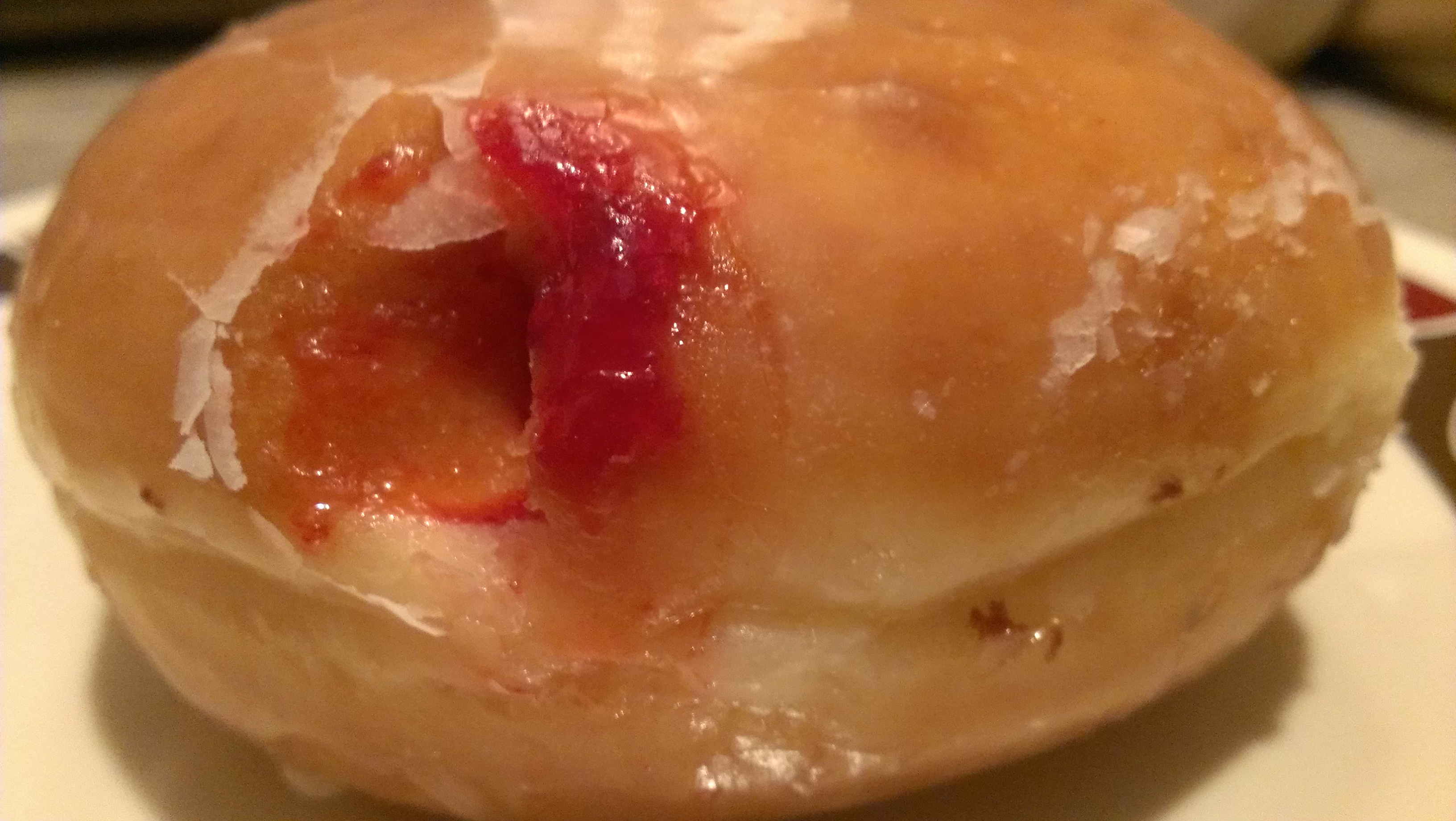
Jelly-Filled Doughnut

Categories: Pastry | Tags: , , , , , | 4 Comments

157/365: National Applesauce Cake Day

Today we’ve got a golden delicious treat for you: June 6 is National Applesauce Cake Day!

Cake has been around for eons, and applesauce dates back to the Middle Ages. But the two never co-mingled until fairly recently: during World War I, when a shady sugar shortage shocked the country. Cooks were urged to display patriotism by substituting applesauce for the sugar that cake recipes called for. The concept wasn’t entirely unheard of; Medieval European fruitcakes sometimes called for fresh or dried apples. Applesauce adds sweet flavor to a cake and makes it impressively moist. The cakes grew in popularity through the 1920s and 30s, before falling off the radar for a while. They were rediscovered in the health-conscious 90s, and seen as a healthier, low-cholesterol and low-fat alternative to a traditional cake. They are typically spiced with cinnamon and nutmeg, and make a perfect autumn treat.

But it’s June.

Nevertheless, we soldiered on (pun intended) and completed our challenge. We kept it simple with a yellow Duncan Hines cake mix and chocolate frosting. When you substitute applesauce for oil, you keep a 1:1 ratio, so it was easy enough to switch that out. Oh, and the cool thing is, last fall Tara and I went out to Hood River for bushels of fresh apples, and I made homemade applesauce. That’s what I used in the recipe, so in that sense, the cake is sort of “from scratch” too. And I have to admit, it turned out tasting pretty good! Just a hint of cinnamon-y spice.

Applesauce Cake

Categories: Desserts, Pastry | Tags: , , , , | Leave a comment

152/365: National Hazelnut Cake Day

Welcome to June, or The Month Of The Dessert. 20 of the food holidays are desserts only, leaving us no choice for substitutions. Actually, it’s going to be that way for the entire summer. Roughly half of the food holidays over the next three months center around desserts. This is going to be the toughest stretch of our challenge, I think. But…we’ve come this far, so we must soldier on. June 1 kicks things off with National Hazelnut Cake Day.

Hazelnuts, also known as filberts, are most widely produced in Turkey – 75% of the world’s production originates there. In the United States, 99% of hazelnuts are grown right here in Oregon and Washington. That makes us the Istanbul of the West, I suppose. The prevalence of hazelnuts pretty much everywhere was one of the things that stood out to me when I moved to the Pacific Northwest in 1994. Hazelnuts, which come from the hazel tree, have been around for thousands of years; an archaeological dig in Scotland in 1995 unearthed a pit full of hazelnut shells that were carbon-dated and found to be 9000 years old! They grew in popularity during the 1940s, when wartime rationing made cocoa scarce. Italian pastry maker Pietro Ferrero introduced what became known as Nutella, a hazelnut-chocolate spread that stretched the limited supply of chocolate by taking advantage of the plentiful hazelnuts in the Piedmont region of Italy. Nutella was imported to the U.S. in 1983 (seems like it’s been around longer than that!) and found a new legion of American fans.

With so many cakes looming on the horizon, we’ve decided to cut down portion sizes whenever possible. Our ingenious solution? Cupcakes! They are officially defined as “a small cake” so we aren’t breaking any rules. (An alternate definition is “an attractive woman” which I find both hilarious and outdated). It was simple enough to find a recipe for hazelnut cupcakes. This one uses both Nutella and Frangelico, so it’s an automatic win-win already. I spent a good portion of the afternoon whipping these up; we’ve got plans this evening and had to make sure we got our challenge in before we left – we probably won’t be back until after midnight!

The verdict? Pretty damn good! First time I’ve made cupcakes from scratch, too.

Chocolate Hazelnut Cake

Categories: Desserts, Pastry | Tags: , , , , | 2 Comments

138/365: National Cheese Souffle Day

There’s no need to feel deflated today, not when you’ve got the perfect excuse to enjoy a puffy, flaky, cheesy treat. May 18 is National Cheese Souffle Day!

Back in February, we celebrated National Chocolate Souffle Day by having a friendly little bake-0ff. In front of a live audience. It was our first (and only) interactive food challenge, and we had a blast. It doesn’t matter who won – the point is that we had fun! (Which, of course, means Tara won. Whatever). We were looking forward to repeating the challenge when cheese souffle day rolled around, only minus the streaming video feed this time. The camera was simply too distracting to me. We would, instead, rely on real-time Facebook posts charting our progress. Either way, I wanted an opportunity to avenge my initial souffle misdeeds and earn the title of Souffle King, which has (through a very odd childhood quirk) been a lifelong dream of mine.

And then, we learned that we would be in Seattle the day of the challenge. In an unfamiliar kitchen, with unfamiliar utensils and an unfamiliar oven. And busy as hell, to boot. So another interactive challenge seemed like too much trouble. It would be tricky enough just finding the time to make a cheese souffle in the first place. But persevere we must, regardless of the circumstances! So it was full speed ahead, strange kitchen or not. I was much more focused on my souffle this time. We mixed, we whipped, we stirred, and we baked. And in the end? Well, let’s take a look at some photos first.

Whisking action.

Whisking action.

Tara's recipe.

Tara’s recipe.

Waiting anxiously for some rising action.

Waiting anxiously for some rising action.

Mark's souffle doesn't look half bad!

Mark’s souffle doesn’t look half bad!

Souffle

Tara’s souffle is pretty impressive, too.

But in the end, there can be only one winner. And though the results were close – both souffles were delicious – in the end, the victory went to…surprisingly and shockingly, I’ll be the first to admit…Mark! So, HA! Redemption is mine. Mine, all mine. Tara’s sharp cheddar and garlic rose impressively and tasted great, but my gruyere and parmesan had a slight edge. Even according to Tara. Yes!!

Truthfully though, this was a lot of fun, and souffles are so technically challenging I’m just proud that both of us could make a souffle that rose impressively and tasted great. Good job, babe!

Categories: Pastry | Tags: , , , | 5 Comments

114/365: National Pigs In A Blanket Day

Grab your napkins and sPORKS and go hog wild over today’s food holiday. April 24 is National Pigs In A Blanket Day!

Even though the first recipe for pigs in a blanket as we know it was published in Betty Crocker’s Cooking For Kids in 1957, different versions of this meal existed long before then. As far back as the 1600s, field laborers in England were putting meat inside of dough for a quick, nourishing, and portable meal. Pigs in a blanket is basically pork wrapped inside something else, though the type of pork (and the blanket itself) has varied greatly over the years. A popular version in the 1800s consisted of oysters that were rolled in a slice of bacon, pinned together with a toothpick, grilled, broiled or fried, and served hot on toast. But in this case, the pig is the blanket, he’s not IN the blanket. That’s just not right! Nowadays, the dish most often refers to hot dogs, Vienna sausages, or breakfast sausages wrapped in crescent dough or a pancake and baked, unless you’re in Europe, where cabbage rolls are often called pigs in a blanket. Technically speaking, that makes perfect sense. They became a popular party food in the 1960s, and for a while in the 70s Pillsbury sold a canned version that was ready to bake. Apparently, they thought the American consumer was wasting too much time and effort actually rolling a hot dog inside dough. It IS an awfully labor-intensive task – amazing that the canned version never really caught on. /sarcasm.

Pigs in a blanket are also called devils on horseback, kilted sausages, and wiener winks.

Yes, really.

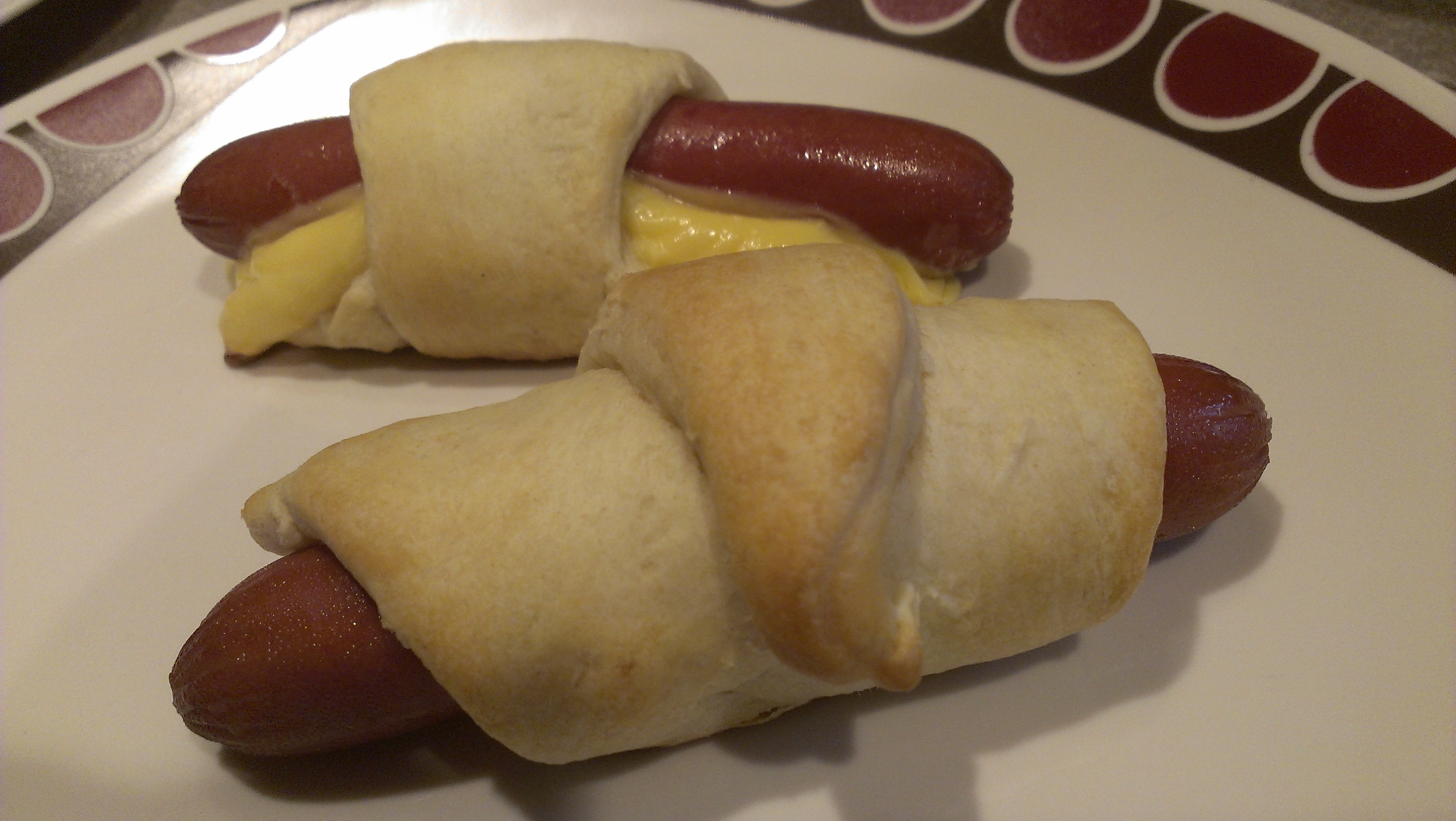
We decided to stick with the tried-and-true and make pigs in a blanket with crescent dough and hot dogs. We even added a slice of American cheese to some of them. For such a simple and lowbrow meal, I have to say, they were pretty damn tasty!

Pigs In A Blanket

Categories: Pastry, Pork | Tags: , , , , , | 2 Comments

100/365: National Cinnamon Crescent Roll Day

Today marks our 100th food challenge! That in itself feels like a tremendous accomplishment, even though we still have a long way to go. It’s already been an eye-opening experience, teaching us a lot about the backgrounds of many foods, and expanding our culinary horizons. We look forward to seeing this challenge all the way through to the end – which is a mere 265 days away now. On we go…

April 10th is National Cinnamon Crescent Roll Day.

These moon-shaped pastries date back centuries. I talked about their history on National Croissant Day back in January, so I’ll skip all that hullabaloo. Crescent rolls are like a poor man’s version of the croissant. They were popularized by Pillsbury back in the 1950s when prepackaged biscuit dough was introduced. The company, formed by Charles and Allen Pillsbury in 1872, was a corporate juggernaut, and at one time owned a variety of restaurants including Burger King, Godfather’s Pizza, Bennigan’s, Haagen-Dazs, and others. They also owned the grocery brand Green Giant, which begs the question: if they pitted their two most famous mascots – the Pillsbury Doughboy and the Jolly Green Giant – in a cage match together, who would emerge victorious? At first I thought the Jolly Green Giant would win hands down, but the Stay Puft Marshmallow Man from Ghostbusters, who is like a giant Pillsbury Doughboy on steroids (and was, in fact, inspired by him) is pretty badass. I think it would be a tossup.  By the late 1990s they had sold all their restaurants and gotten out of that business completely, focusing on the cake mixes and refrigerated doughs they are best known for. Pillsbury is actually now owned by Smucker’s, who also owns Crisco, Folger’s, Eagle, Laura Scudder, Hungry Jack, and other brands.

Regardless of who owns whom, this morning I whipped up a batch of cinnamon crescent rolls for breakfast. I rolled out and baked a can of regular crescent rolls according to the instructions, then topped them with butter, cinnamon, and sugar. According to the research I did after the fact I could have brushed them with melted butter and sprinkled cinnamon and sugar on them prior to baking…duh, that would have been good!…but they still turned out delicious, and were especially good with coffee.

IMAG0720

Categories: Pastry | Tags: , , , , | 2 Comments

98/365: National Empanada Day

Hope you aren’t too stuffed to enjoy today’s food holiday. April 8 is National Empanada Day!

Empanadas come in all shapes and sizes, and there are different versions throughout the world. They originated in Spain and Portugal and are similar to calzones, which are a variation of the Indian samosa; all are essentially a stuffed pastry that can be either sweet or savory. A cookbook published in 1520 features a recipe for a seafood empanada. Made of a thin circular dough patty folded over whatever is stuffed inside, empanadas became popular with the working classes, who were able to carry around the sandwich-sized pie-like lunch meal; this was especially convenient considering Star Wars lunch boxes wouldn’t be invented for another 400 years. Regional favorites include meat, hardboiled egg, olives, and raisins in Argentina; guava, pineapple, and jelly in Costa Rica; spicy tuna and chili peppers in Indonesia; and pumpkin, yams, sweet potatoes, and cream in Mexico.

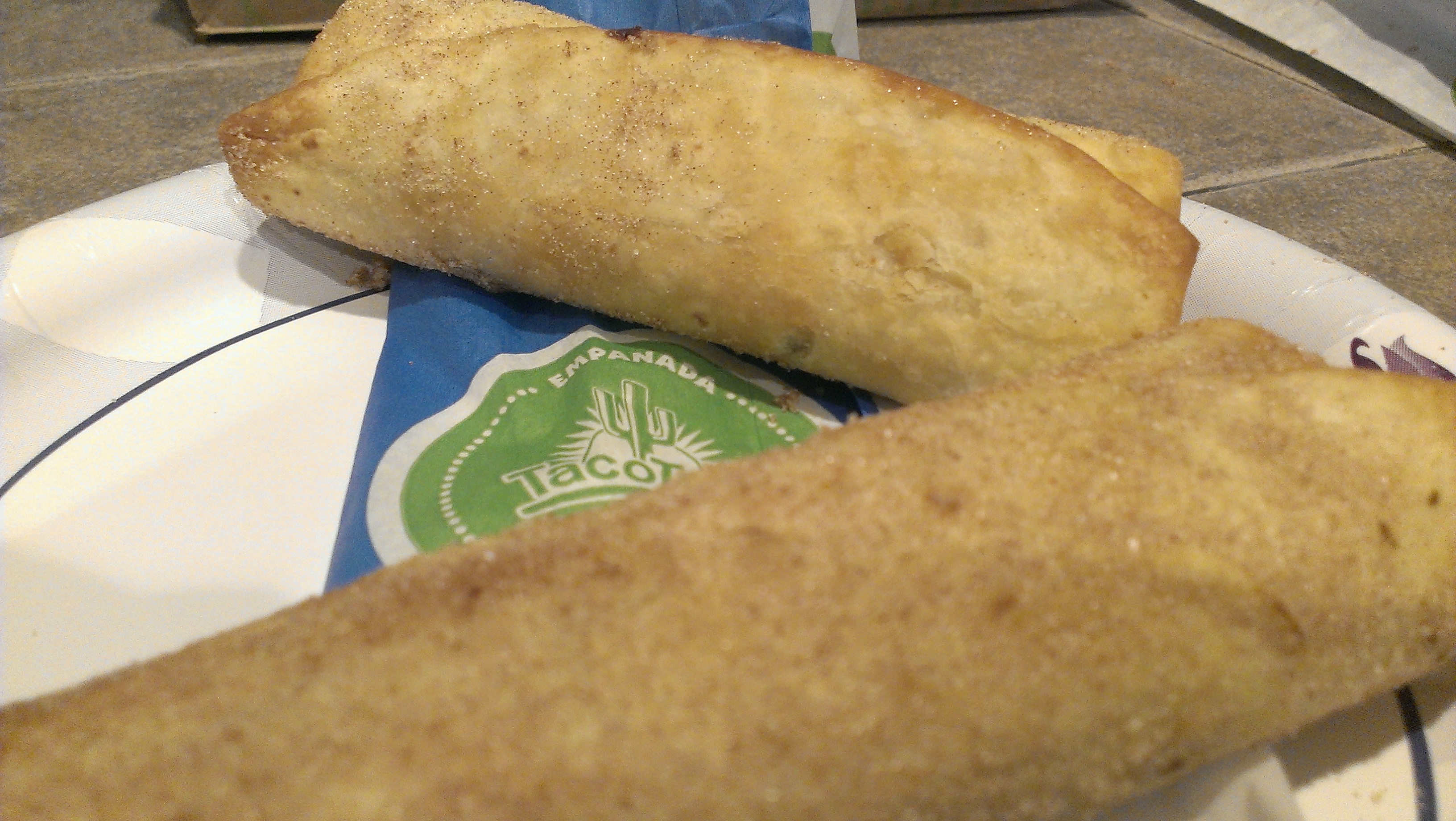
For some reason, I always pictured empanadas as a dessert item. Maybe that’s because there’s a booth at our local farmer’s market that sells sweet empanadas filled with a variety of fruits and dusted with sugar; these are very pie-like. Unfortunately, we were out of town and unable to stop by the farmer’s market to pick some up, so I had to do a little searching around town to find empanadas. I found out Taco Time, a regional Mexican fast-food place, had them, so I swung by the food court in the mall after work to pick up a couple. Granted, they don’t look like traditional empanadas, which are usually half-moon shaped, but they were filled with cherry and berry, dusted with cinnamon and sugar, and tasted pretty damn good.

Empanadas

Categories: Pastry | Tags: , , , , , , , , , , | 1 Comment

97/365: National Coffee Cake Day

Pour yourself a hot cup of joe, dish up a pastry, and celebrate today’s food holiday before morning gives way to afternoon. April 7 is National Coffee Cake Day!

Coffee cake isn’t an invention so much as an evolution. Any sweet cake meant to be eaten for breakfast and paired with coffee is considered a coffee cake. It may also be eaten on a coffee break, or served to guests on a coffee table. Bonus points if it’s dished up by psychic, medium, and spiritual counselor Chip Coffey. The Danish were the first to come up with the idea of eating cake for breakfast, alongside coffee. Funny, you’d think they’d prefer a danish instead. Most coffee cakes are single layers, square or rectangular, and many feature a crumb-like topping. They often contain fruit, nuts, and cinnamon. Contrary to the name, they do not taste like coffee. Unless, of course, you dip them in coffee. In which case, yes – they taste very much like coffee. Scandinavian, German, and Dutch immigrants brought their favorite coffee cake recipes to America, where early Colonialists often took a break from killing indians to indulge in a delicious, sweet coffee cake and a steaming hot mug of java before it got too hot for murder.

Fortunately, coffee cake is pretty simple to find, even when you’re traveling. Virtually any convenience store in America is going to have it. We picked up a marionberry (no relation to the disgraced former mayor of Washington D.C.) coffee cake from the Fred Meyer in Bothell, and enjoyed that as part of a delicious homemade breakfast.

Marionberry Coffee Cake

Categories: Breakfast, Pastry | Tags: , , , , | 3 Comments

88/365: National Lemon Chiffon Cake Day

Paula Deen must hate today’s food holiday. Not because we celebrate a cake…but because that cake is made without butter. Gasp! What a travesty! Happy National Lemon Chiffon Cake Day.

A chiffon cake is very light and airy and is made with eggs, sugar, flour, baking powder, and – instead of butter – vegetable oil. This is considered a “foam ” cake, similar to angel food, and gets it’s fluffy texture from beating egg whites until they’re stiff. Traditionally you’ll want to use a baseball bat, but if one isn’t available, a mixer will suffice. Since no butter means no flavor less flavor less rich flavor, chiffon cakes are typically served with flavorful sauces, such as chocolate or fruit filling. Hence, lemons.

California insurance agent-turned-caterer Harry Baker invented the chiffon cake in 1927. You might say he traded in policies for pastriesDeductibles for delectables. Commissions for…well, you get the picture. The point is, Baker became a baker. A smart one, too: he took regular ol’ sponge cake and added cooking oil to turn it into chiffon. And because he was running a successful catering company, he kept his recipe secret for twenty years, until finally selling it to General Mills. In 1948, a pamphlet was released by Betty Crocker, containing 14 different chiffon cake recipes. It became popular seemingly overnight, and soon became synonymous with weddings. Which means, many chiffon cakes over the years have ended up smeared across the faces of brides and grooms. Oh, the inhumanity.

We tried to take the easy way out today, searching high and low for a lemon chiffon cake in a couple of different grocery stores, but had no luck. We could have bought a cake from the local bakery, but $18 was a bit steep, so Tara decided to make one herself. It turned out fantastic! Tall and fluffy and lemony.

Lemon Chiffon Cake

Categories: Desserts, Pastry | Tags: , , , , , | 4 Comments

69/365: National Blueberry Popover Day

If you lived nearby, we’d invite you to pop on over to help us celebrate today’s food holiday: it’s National Blueberry Popover Day!

Popovers are light, hollow rolls similar to Yorkshire pudding, a staple of British cuisine since the 17th century. They are named because the batter “pops over” the top of the muffin tin while baking. Yorkshire pudding was created in order to use up the excess pan drippings from roasting meat; this was added to the batter, and the rolls were originally called “dripping pudding.” American popovers were originally cooked the same way: settlers in Portland, Oregon lined custard cups with a batter that contained meat drippings, garlic, and herbs. These were coined Portland Popover Pudding. Nowadays, popovers are made without pan drippings or herbs; butter is the preferred ingredient. American poet Ogden Nash once wrote,

Let’s call Yorkshire pudding
A fortunate blunder:
It’s a sort of popover
That turned and popped under.

Clever, that guy.

We had a three-hour drive home from Seattle today, and then had to make a trip to the grocery store. Despite our busy schedule, I still found time to make blueberry popovers from scratch. Yes, me…not Tara. This is huge, because I am not a baker. The chocolate souffle challenge was my first attempt at baking something for the blog, and you might recall I lost miserably to my fiance. I was determined to do these popovers on my own though, and the recipe was pretty straightforward. To my surprise and delight, they turned out very good. Light and airy, with just a touch of sweetness. A little bit of powdered sugar on top brought all the flavors together. I am excited, because this means I can bake!! 

Ingredients

  • 3 whole eggs
  • 1 cup milk
  • 1 teaspoon vanilla
  • 5 Tablespoons sugar
  • 1 cup all-purpose flour
  • 3 Tablespoons butter
  • 1/2 cup blueberries 

Preheat oven to 375 degrees. Divide the butter into the 6 cups of your popover pan. (If using a muffin tin, you will need to use all 12 cups. Just divide the butter up evenly.) Place the pan in the oven for 3-5 minutes while you are making the batter. In medium bowl, beat the eggs with the milk, vanilla, and sugar, then whisk in the flour. Pour the batter into the butter-filled cups, then evenly add a few blueberries to each cup. Return to the oven for 5 minutes, then reduce the temperature to 350 degrees and continue to bake for another 25 minutes. Popovers will be tall and gorgeous just out of the oven, but they shrink very quickly. It doesn’t affect the taste. Serve with a sprinkling of powdered sugar and maple syrup.

I can bake!! Blueberry popovers are light and airy, and delicious.

I can bake!! Blueberry popovers are light and airy, and delicious.

Categories: Pastry | Tags: , , , , , , | 4 Comments

Create a free website or blog at WordPress.com.