Monthly Archives: February 2013

49/365: National Drink Wine Day*

I don’t mean to whine over today’s food holiday. Well, actually, I do. Today is National Drink Wine Day! It’s also National Crab Stuffed Flounder Day, but holy crap, that sounds like a lot of work. We were much more eager to just sit back and sip some vino, so that’s precisely what we did!

Wine is an alcoholic beverage made from fermented grapes, and has been a popular drink throughout the ages, dating back as far as 6000 B.C. A few years ago, archaeologists found wine residue inside 8,000 year old ceramic storage jars in Georgia (the country, not the state), making Russians the world’s first winos! It was very popular in ancient Greece and Rome; both countries honored gods of wine (Dionysus for the Greeks, Bacchus for the Romans). Catholics associate it with religion, as well; according to the Bible, Jesus famously turned water into wine, which you’ve gotta admit is a pretty nifty parlor trick, ranking right up there with the parting of the Red Sea. Take that, Moses! Ancient bottles from Christ’s private cellar are listed at upwards of $1000 on eBay. Eventually wine made its way to Asia and spread throughout Europe. Thomas Jefferson became a big wine aficionado after serving as ambassador to France, and attempted to plant vineyards in his home state of Virginia. The French grapes were just as snobby as their home country, and refused to grow in the Virginian soil. Jimmy Carter was more successful; to this day his family produces and bottles their own wine in Georgia (the state, not the country), perhaps in an effort to distance themselves from the whole Billy Beer fiasco.

My parents have loved wine since the 1970s, but it took me a lot longer to develop an appreciation for it. It’s really only happened within the past seven years or so. Nowadays, I enjoy it on occasion. I’m partial to white wines, especially sauvignon blancs from the Marlboro region of New Zealand, though sometimes red, red wine makes me feel so fine and keeps me rocking all of the time, too. This evening Tara and I enjoyed a German Riesling from Trader Joe’s.

Here’s a little music to get you in the mood.

Cheers!

Drink Wine Day

Categories: Alcohol | Tags: , , , , , , | 3 Comments

48/365: National Cabbage Day*

Happy February 17th! There are three holidays on the ol’ food calendar today: National Indian Pudding Day, National Cafe Au Lait Day, and National Cabbage Day. When given an option we’re likely to avoid a dessert, since there are so many. And drinking coffee is too easy. So, we opted today to celebrate National Cabbage Day.

Do you know where cabbage grows? In a cabbage patch, dolls and guys.

(See what I did there?)

Wild cabbage existed long before creepy looking dolls, first appearing in England. It was cultivated and domesticated around 1000 B.C. and spread throughout Europe, where it grew very well in the cool northern climate. Greeks and Romans believed cabbage had medicinal properties, and could help those suffering from gout, headaches, and poisonous mushroom ingestion. Dutch sailors went so far as using sauerkraut to prevent scurvy. By the 17th century it became a food staple in many countries, including Germany and Russia, and is in fact considered Russia’s National Food (a fact which surprises me…I’d have guessed beets). Cabbage is considered a good cash crop due to its short growing season (three months). It can be used in many different ways: from eaten raw to steamed, pickled, sauteed, stewed, and braised. But the reward for Oddest Use Of Cabbage Ever goes to baseball legend Babe Ruth, who wore a cabbage leaf beneath his cap during games in order to keep his head cool. He would switch it out for a new leaf every two innings. I’m not sure what he did with the old leaf, but I gotta admit it wouldn’t totally surprise me if he just ate it.

Cabbage is closely related to broccoli, cauliflower, Brussel’s sprouts, and my aunt Nancy. Interestingly, I despise cauliflower and Brussel’s sprouts, but am quite fond of broccoli and cabbage. (And my aunt Nancy, too).

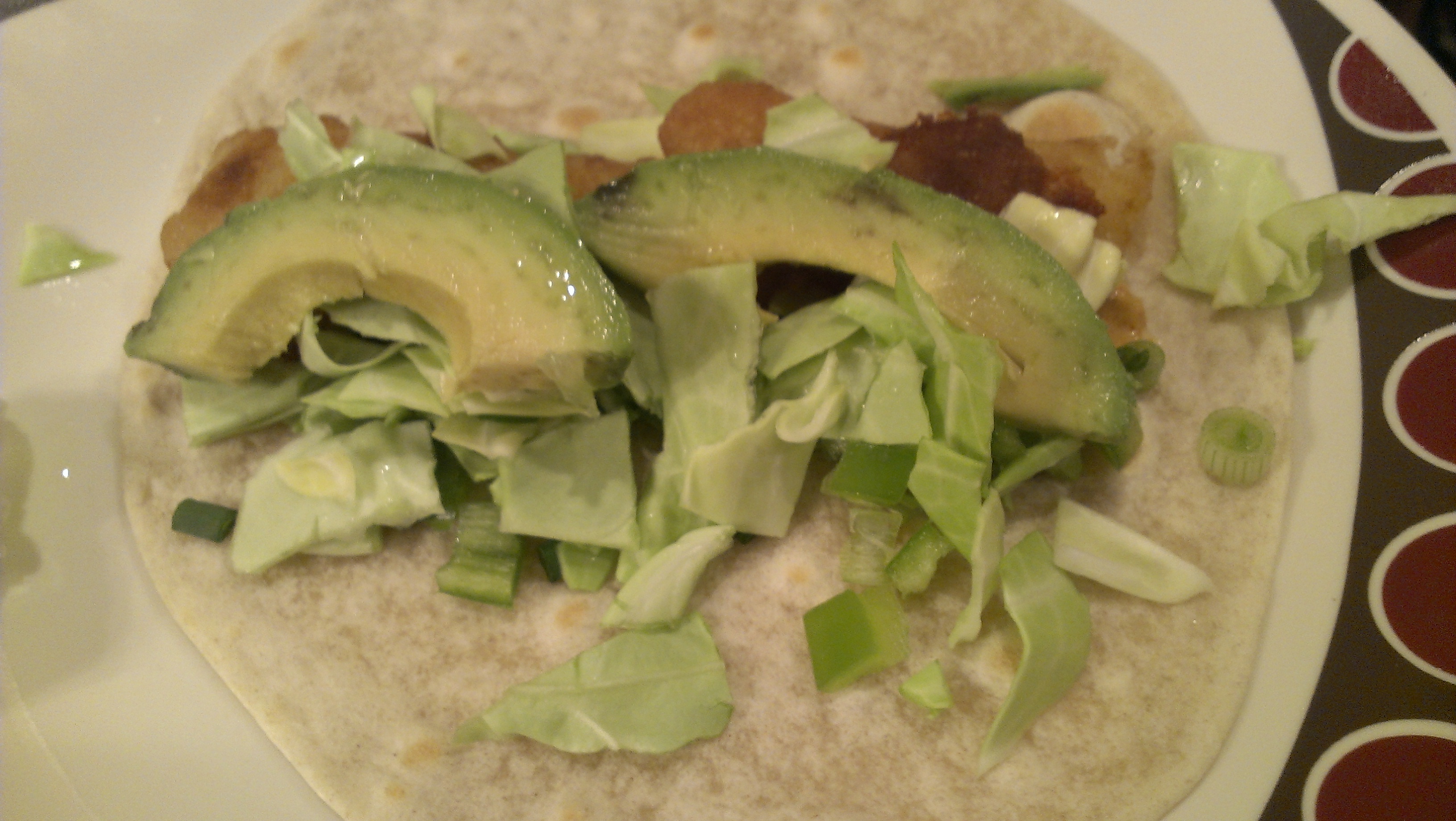
Given the variety of preparation methods, we could have gone in a dozen different directions for this challenge. In the end, Tara made fish tacos topped with a mixture of onions, Anaheim chilies, and strips of raw cabbage. The crunchiness of the cabbage perfectly complemented the soft chewiness of the fish and the kicked-up tartar sauce. It was delicious, and the cabbage was a perfect accompaniment.

Cabbage on fish taco

Categories: Vegetables | Tags: , , , , , , | 4 Comments

47/365: National Almond Day

Some of these food holidays are downright nutty. Take, for instance, today: it’s National Almond Day!

Actually, I should strike that joke from the blog, because it turns out almonds aren’t true nuts at all – they are actually a fruit, more closely related to cherries and plums than to cashews or walnuts. The almond “nut” is the seed of the green, fleshy fruit. I guess the folks at Almond Joy never got the memo; their candy bar slogan – “Almond Joy’s got nuts, Mounds don’t” – is just plain wrong (not to mention grammatically clunky to begin with). In truth, Almond Joy’s got fruit, Mounds don’t.

Almonds are native to the Middle East, where they grew like weeds in the lands around the Mediterranean Sea, and were one of the first trees domesticated by man. Most ancient civilizations relied on almonds as a food source; they date back to 4000 B.C. They are mentioned numerous times in the Bible, where they were revered as symbols of divine approval and hope. The Book of Genesis calls almonds “among the best of fruits,” and almond branches were a symbol of the virgin birth of Jesus. In fact, many paintings depict almonds circling the baby Jesus (though it could be that the artists had merely worked up hearty appetites while slapping oil on canvas). King Tut was buried with several handfuls of almonds when he died, in order to nourish him on his journey to the afterlife. I’d have preferred a pizza myself, but maybe all their Round Tables were closed for the night.

Cultivated almonds are delicious and nutritious, but wild almonds are another story. Their kernels contain prussic acid, a fancy name for cyanide, and are deadly if eaten raw. Domesticated almonds are safe due to a genetic mutation that eliminated the toxic substance.Today, nearly 80% of all almonds in the world are grown in California. Earlier attempts to grow the fruit in southern states were unsuccessful due to killing frosts and high humidity, but the Golden State’s climate proved to be ideal for these little suckers.

We could have just eaten a handful of almonds to celebrate today’s holiday, but it’s the weekend and we wanted to get creative, so we decided on a chicken teriyaki stir-fry topped with slivered almonds. It was a delicious combination!

Stir-fry with slivered almonds

Categories: Nuts | Tags: , , , , , , , , | 3 Comments

46/365: National Gumdrop Day

Oh, good. Just in case anybody’s sweet tooth wasn’t satisfied with all that chocolate yesterday, today we get to celebrate National Gumdrop Day.

Gumdrops were supposedly invented by a man named Percy Trusdale in 1801, but there is no information on this mystery man. This is going to be a fun post, I can tell already! I’m sure Percy was an upstanding citizen, doing whatever he did wherever he lived for however long he lived and with whomever he lived.

Gumdrops are brightly colored, sugar laden treats that have been popular for at least 200 years. They are usually fruit flavored (except the ones sold on the Hogwarts Express, which may taste like grass, boogers, dirt, or snot). References to the sweet treat abound in pop culture: the board game Candy Land pays homage by featuring a place called Gumdrop Mountain, Buddy the Elf had to pass through a sea of swirly twirly gumdrops (after conquering the seven levels of the Candy Cane forest) on his way to New York City in Elf, and BJ Thomas had a hit song in the ’70s called “Gumdrops Keep Falling On My Head.”

The most popular brand of gumdrops in America is DOTS. They were launched in 1945, and acquired by Tootsie Roll in 1972. Gumdrops have never really excited me. What can I say about a candy that is more a decorative feature of gingerbread houses than something you’d actually want to eat?  Give me sour Zotz any ol’ day!

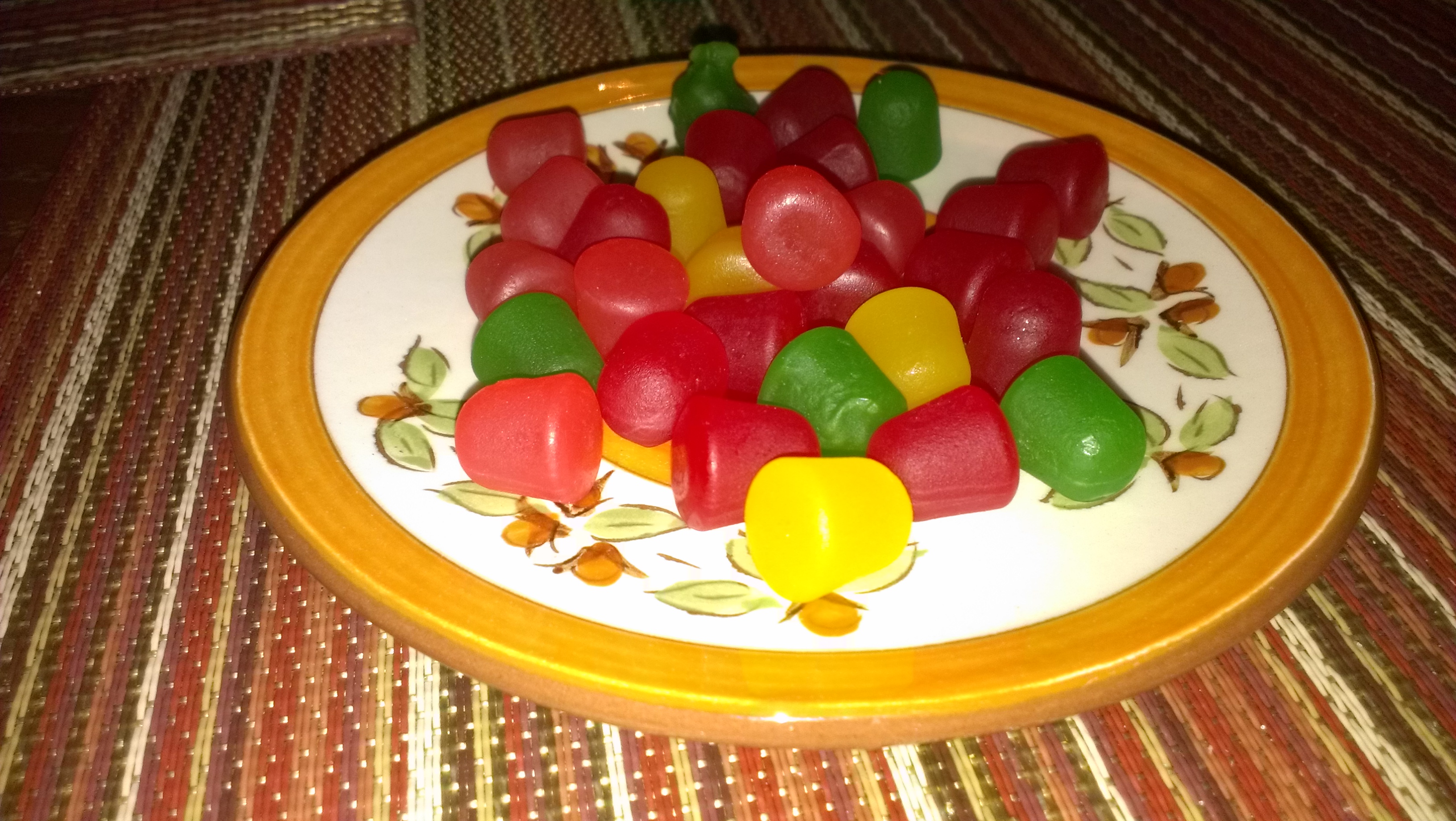
To celebrate today’s holiday, Tara and I simply ate a few DOTS gumdrops. They were chewy and fruity and…well, not all that great. But the orange ones were the best.

Gumdrops

Categories: Candy | Tags: , , , , , | 2 Comments

45/365: National Cream-Filled Chocolate Day

Once in awhile these food holidays make perfect sense, and today is one of those occasions: it’s Valentine’s Day, and also, National Cream-Filled Chocolate Day. The two go together like peas and carrots, as Forrest Gump would say. (Forrest was also known to enjoy a box of chocolates every now and then, making the analogy especially appropriate).

Today’s history lesson is a little different. You’ll get the story behind Valentine’s Day, and how chocolate came to be associated with it.

There were no fewer than three Catholic saints named Valentine, making that name the “John Smith” of ancient times, I suppose. Most people believe the holiday honors the saint who defied Roman emperor Claudius II’s orders outlawing marriage for single men, who were forced into the army instead. Valentine performed the marriages in secret and, when caught, was sentenced to death. While languishing in prison he fell for the jailor’s daughter, and before his execution sent the girl a letter which he signed “from, your Valentine” – a phrase that has been around ever since. Because of his sympathy toward those in love, and his own romantic gestures, St. Valentine was given his own holiday, one that has come to symbolize love. By the 15th century, lovers were presenting gifts to one another to mark the occasion; these included flowers, sweets, and greeting cards. Why chocolate? Because it has long been a symbol of love thanks to its, ahem, “mood-enhancing” properties (read: it’s an aphrodisiac, yo). Even the Aztecs would give cocoa as offerings to their gods, as a sign of appreciation. Appreciation for not smiting them with bolts of lightning, I guess? Anyhoo, the tradition persists to this day. More than 36 million heart shaped boxes of chocolate are sold on Valentine’s Day, and it’s a good bet that many of those chocolates are filled with cream!

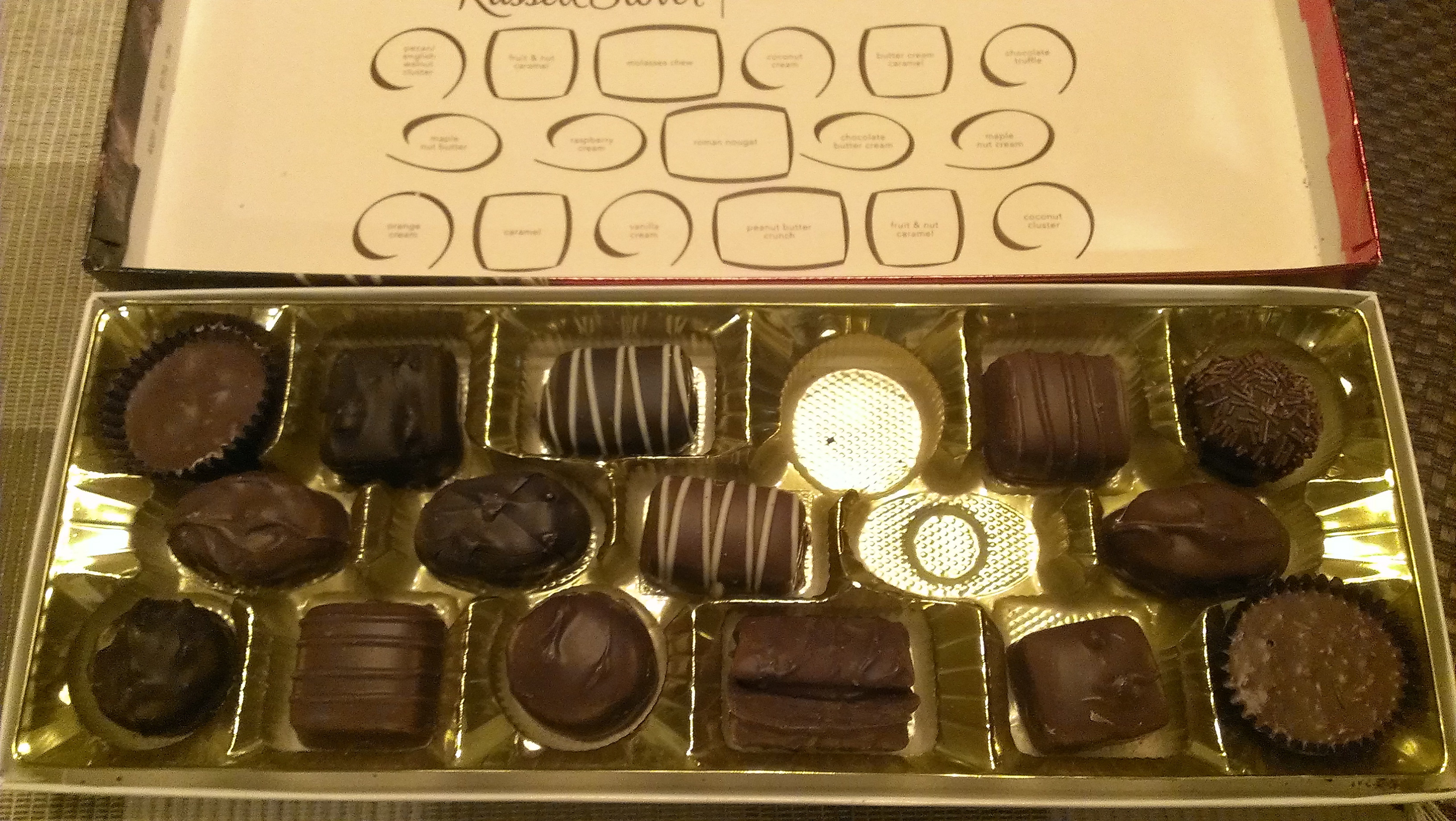
I have often said that if anything trips us up during this challenge, it won’t be something tricky like Peking Duck or Chocolate Souffle. It’ll be something deceptively simple, like cream-filled chocolates. Sure enough, I found myself digging frantically through nearly-empty shelves of Target today on my lunch, searching for a box of chocolates. We had all kinds of chocolate in the house, but none of it contained cream in the middle, and truffles don’t really count. Fortunately, I happened upon one overlooked box of Russell Stover – the last one in the entire store. Whew! I had a piece of coconut cream, and Tara indulged in butter cream. Good stuff. Happy V-Day!

Russell Stover to the rescue!

Russell Stover to the rescue!

Categories: Candy | Tags: , , , , , , | 6 Comments

44/365: National Tortellini Day

When it comes to stuffed pasta, tortellini ranks right up there in my top three! Right behind ravioli, but ahead of manicotti. Then again, there are really only those three varieties of stuffed pasta  in the first place. Technicalities aside, Happy National Tortellini Day!

Tortellini has a sensual history; it is rumored to be the creation of a Peeping Tom. Lucrezia Borgia, the illegitimate daughter of Pope Alexander VI, was a stunning beauty with long blonde hair, hazel eyes, and an ample bosom. One night she checked into an inn in Modena, Italy. The host was so entranced by her beauty that he spied on her through the keyhole to her room, where he caught a glimpse of her navel. Captivated by the sight, he created a pasta shaped like her belly button that very night, and to this day tortellini is also known as umbellico (“belly button”). No word on whether the pervert served the dish with two ripe cantaloupes. Others say it was the goddess Venus’s navel that inspired the dish. An alternate theory claims that tortellini represent turtles, which decorated many of the buildings in 17th-century Modena. The Bolognese, on the other hand, say these  stories are bunk, and that tortellini originated in their fair burg. These guys are so hardcore about the pasta, they created the Learned Order of Tortellini, a secret group based in Bologna that is dedicated to the preservation of the pasta. During their gatherings members wear red and gold hats shaped like tortellini and ribbon necklaces adorned with a gold tortellini. Members do not speak a word until after finishing a meal of tortellini in broth. (I know I tend to joke around a lot on this blog, but I am not making this shit up, I swear!). And we poke fun at Green Bay Packers fans for wearing cheese-shaped hats on their heads…

Regardless of where it came from and what it represents, tortellini are delicious! Tara and I were looking forward to today’s challenge. And to be honest, there wasn’t anything “challenging” about it, thanks to a package of refrigerated cheese-filled tortellini and a jar of pasta sauce.

Tortellini

Categories: Pasta | Tags: , , , , , , , | 6 Comments

43/365: National Plum Pudding Day

Today is National Plum Pudding Day! If you’re wondering what plum pudding is, you’re not alone – so were we! Imagine our surprise when we learned that plum pudding contains no plums, and is more of a cake than a pudding. Before you scream “false advertising!” you have to understand that in Medieval times, when the dessert was first invented, raisins were called plums.

Plum pudding is also known as Christmas pudding, and in England – where it originated – it is traditionally served at Christmas time. It was historically prepared with 13 ingredients, to represent Jesus Christ and the twelve apostles, and made on the 25th Sunday after Trinity (which occurs on the 8th Sunday after Easter, which itself occurs on the first Sunday after the first full moon of the vernal equinox (March 21). How anybody keeps track of all that is beyond me). It all roughly translates to Christmas time anyway, hence the name. Tradition dictates that all members of the family grab hold of the wooden spoon and help to stir the batter while making a wish. (If it were me, I’d wish we were making something other than plum pudding, but more on that later). This was known as “Stir-Up Sunday,” not to be confused with “Stirrup Sunday,” the popular gynecological holiday. Plum pudding was actually banned during the Puritan period in England because it was deemed “sinfully rich.” It used to be baked with silver coins and miniature thimbles, anchors, and wishbones, to signify wealth, thrift, safe harbor, and luck. This practice died out because people could never find their Monopoly pieces when they were ready to play.

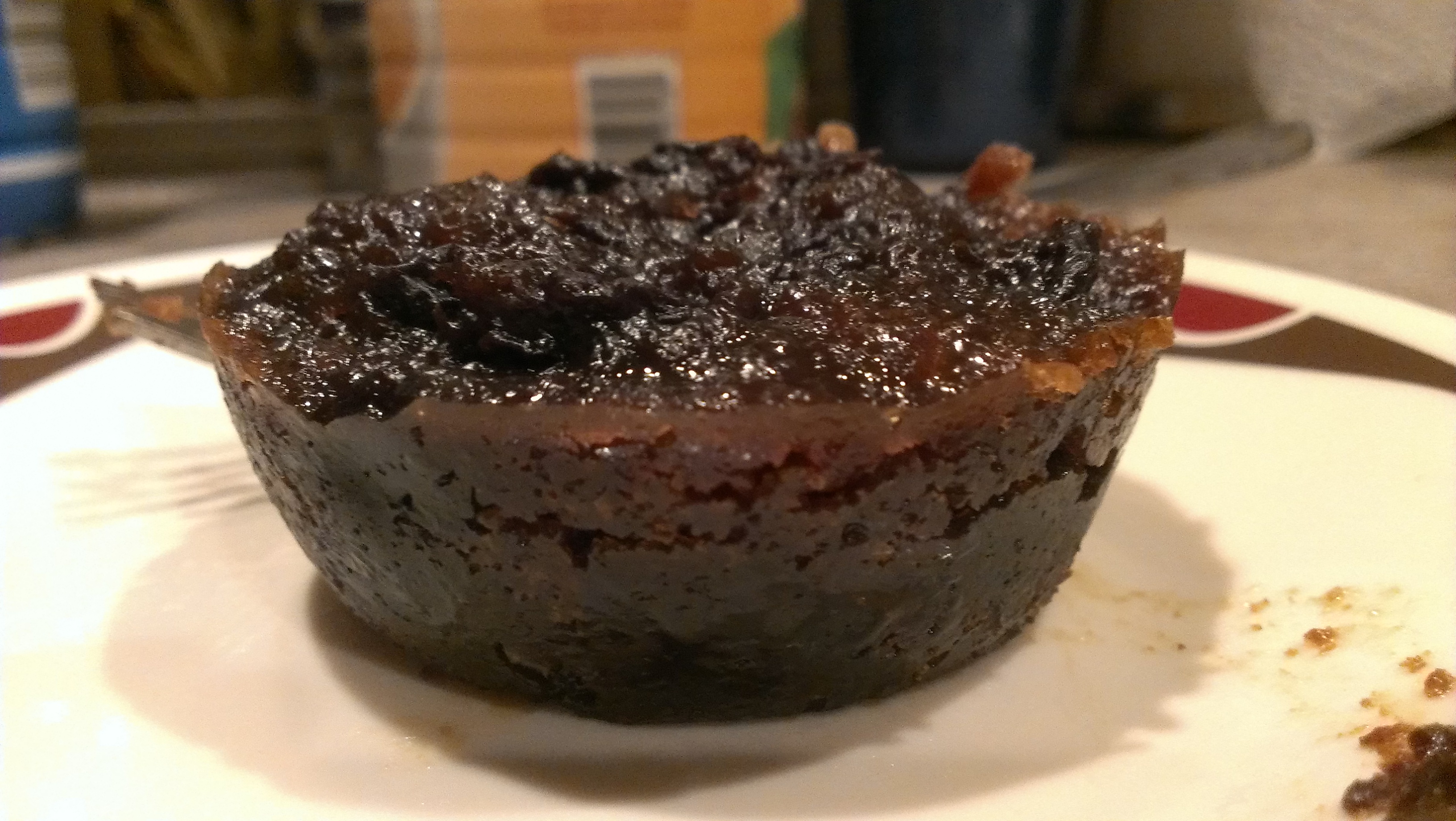
3.5 ounces was plenty.

3.5 ounces was plenty.

I’m glad we planned ahead for the plum pudding, because lemme tell ya, it is a bitch to find in stores. Maybe it’s common in Liverpool, but in Portland? Not so much. So we looked up some recipes, and to say they looked daunting is an understatement. The ingredient list is a mile long (13, my ass!) and includes things like suet, mace, and currants. Oh, plus, after steaming it for six hours, you’ve got to let it all sit – in order for the flavors to blend together – for three weeks. This food holiday might easily have tripped us up had we not planned in advance. Planning in advance, in this case, meant ordering a small plum pudding online from Blue Moon Tea, an importer of teas and foods from the UK located just a few hours north in Tacoma, Washington. Whew! We ordered a small 3.5-ounce container of plum pudding, and believe me, that was plenty. The stuff is dark (because of treacle and other dark sugars, and the long cooking time) and not very appealing in appearance. We microwaved it for 30 seconds and each had a fork full with our morning coffee. It is cloyingly sweet and fruity, and reminds me of fruitcake. Suffice it to say, neither Tara nor I were real impressed with plum pudding.

Mmm!! Your mouth is watering now, huh?

Mmm!! Your mouth is watering now, huh?

Categories: Desserts | Tags: , , , , , | 6 Comments

42/365: National Peppermint Pattie Day

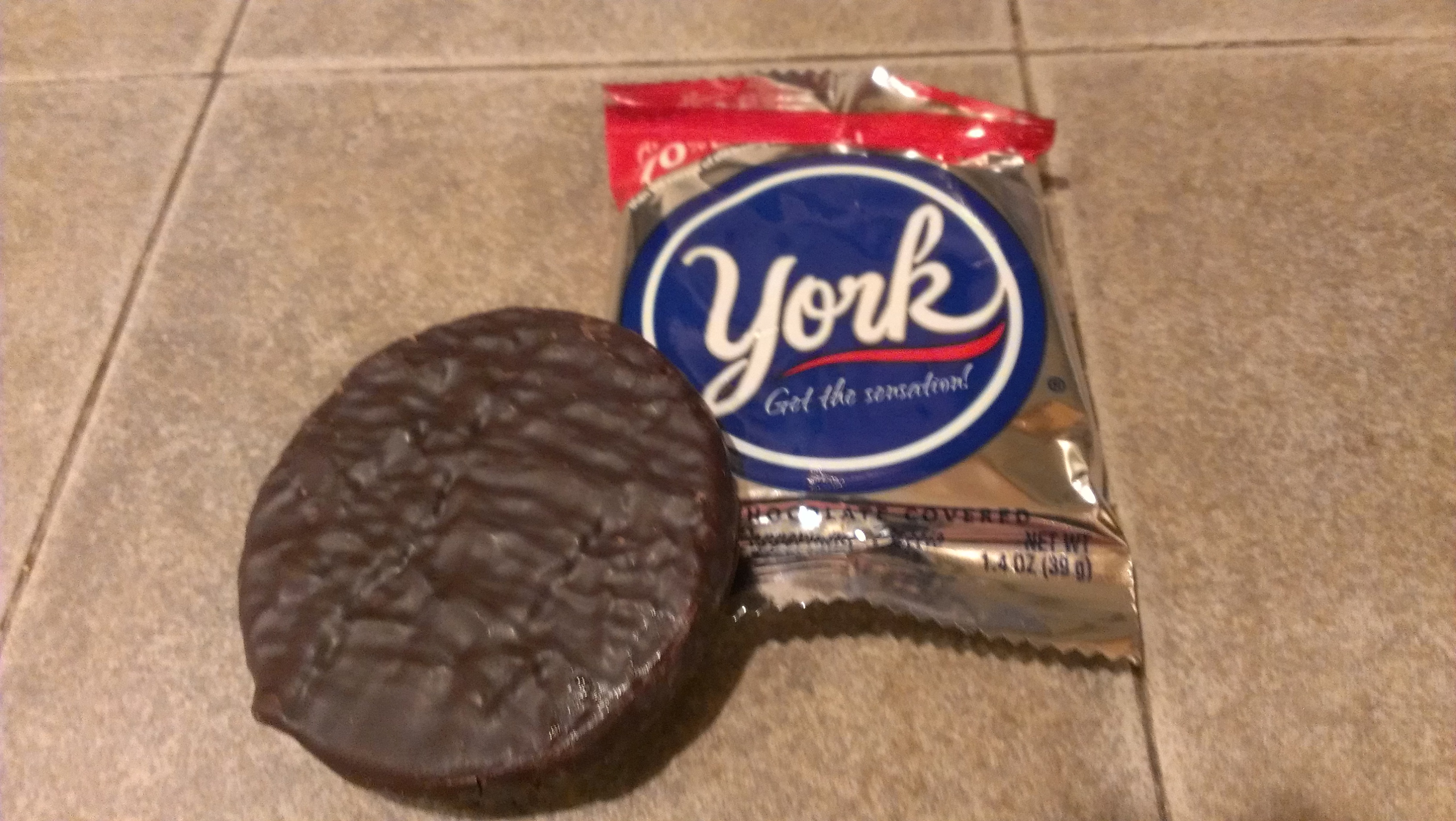
When I learned today was National Peppermint Pattie Day, I was confused. Tara makes us a drink called the Peppermint Patty, with hot chocolate and peppermint Schnapps, and I at first assumed this is what we were celebrating, cold winter day and all. Nope. And we’re not celebrating Charles Schulz’s fictional cartoon character from Peanuts, either. Instead, we are honoring the York Peppermint Pattie®.

Oh, well. They’re good, too.

The Peppermint Pattie was created by Henry Kessler of the York Cone Company in 1940. York’s traffic cones were selling well, but didn’t taste very good, so he decided to branch out into candy. Wait a sec…he sold ice cream cones. My bad. Anyway, chocolate covered peppermint candies had been around for years, but Kessler thought they were too soft, so he set out to create a crispier version, even performing a “snap test” to ensure it would break cleanly in the middle. The Peppermint Pattie became so popular, York stopped making cones altogether. The candy was only available regionally – mainly in the Northeastern United States – until 1975, when Peter Paul (which purchased the York Cone Company a few years earlier) rolled out the York Peppermint Pattie nationally. Peter Paul merged with Cadbury, and then Hershey’s acquired Cadbury, so nowadays they are the ones making the York Peppermint Pattie. In Mexico, no less. Peppermint Patties are known for their strong, clean flavors – cool, minty sugar surrounded by crispy dark chocolate – and have far fewer calories and fat than competing candy bars. They’re the health food of the candy world!

Maybe not quite.

To celebrate the holiday, we just stuck with the basics and enjoyed a Peppermint Pattie after dinner. Sometimes the simplest solution is the best, especially with something so distinctly flavorful.

Peppermint Pattie

Categories: Candy | Tags: , , , , , | 7 Comments

41/365: National Cream Cheese Brownie Day

Whew! Thank goodness today’s food holiday celebrates a dessert. It’s been two whole days! (Even though we ate our molasses bars for breakfast). Today is National Cream Cheese Brownie Day.

Brownies are delicious. Cream cheese is great. Combining the two verges on genius, if you ask me!

I already discussed the history of brownies back on January 22nd, when we celebrated National Blonde Brownie Day. Chicago World’s Fair, Bertha Palmer, yadda yadda. No need to rehash the past. I guess that means I’ll have to focus on cream cheese instead! Early versions of cream cheese date back to the 16th century, but the American version was another of those happy accidents. In 1872, New York dairy farmer William Lawrence was attempting to make a batch of Neufchatel, a type of soft white cheese popular in France, but screwed up the recipe. His cheese was richer and contained cream, so he capitalized on his mistake and called it “cream cheese.” As if that were his intention all along. Typical entrepreneur! He ended up purchasing a Neufchâtel cheese factory and mass-producing cream cheese with his business partner, Samuel Durland. In 1880 a cheese distributor named Alvah Reynolds began selling Lawrence & Durland cheese, and he created a new brand name for it: Philadelphia Cream Cheese, based on that city’s reputation for making really good movies about down-on-their-luck boxers named Rocky cream cheese. Eventually Philadelphia merged with Kraft, and to this day those silver rectangular boxes are considered to be the gold standard of cream cheeses. Neufchâtel, by the way, is still manufactured, usually as a reduced-fat version of cream cheese, since it contains 33% less fat and a higher moisture content. Tara, in fact, is quite fond of Neufchâtel. The first time she bought it, I asked her where the “real” cream cheese was. I’ve since learned not to question her in matters of cheese. Cream cheese brownies consist of regular chocolate brownies with cream cheese swirled in to the mix.

Before I get to our brownies, I wanted to mention that once again we had a surprise visitor to the blog. Or a pair of visitors, actually: Alfredo and Ilse Di Lileo, the grandchildren of Alfredo Di Lileo, the inventor of Fettuccine Alfredo. I told his story here, and his grandkids happened upon the article and dropped by to say hi. They gave me a little information on what happened to their grandfather after his pasta dish achieved acclaim, and offered a slight correction, letting me know the current name of the restaurant in Rome is Il Vero Alfredo. We were honored and humbled that they would stop by and take the time to write us. This blog continues to surprise us in unintended ways!

So, the cream cheese brownies. What can I say? What else is there to say?? They were, of course, fantastic!

Cream Cheese Brownie

Categories: Desserts | Tags: , , , , , , , | 6 Comments

40/365: National Bagels and Lox Day

Here’s the truth, the hole truth, and nothing but the truth: today is National Bagels and Lox Day.

I was pretty excited for this holiday. I love bagels – they’re in my Top 2 list of favorite foods with a hole in the center – but had never tried one with lox. In fact, I wasn’t completely sure what lox even is. Some kind of fish, I knew that much. Turns out it’s thinly sliced smoked salmon – yum! My favorite fish. Living in the Pacific Northwest, it’s basically a prerequisite that you like salmon. Apparently Tara didn’t get the memo (ahem), but we decided to let her in anyway.

Bagels and lox traditionally consists of a bagel, cream cheese, salmon, and sliced red onion. Other ingredients such as capers, dill, and chives may be added. Bagels originated in Poland in the 16th century. They were a nod to the bublik, another circular bread with a big hole in the middle. Why the world needed two such similar foods is anybody’s guess, but then again, Ding Dongs and Ring Dings have coexisted peacefully for decades, so why not? Polish Jews immigrating to the United States brought along bagels, which is why they’re such a staple in New York City (which still makes the best in the country, in my opinion). Bagels caught on everywhere in the 1960s, when bagel bakers Harry and Murray Lender teamed with Florence Sender (they went on a real bender!) to mass produce and distribute frozen, pre-sliced bagels.

Lox have been around for thousands of years, swimming around contentedly in oceans and rivers.

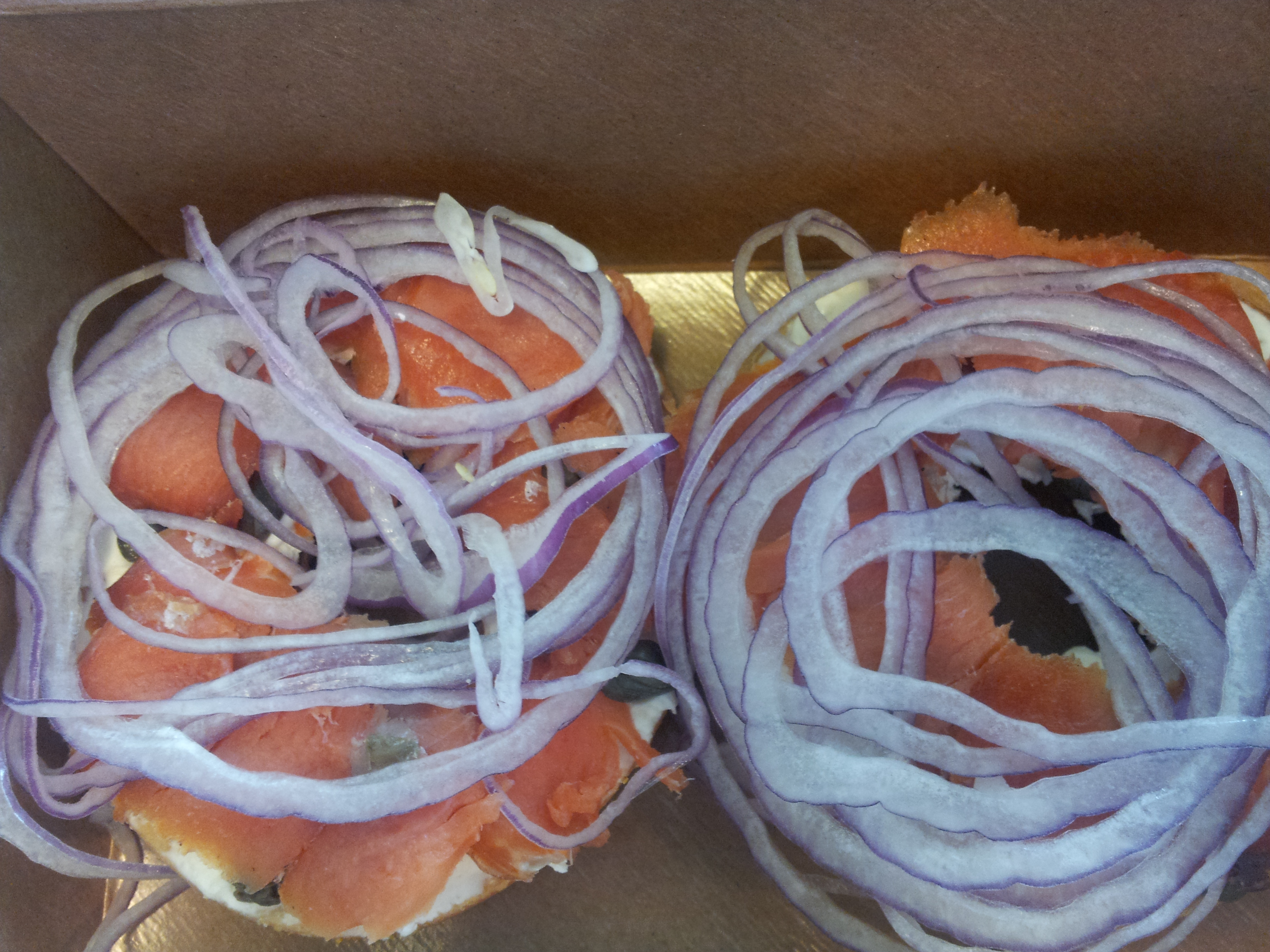
For our bagels and lox, we headed to New Season’s Market, a local grocery store that advertises the delicacy. They served theirs with cream cheese, lox, red onions, and capers. I have to say, I was blown away, and declared this my favorite food challenge yet. The salty, smoked salmon perfectly contrasted the sweetness of the cream cheese, while the thinly sliced red onion added subtle crunch and the capers, a tart bite. I loved the bagels and lox, and will order this one again soon!

A little heavy on the red onion, but oh so good!

A little heavy on the red onion, but oh so good!

Categories: Breakfast | Tags: , , , , , , | 5 Comments

Blog at WordPress.com.