National Chocolate Caramel Day

Last year we celebrated too many chocolate holidays to count, and various caramel-themed ones (apples, popcorn, custard, etc.) as well. But never the two together! I guess you could say last March 19 we were too chicken, since it was National Poultry Day. We’re taking care of unfinished business this year by celebrating National Chocolate Caramel Day!

Hard to believe one year ago we were 78 days into our year-long challenge already. On a personal note, we haven’t been as proactive this year as I’d hoped, but there has been a LOT going on in our personal lives. Including downsizing from a townhouse to an apartment. We moved last weekend, and boy are we tired and sore! All the more reason to treat ourselves to chocolate caramel, eh?

This particular flavor combination is one of the most popular, as evidenced by the countless number of sweet treats boasting both chocolate and caramel. It’s one of those classic combinations, like spaghetti and meatballs. Or wine and cheese. Or Jim Carrey and Jeff Daniels. (What?! Tell me you didn’t laugh out loud during Dumb & Dumber)! We can thank none other than Milton Hershey for combining the two. Hershey began his illustrious career in a caramel company. In the late 1800s, looking for a way to improve plain ol’ caramel candy, he got his hands on some German built chocolate manufacturing machines. His very first product? A chocolate covered caramel! Eventually Milt focused his attention solely on chocolate, but if not for his inventiveness, we might never have Snickers, Milky Way, or Twix. And the world would be a sadder place.

To celebrate, I stopped by 7-Eleven (oh, thank heaven) and grabbed a Rolo. These chocolate covered caramels are one of my favorites!

Now that things are finally settling down (knock on wood), we hope to focus more attention on this blog. We’ve got some big ideas, and will start incorporating those more. Stick around…it’ll be worth it, I promise!

unnamed

Enhanced by Zemanta
Categories: Candy | Tags: , , , , | Leave a comment

Canned Corn: Which Brand is Best?

Tara and I were shopping for our weekly groceries this afternoon and were in the canned vegetables section. She needed canned corn for a goulash recipe she was making. “Normally I buy Green Giant,” she said. “But when I’m just mixing a bunch of ingredients together, the cheap stuff will do.” At that point she plucked a can of Santiam off the shelf and started to walk away.

“Wait!” I said. “Is there really a difference between brands of canned corn?”

“I have no idea,” she replied.

“We should find out,” I said. And just like that, a new food challenge was born!

We can thank Napoleon Bonaparte for canning. French troops were suffering badly from malnutrition during their war with Russia in the 18th century, and Napoleon offered a reward of 12,000 francs to anybody who could develop a method of preserving food to keep the troops fed. Nicolas Appert, a candy maker from Paris, won the prize in 1809. Keenly aware that storing wine in sealed bottles helped preserve it, he applied the same principle to food, filling wide-mouthed glass bottles with food, corking them, and boiling them. The tin can followed shortly after, introduced by Englishman Peter Durand. And the rest is history.

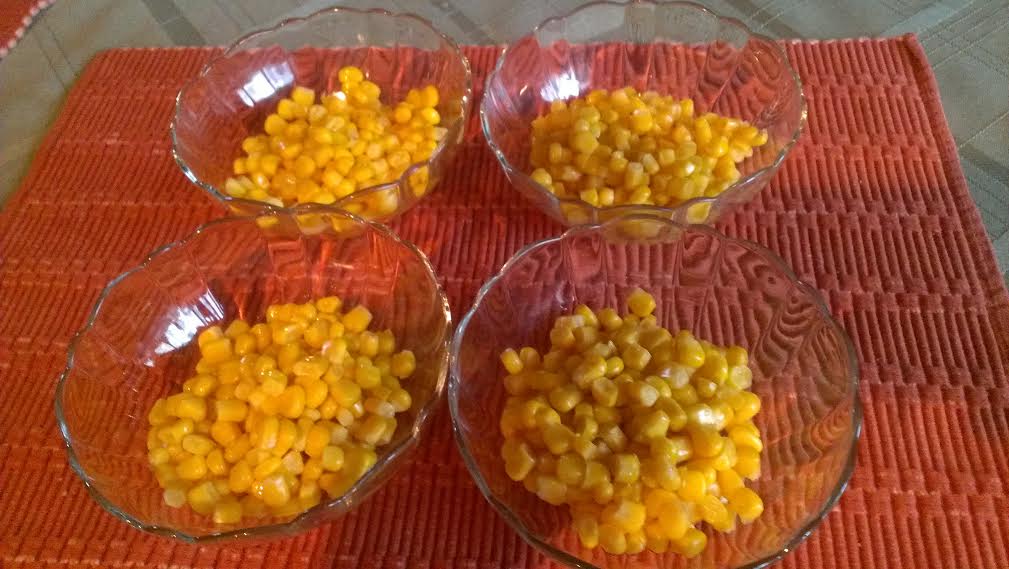
To keep the playing field even, I chose the same type of corn: sweet, whole kernel yellow corn. There were two “economy” brands, Santiam and the WinCo store brand, and two “premium” brands: Green Giant and Del Monte. We decided to sample them straight out of the can – uncooked and not doctored up with butter, salt, or any other flavoring that might inadvertently sway our opinions. It was a double-blind study in which I labeled the bottom of each bowl with a number from 1-4, each one matching with a corresponding can, and mixed them up so that I had no idea which bowl corresponded to which can. Tara and I enlisted the aid of my daughter, as well, for a third opinion. unnamed

I went first, and it became immediately apparent that there were differences in flavor between each brand. They looked identical, but taste-wise, that was another story. After sampling all four, I chose my favorite. Then my daughter went, followed by Tara.

Surprisingly, the results were unanimous. We all chose the same brand as our favorite.

The winner? Del Monte. 

Del Monte’s kernels were plump and sweet, and had a pleasing consistency that was nearly creamy in texture. They were slightly salty, slightly buttery. Just a good, crisp fresh-tasting corn.

Green Giant came in second. Again, the corn was high quality, but the flavor was just a little lacking.

We were split between the bottom two as to which was worse, but they both finished 3 and 4 in the rankings. I found the WinCo brand to have a strange “burned” flavor, while Tara described it as tasting metallic. The Santiam brand didn’t have much flavor at all, and the kernels were a little smaller – and stringier.

I have to admit, the results of this taste test surprised me. I had always assumed all canned vegetables were the same, and that if you bought a more expensive brand you were essentially paying for the name. It turns out I was wrong, that there are differences in quality. The lesson? You get what you pay for! From now on, we’ll be buying Del Monte when we purchase canned corn.

I’m curious to see how other canned veggies stack up. Look for a sequel coming soon.

In the meantime, here are 15 great recipes using canned corn.

When it comes to canned corn, you get what you pay for.

When it comes to canned corn, you get what you pay for.

Enhanced by Zemanta
Categories: Vegetables | Tags: , , , , , , , , | 6 Comments

National Homemade Soup Day

Warm, hearty, and comforting, soup is the perfect food for those chilly winter days. And since the groundhog saw his shadow and informed us we have six weeks of winter left, it’s especially fitting. We didn’t celebrate this holiday last year because mushrooms were on the plate, but we lucked out this year. February 4 is National Homemade Soup Day!

I say lucked out, because we didn’t plan this food challenge. I just happened to make a pot of homemade albondigas soup for dinner last night, and brought leftovers to work for lunch. It may be an accident, but hey, I’m going with it. I’ll take every opportunity I can to cross another food holiday off our official list!

Whether you’re enjoying a bouillon or consomme, a puree or a bisque, soup has been a part of the human diet for a very long time. Evidence dates back to 20,000 BC. Holy cow, were there even people back then?! Since waterproof containers were rare back then, liquid soups were cooked in either animal hides or baskets made of reed or bark, heated to boiling with hot rocks. Interestingly, the word restaurant means “physically restoring,” and was first used to describe a soup sold by 16th century French street vendors that purportedly was used as an antidote to physical exhaustion. In 1765, a shop was opened in Paris that specialized in these soups, and the term restaurant was used to describe eateries from that point forward. Dr. John T. Dorrance, a chemist with Campbell’s Soup Company, invented condensed soups in 1897; these canned soups allowed customers to simply add water and heat at home. Campbell’s remains popular to this day; the top three selling flavors are Tomato, Cream of Mushroom, and Chicken Noodle. Soup has been popularized in American culture thanks to people as diverse as Andy Warhol and the Soup Nazi, of Seinfeld fame.

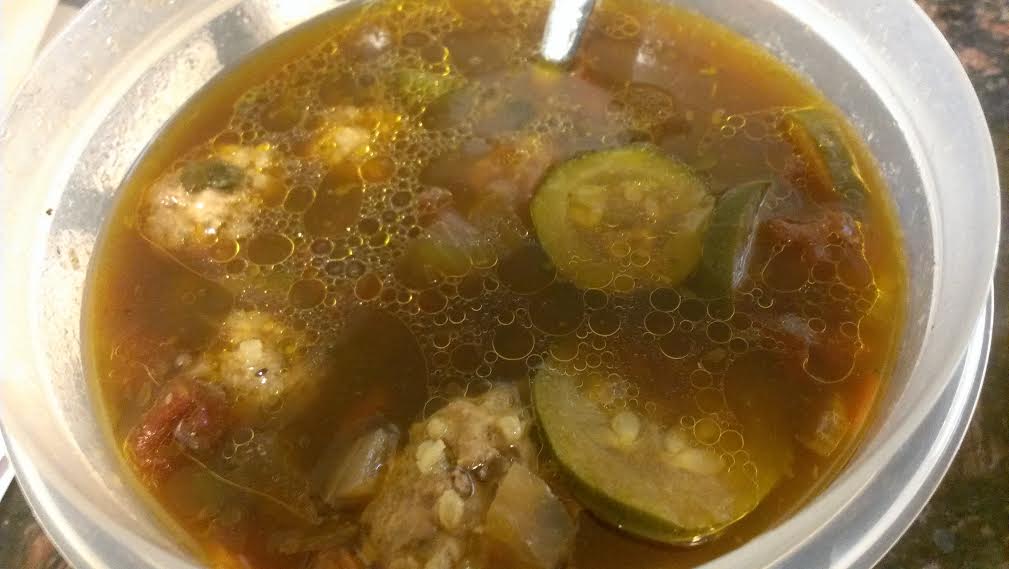
Last night, I prepared a homemade albondigas soup. Albondigas is the Spanish word for meatball. Sure enough, this soup focuses on meatballs, cooked in a broth (I use beef, though many recipes call for chicken) with onion, tomato, carrots, celery, cilantro, and zucchini. A squirt of lime juice brings out the flavors. And, like many soups and stews, it’s better the next day, once the flavors have had time to meld together. My lunchtime bowl hit the spot!

National Homemade Soup Day

Enhanced by Zemanta
Categories: Soup | Tags: , , , , , | 4 Comments

Does Wine Get Better With Age?

All my life, I’d heard that wine gets better with age. The myth is perpetuated through the exorbitant prices people pay for certain bottles of aged wine. The truth is, some wines do improve with age, while others reach their peak within 2-3 years. We decided to find out for ourselves when my parents stumbled across a couple of bottles of wine they had bought in the mid-1980s. This didn’t merely make them “aged,” but downright old: 30  years is a long time to wait to open a bottle of wine. Would it still be drinkable, let alone good? We were soon to find out, and turned the whole experience into a food challenge: determining whether wine really does improve with age.

The ancient Greeks and Romans prized aged wines, often storing them in sealed earthenware jugs where they would keep for many years. After the fall of the Roman Empire, wines were paler, light bodied, and lower in alcohol content. These did not age well and would turn to vinegar after a few months, so old bottles were steeply discounted. In the 17th century the cork and bottle were invented, and wines were being produced with a higher alcohol content, two factors leading to improved preservation and aging.

Today, it is estimated that only 10% of red wines and 5% of white wines improve enough to taste better after 5 years of aging, and only the top 1% of all wine tastes better when it’s a decade old. Wines with the best potential for aging have low pH levels and a high amount of tannins, meaning reds such as Pinot Noir, Cabernet Sauvignon, and Syrah.

We were not really looking forward to this challenge. We had my parents over to participate, since they are pretty knowledgeable about wine. They had opened old bottles before that had gone sour and tasted like vinegar. Our hopes were not high, putting it lightly.

Our well-aged wine.

Our well-aged wine.

The wines we tried: a 1985 Hangtown Red California Red Wine, and a J. Lohr California Red Wine that had been purchased in South Dakota sometime between 1983-1986. So, two 30 year-old bottles of generic red wine awaited our palates. Right on!

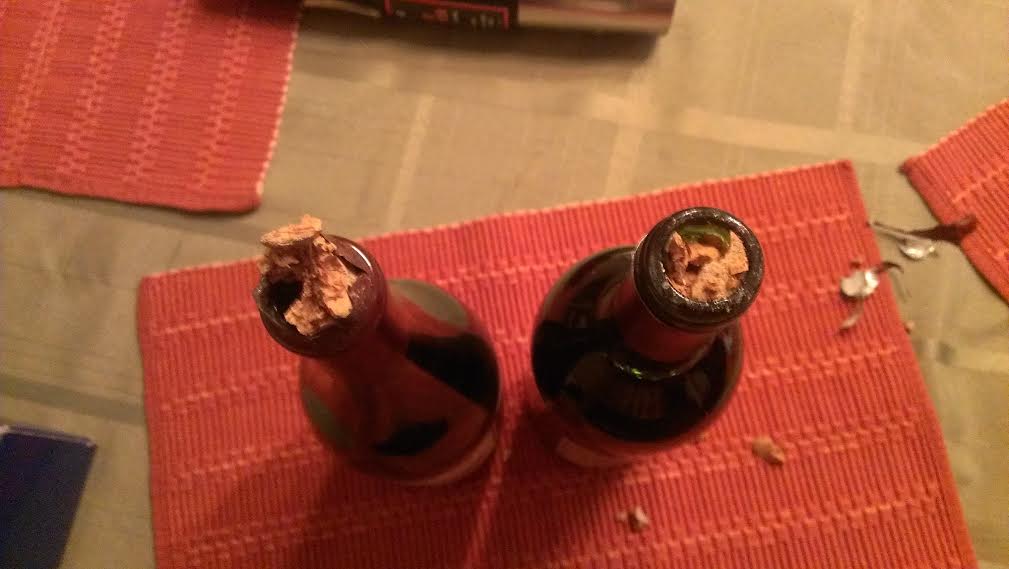
We ran into trouble almost immediately. Both corks splintered when we tried to remove them. To properly store wine, you are supposed to lay the bottle on its side and give it a quarter turn every couple of months. These bottles were sitting upright in a box for decades, and so the corks had long ago dried out. This can lead to oxygen leaking into the bottle, leading to an off-taste (at best) and mold (at worst). Still, we didn’t let a little thing like crumbling corks stop us. We soldiered on, eventually prying one cork out and pushing the second cork into the bottle. Luckily, we had a strainer. Where there’s a will, there’s a way.

We poured the wine into glasses. For comparison and contrast, we had a “fresh” bottle of wine, as well. The first thing we noticed was the difference in color. The “new” wine was bright, almost purple in color, while the older wines had faded somewhat to a brownish-red color.

The corks had crumbled and were difficult to remove thanks to improper storage techniques.

The corks had crumbled and were difficult to remove thanks to improper storage techniques.

Now it was time for the ultimate test: the tasting! Everybody seemed reluctant, so I picked up the glass of J. Lohr California Red and took a deep swallow.

Fortunately, not only had it not oxidized or turned to vinegar, it was actually pretty good. For a cheap red wine that was 30 years old, anyway. It tasted to me of prunes. The others followed suit – Tara and my parents – and we all agreed. We were pleasantly surprised.

The second glass, the 1985 Hangtown Red, was pretty similar. I thought this one had more of a smokiness to it, but it was certainly drinkable, if not delicious. Again, everybody took a sip or two. Again, we were all surprised.

“You know,” I said, “If you were trapped on a deserted island and these two bottles of wine washed up on shore, you’d be thanking your lucky stars,” I commented.

“You’d be smashing them open by the neck to drink them,” my dad countered.

So, there you go. I don’t know if this challenge was the exception or the rule, but our well-aged red wines – while not necessarily improving in flavor – didn’t really suffer all that much. In fact, I ended up finishing the entire glass of J. Lohr. I’ll admit: I actually liked it!

L to R: J. Lohr CA Red (circa early-mid 80s), Hangtown Red CA Red (1985), 120 Cabernet Sauvignon (2011).

L to R: J. Lohr CA Red (circa early-mid 80s), Hangtown Red CA Red (1985), 120 Cabernet Sauvignon (2011).

Enhanced by Zemanta
Categories: Alcohol | Tags: , , , , , , , , | 5 Comments

Parmigiano-Reggiano v. Kraft

Last night I was making meatballs, and was forced to break a cardinal rule by using Kraft parmesan cheese – the powdery stuff with a sawdust-like consistency – in place of the Parmigiano-Reggiano I normally use. I hadn’t realized we were out of the “good stuff” until I started cooking, and at that point there was no turning back. Desperate times called for desperate measures. “How much of a difference can it really make?” I asked myself.

The sad truth is, a lot.

Kraft Grated Parmesan Cheese 9oz The Italian wedding soup I was making turned out fine, but the meatballs were definitely missing something. I tried to compensate for the lack of real cheese by adding garlic salt, minced onion, and parsley, but it was all for naught. They were blander than usual. At that point, I began to wonder what – exactly – is in that can of Kraft parmesan, a childhood staple growing up that has long since fallen out of favor, except to shake onto slices of pizza. The can does say it’s made with “100% real grated parmesan, no fillers.” So I did some digging, and it turns out our definition of parmesan differs from Europe’s definition of parmesan.

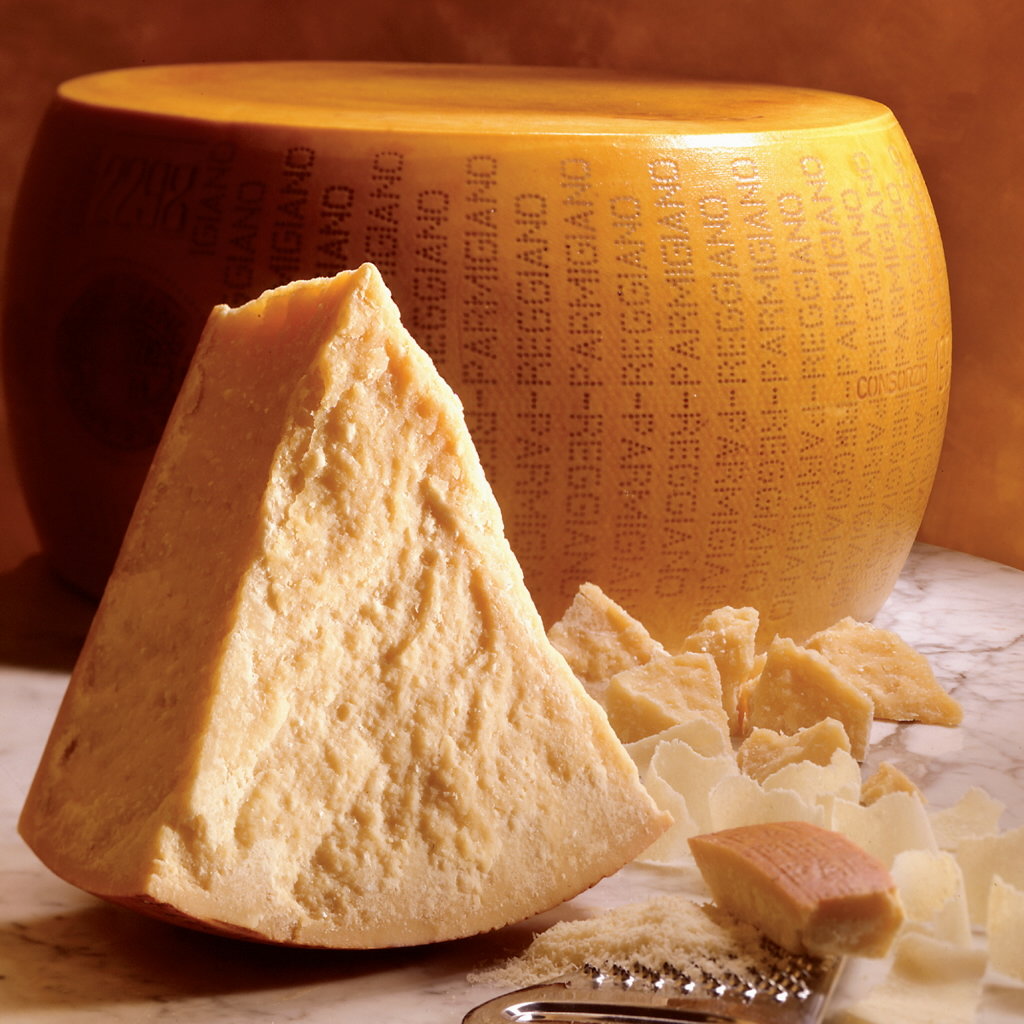
The only true parmesan is Parmigiano-Reggiano, a hard cow’s milk cheese produced in the Parma, Reggio-Emilia, Modena, and Bologna regions of Italy. Under European law, only cheese produced in this region can be called Parmigiano-Reggiano. There’s a very exacting process of producing this cheese (cows must be fed grass or hay only; the cheese is made in heated copper kettles, rested in molds, soaked in brine, then allowed to age a minimum of twelve months; it contains unpasteurized milk, salt, and rennet only; etc.). The cheese has a long history, and was originally created during the Middle Ages in Bibbiano, Italy. While the name is trademarked in Europe, no such rules apply outside of that continent. In the U.S. and other countries, commercially produced imitation cheeses can be sold under the generic name “parmesan.”

And that’s where our friend in the green can comes in.

Real parmesan looks like this.

Real parmesan looks like this.

Kraft first introduced the product in 1945. It gained widespread popularity as a topping for spaghetti and other pastas. There was always a can in the fridge growing up. My dad called it “stinky cheese.” We used it liberally. Though what exactly we were using is open to debate. Kraft developed a process in which the cheese is aged a mere six months, rather than the year or two required of true parmesan. This was nothing more than a business decision for Kraft: less time on the shelf opens up costly plant space and cuts down on production costs. Both Italians and smaller U.S. cheese makers scoff at the idea. Paul Bauer of Wisconsin’s Antigo Cheese Co. says cheese cured in six months “is not parmesan. Parmesan is cheese that develops its flavor over time.”

Be that as it may, the FDA stands behind Kraft’s shorter-production “parmesan” cheese. Let’s not even get into the fact that it contains ingredients such as “cellulose powder” and “potassium sorbate.”

All I know is, my meatballs did not taste the same, and based on everything I’ve read, I can blame it on the fake cheese.


Enhanced by Zemanta
Categories: Dairy | Tags: , , , , | 8 Comments

National Fresh Squeezed Juice Day

As promised, occasionally we’ll celebrate some of the food holidays we chose to skip last year in favor of others. Today marks one of those. January 15 is National Fresh Squeezed Juice Day!

Actually, this is a recent addition to the calendar. I updated the National Food Holidays page to directly link to each challenge, and in the process, did some double-checking against a variety of online calendars looking for missed holidays. There were a bunch, as it turns out. I lamented often last year about the lack of consistency between calendars and our “majority rules” stipulation. I have yet to find two food holiday calendars that are perfectly identical, but feels ours is as close to perfect as it gets!

This holiday was a timely one, as Tara had zested a bunch of lemons over the weekend in order to bake my dad a birthday cake, and had no idea what to do with the leftover peeled lemons. I’ve always subscribed to the axiom “when life hands you lemons, make lemonade!” – and in this case, I took that quite literally. Fresh squeezed lemonade it was!

Fresh squeezed juices have been a staple of the American diet ever since some klutzy Colonist accidentally stepped on an orange. Actually, that’s not what the history books tell us, though it makes for a humorous story. Humans have probably been drinking the juices from a variety of fruits for thousands of years, but the modern juice industry got its start in the mid-1910s thanks to an excess of oranges. California farmers had grown too many to sell, and not wanting to waste them, decided to juice them instead, taking advantage of a new process known as pasteurization. Now the juice could be stored for longer periods of time, and the nation’s railway system was able to whisk away cartons to major cities around the country. The juicing industry was born.

Of course, this refers to commercial juice, which is anything but fresh-squeezed. Fresh juice was seen as a healthy alternative to sodas and other beverages, and in the 1980s the popularity of juice bars (and home juicing machines) exploded. Suddenly, every Dick and Jane worth their salt was juicing their own fresh squeezed oranges, apples, grapefruits, pineapples, tomatoes, grapes, carrots, cranberries, mangoes, passion fruit, and pomegranates.

I have always been a big fan of lemonade, and fresh squeezed is about a thousand times superior to Minute Maid or any type of frozen concentrate. Tonight’s was no exception!

National Fresh Squeezed Juice Day

Categories: Beverages, Fruit | Tags: , , , , , | 2 Comments

Chicken Paprikas

Our first challenge of the new year coincides with my dad’s birthday. Our family tradition is for my mom to make chicken paprikas to celebrate the big day. It’s always a special occasion, because she makes it exactly once a year. Why? As delicious as it is, it’s not the healthiest dish in the world. Her recipe calls for a dozen eggs, plus sour cream, and butter…definitely not a low-calorie or low-fat meal.

But absolutely delicious.

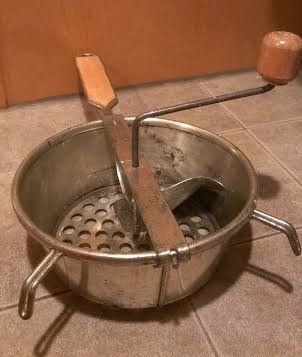
Chicken paprikas is a traditional Hungarian stew that usually incorporates chicken, onions, butter, paprika, and sour cream. Many recipes also call for tomatoes and green bell peppers, though my mom has always left these ingredients out. My family has Hungarian roots, and this recipe has been passed down through the generations, so I have no doubt about its authenticity. (Or its flavor: it’s mouth-wateringly good). Chicken paprikas (pronounced, and sometimes spelled, paprikash) is traditionally served with dumplings. We use old-fashioned metal dumpling makers to make ours.

My dumpling maker. This once belonged to my grandmother.

My dumpling maker. This once belonged to my grandmother.

True to its name, the most important ingredient is paprika. And it’s got to be Hungarian paprika – a nice combination of sweet and pungent. I never buy any other type. (Shout out to my ancestors!).

Recipes such as this were meant to be passed down. I like to think my grandkids’ grandkids will be enjoying this same dish 50 years from now. It’s not particularly complicated to make, but it is time-consuming. My lone attempt, about ten years ago, resulted in dumplings that were thinner and not quite as flavorful as my mom’s. So for this food challenge, Tara wanted to see if she could replicate my family’s famous chicken paprikas recipe.

How’d she do? Let’s hear it from her!

Well, according to everyone’s slurping and munching at the dinner table, I did pretty well.

I absolutely adore my mother-in-law and was looking forward to having her teach me this family dish.  I chopped onions while she threw butter into the pots.  I seasoned the chicken thighs and legs while she told me not to use too much pepper.  And then I beat the dozen eggs and too slowly added flour until the dumpling batter reached the right consistency; halfway between pancake batter and a quick bread dough. She poured the batter while I cranked the dumpling maker.  

*insert dirty joke here*

Good job, Mrs. P!

Good job, Mrs. P!

The dumplings (similar to spaetzel) cooked in boiling water and then were later added to the sauce. The sauce came together quickly after removing the stewed chicken and straining the onions.  The reserved cooking juices were combined with equal parts sour cream and water…and another egg.  The dumplings were added to the sauce and brought to a boil.  

Yes, labor intensive, but not as bad as I thought it would be.  Not anymore so than my mom’s Chicken ‘n Noodles or Chicken Chimichangas. The flavor is wonderful and definitely worth all the hard work.  The real test will be when I make it without Carol’s guiding hand.  I ‘m looking forward to getting the recipe down pat, and passing it on to younger generations!

We all agreed, the paprikas turned out fantastic. And trust me, we’re tough critics when it comes to this dish! Job well done, Tara. You singlehandedly – and easily – accomplished the first of this year’s food challenges: recreating a favorite family recipe.

On to the next!

Chicken Paprikas

Chicken Paprikas

Categories: Pasta, Poultry | Tags: , , , , , | 2 Comments

Q & A

Hi, there! Guess who’s back?

Not “back” in the sense that we are celebrating daily food holidays. We did not have spaghetti yesterday, chocolate covered cherries the day before, or cream puffs the day before that (though we did start the New Year with Bloody Marys again, but that’s a tradition we’ll probably always partake in). As liberating as it is not having to plan our menu around a particular food holiday, it has felt kind of weird readjusting to a normal schedule. It’s like we’ve stepped into “civilian life” after spending a year in jail, or perhaps the military. I still find myself automatically checking in on what the food holiday is, out of habit. Like, a year ago we celebrated whipped cream in Seattle. Ahh…memories. Questions-and-Answers

But life goes on, and while we do miss the challenge at times, we are both glad it’s over. We came, we saw, we conquered. Time to move on.

Last month I asked our dear readers for questions, and they came through with plenty. So here are the answers!

  1. What was the worst food you tried? Ironically enough, one of the most expensive: caviar. It’s the only one that made Tara dry heave. Fish eggs may be considered a delicacy, but they didn’t win us over. Even the dog biscuits were better. We also despised the martini. I’ve since learned how awful vermouth is. 
  2. What was the best? We both loved Julia Childs’ Coq au Vin. Tara was also impressed with the chocolate souffle. She did a kick-ass job with that one. I loved the Peking Duck and was blown away by the Pepper Pot. 
  3. What was the most difficult challenge to celebrate? Vanilla custard, because it took multiple attempts to get it to set properly, and then we had to drive it across three states due to an unexpected death in the family. When we finally ate it, it had separated, and was quite frankly a mess. 
  4. What food surprised you the most (in taste, and in what it actually was)? We were both surprised that we didn’t hate lima beans. Tara thought the escargot was much better than she expected. The Yorkshire Pudding was nothing like we expected, but delicious; when I hear pudding, I think a custard-like dessert, not a baked popover. 
  5. Have any new foods youve been exposed to incorporated themselves into your regular repertoire of meals/snacks? Yes! We have made the curried chicken salad several times, and in fact, it’s on our dinner menu this week. We’ll also be making Coq au Vin once in awhile, and Pepper Pot, for sure. Same goes with welsh rarebit. And I’m sure at some point down the line we’ll be trying our hands at souffles again!
  6.  If you were to do this challenge again, what would you do differently? I’m proud of the way we took on this challenge, and wouldn’t change much. Maybe try to make a few more things from scratch. Tara wished we had kept track of our expenses, and I would have used a real camera rather than my cell phone to concentrate more on getting a good picture of each challenge.
  7. What advice would you give to someone who would want to try to do this challenge? I answered that in detail on our last post. 
  8. What did you learn most? We learned tons about the backgrounds of many foods – how they were created, named, etc. I loved hearing the story behind Fettuccine Alfredo, Peach Melba, Tollhouse cookies, Popsicles, fried clams, and so much more. These histories have given us a better appreciation of many different foods and drinks. 
  9. What was the cheapest challenge? Most expensive? A lot of the challenges were cheap. Buying a kiwi, eating an apple, a candy cane, a handful of nuts – none of these cost much. On the opposite end of the spectrum, the roast leg of lamb cost us $40, making that one the costliest. We also had to buy a lot of alcohol, which added up. 
  10. Did you ever take the easy way out of a challenge? Of course! We would have driven ourselves crazy if we hadn’t. Buying pudding cups for some of the pudding challenges, for instance. Or eating Boston Creme Pie flavored yogurt instead of making an actual Boston creme pie. But you get to a point where there are so many dessert challenges in a row, or dishes that require a lot of cooking, and you are just too tired to put in every bit of effort. Like I said, I’m proud of what we accomplished!

There you go! Consider this a helpful tip if you ever plan on taking on this challenge yourself.

And stick around – our first challenge of the new year will be taking place next weekend!


Categories: Uncategorized | Tags: | 3 Comments

365/365: National Champagne Day

Today we’re feeling especially bubbly. Pop a cork and offer up a toast: we have successfully completed our yearlong celebration of food holidays in a most fitting manner. December 31 is National Champagne Day!

One year ago, we set out on what seemed like a monumental quest: to celebrate at least one American food holiday every day, for an entire year. The rules were simple: eat or drink the food or beverage of honor anytime within that 24-hour period. We could take a single sip or bite, or devour an entire plate (or pitcher) if we wanted. We were allowed to purchase items from the store, order them from restaurant menus, or create them from scratch. We did all of the above, regardless of circumstances. There were work functions, camping trips, family visits, and vacations out of state – not to mention our wedding. It wasn’t always easy, and at times felt downright tedious, but in the end the sense of accomplishment is enormous. Tara and I are proud to have done this, and have no regrets! We had fun, got to sample a lot of foods we might otherwise never have tried, and learned a lot about the history of the foods we eat, and how many popular dishes came to be named. There really was a Melba, for instance (of toast and peach fame). And an Alfredo (fettuccine). We even had the pleasure of speaking with the latter’s blood relatives, his grandchildren who stumbled upon this blog and gave us some additional insight into their famous grandfather. We were touched and honored; I think that alone made this project worthwhile. The rewards far outweighed the hassle. Yes, sometimes it felt like a chore preparing a labor-intensive dish like Coq au Vin late into the evening after a busy day at work, and the many (too many!) desserts stretched our patience, not to mention our waistlines. Thank goodness for that gym membership, at least!

If you’re thinking of doing a similar challenge, I’ve got some advice for you. The most important thing you can do is plan ahead! Because if you are looking for blueberry popsicles in the grocery store late at night on National Blueberry Popsicle Day, you’re going to be screwed since that flavor does not exist! But if you’re prepared, you’ll have made your own from scratch already. Also, don’t be afraid to take the easy way out. You don’t have to create a fancy dish that revolves around cashews on National Cashew Day, when a few nuts from a can will suffice. At the same time, don’t take too many shortcuts. Pudding cups may be your best friend one day, but try to mix it up and make pudding from scratch (or at least a box) the next time. It’s the best way to fully immerse yourself in the food that you are celebrating. Be careful about cutting corners: maple flavored syrup is NOT maple syrup! Think small when it comes to desserts: instead of baking a whole pie or cake, go for individual slices from the grocery store or corner bakery. This will save you a lot of time, money, and calories. Remember, cupcakes are really just individual cakes! Finally, above all else, prepare for a lot of work…but have fun! Doing this will take up a lot of your time. But when you’re kicking back in a tiki bar on a Tuesday night, sipping a rum punch from a glass with a tiny folding paper umbrella, you can’t help but laugh. It’s probably not even remotely close to how you’d normally spend an evening like that. EMBRACE IT! You’ll look back fondly afterwards. I already am, and this challenge just barely ended.

Here are a few words from Tara, my lovely wife and partner in this challenge. I never could have completed this without her, by the way.

I haven’t contributed as much to this blog as I had hoped to, but I’m grateful for the opportunity to experience this with Mark.  I remember the weeks leading up to January 1st last year and feeling a sense of dread over how much time and effort this was going to take.  When you look at a website with three hundred and sixty-five foods you’ll be eating, it’s a little daunting!  Huge kudos to Mark for doing the bulk of the planning and writing for this project.  I did lots of cooking and baking, but I know there was a lot more time invested in researching and typing up all those posts.  It took a few weeks to find our groove, but once we did, it was pretty smooth sailing.

This past year has definitely opened my eyes and my palate to new foods, cooking techniques, and recipes.  We’ve consumed foods that we never would’ve tried otherwise…and ended up loving.  Mark hates watermelon, but loved Interurban’s Watermelon Salad with habenero, feta, and cilantro.  Go figure.  We were both surprised that the lima beans didn’t make us gag.  And chocolate covered insects weren’t bad either!  Some of our new favorites include the Chicken Curry Salad Lettuce Wrap, Coq Au Vin, Pepper Pot, and Welsh Rarebit.  I’m especially excited to try even more new recipes next year and really challenge ourselves in terms of local cuisine and healthier eating.

National Champagne DayI would also like to thank some of our supporters, without whose encouragement we could not have completed this challenge. Wendy, Jill, and Heidi – our real-life friends who offered lots of input over the course of the year. John from National Food Holiday Tour, who partook of this same challenge himself two years ago and was a source of inspiration from the start. The Muscleheaded Blog, for sharing so many of our posts with his readers. George B., whose continued presence did not go unnoticed. And everybody else who ever stopped by to read, comment, or even critique. You are all greatly appreciated. And of course, a big thank you to my parents: my mom helped us out several times (she made us a Baked Alaska from scratch, for crying out loud, not to mention roast leg of lamb, Mint Juleps, and others) and who got to share in many of the meals. And my MIL Tracy, who has been the most loyal blog follower of mine EVER…even long before I married her daughter! She also helped out, and lent us the use of her oven for our Cheese Souffle Challenge. Thank you all VERY much!

Normally at this point I would talk about the history of champagne, but I’m going to keep it simple. Champagne is a sparkling wine produced from grapes grown in the Champagne region of France. The wine undergoes a process known as secondary fermentation to create carbonation. Purists argue that champagne must adhere to these strict standards in order to be classified as true champagne, while others use the term more loosely, referring to any sparkling wine as champagne.

This whole thing began with a raised glass and a toast: January 1, early in the morning, we began the challenge with Bloody Marys, clinking our glasses together and wishing each other luck, barely able to comprehend what we were getting ourselves into. Appropriately enough, things ended in a similar manner: with another raised glass and a toast – this time, to a job well done. In that regard, it feels like we came full circle.

We are in Ely, Nevada for New Year’s, and celebrating tonight at the Fireman’s Ball. But we didn’t wait for the clock to strike midnight to sip our champagne and risk elimination on a technicality! We actually brought along a bottle of French champagne, Nicolas Feuillatte, that was recommended to us by David, Tara’s stepfather-of-sorts. He’s a sommelier and knows his way around fermented grapes! And at $27 it was reasonably priced, and still tasted delicious. We toasted earlier in the day.

So, that’s it!!!

But, that’s not “it” for Eat My Words. As previously mentioned, we’re continuing the blog in 2014. Instead of celebrating daily American food holidays, we’ll be focusing on a whole new series of food-related challenges. We’ll take a fun, whimsical look at some popular dishes that don’t have food holidays devoted to them yet, giving you the scoop on their history. We’ll post food-related essays, pictures, cartoons, etc. We’ll even celebrate the occasional food holiday we overlooked this year, in favor of another. And most importantly, we’re on a mission: to have an official holiday created for the often lamented and overlooked king of condiments, ketchup. Follow along as we do whatever it takes, short of storming the White House, to get a resolution passed. So, if  you’re a subscriber, stick with us. There’s plenty more fun ahead!

Happy New Year!

We did it!!
We did it!!

Categories: Alcohol | Tags: , , , , , | 12 Comments

364/365: National Bicarbonate of Soda Day

Continue reading

Categories: Uncategorized | Tags: , , , , , , | 3 Comments

Create a free website or blog at WordPress.com.