23/365: National Pie Day

Today is National Pie Day, and to be honest, we were caught a little off guard. The chart we have been following indicated it was Rhubarb Pie Day, which made little sense given that rhubarb won’t be in season for another few months yet…but then again, not all of these holidays make sense. We were able to find a cheap strawberry-rhubarb pie in the grocery store, and that would have sufficed, but then a friend pointed out that it was actually Pie Day – no specific ingredient – and that changed everything. Especially since there is a Strawberry-Rhubarb Pie Day in June. Given the choice, Tara and I would prefer a different pie, maybe a cream version. We got our wish – more on that in a sec.

Pies have been around since about 9500 B.C., and were created as a means of transporting foods over long distances, such as ocean voyages. Ship manifests used to include a butcher or cook and live animals, but this proved to be uneconomical and a waste of cargo space (have you seen how much head room a giraffe needs?!). So when flour was created and baking invented, pies proved to be an easy, nutritious, and long-lasting food to bring along on a journey. The first published recipe was for a goat cheese and honey pie with a rye crust. Most early pies were made with meat; the Romans, who weren’t just skilled world-conquerors but also pretty good cooks, were adept at using salts and spices to preserve and flavor meat. A favorite meal of Caesar’s was four and twenty gladiators baked into a pie. Pie cooking spread through Europe; songbird pie was a big hit with English royalty. During his coronation in 1429, King Henry VI was served a “Partryche and Pecock enhackyll” pie consisting of cooked peacock and topped with a cooked and mounted peacock, colorful feathers and all. This tradition of placing a cooked bird atop a pie was a popular way to identify what was beneath the crust. I don’t know about you, but I’d much rather just take a bite myself. Fruit pies were (thankfully) developed soon after.

Once we found out today was actually Whatever-Kind-Of-Pie-We-Want Day, we decided to ditch the cheap strawberry-rhubarb pie (I anonymously gifted it to my coworkers) and swing by Shari’s, a restaurant known for their – everybody ready? – chicken fried steak.

Just kidding. They’re also known for their pies. And with a dozen varieties to choose from, we were in pie heaven. Could we have baked our own? Sure. Should we have baked our own? Maybe…but this challenge is tough enough without having to worry about making everything from scratch. Come June 9, I’ll bake my own strawberry-rhubarb pie. In the meantime, we enjoyed individual slices. I got coconut cream, she got chocolate silk. Suffice it to say, we enjoyed ’em both!
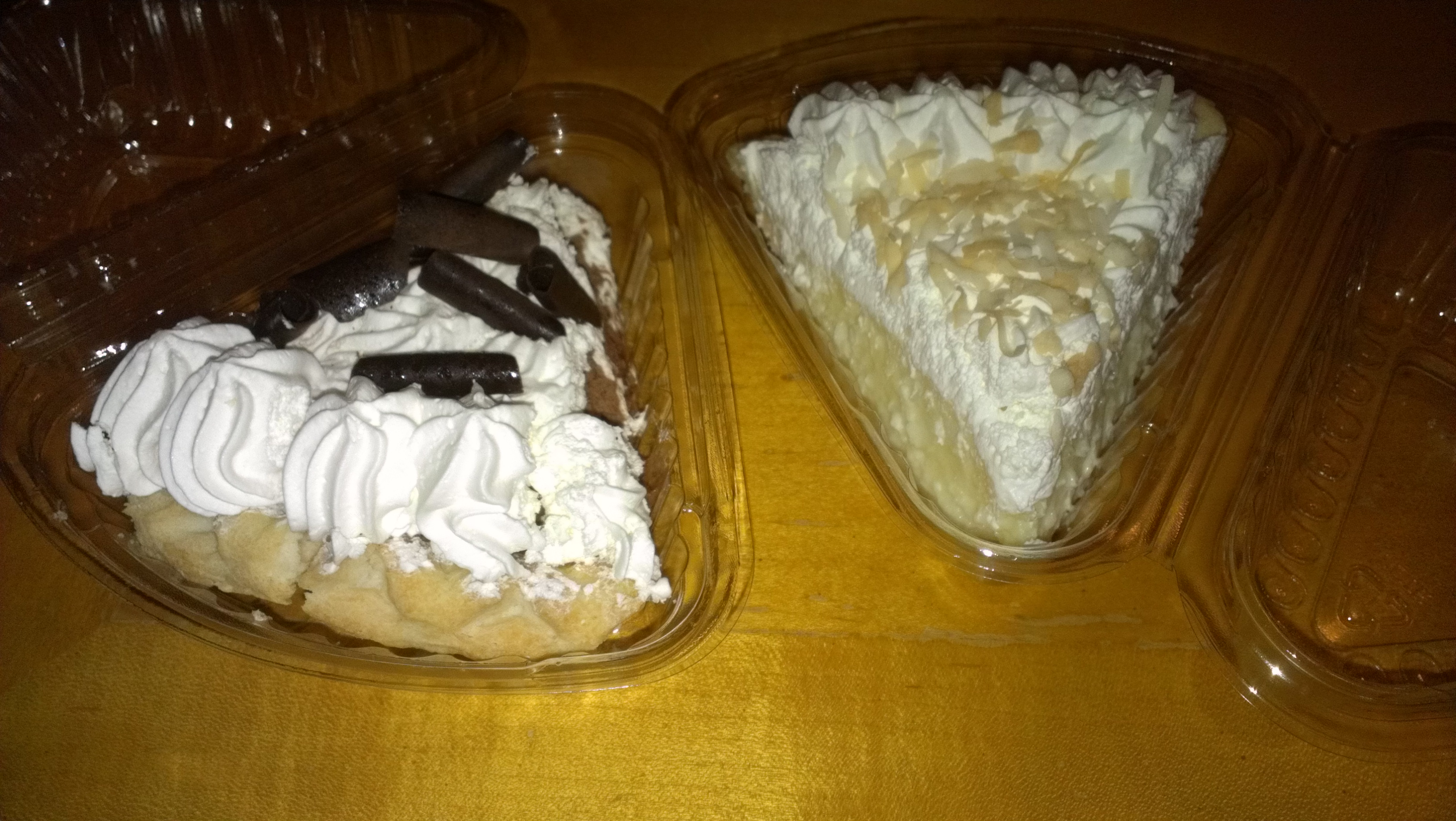
National Pie Day

Categories: Desserts | Tags: , , , , , | 4 Comments

22/365: National Blonde Brownie Day

Today we celebrate all things Deborah Harry! From “Heart of Glass” to “Rapture,” Blondie had a string of hits beginning in the 1970s and continuing through the…oh, wait…wrong Blondie. January 22nd is actually National Blonde Brownie Day. My bad.

Blonde Brownies are often called Blondies, though. They may look like brownies, but they are made with brown sugar instead of chocolate. If you think a brownie without chocolate is sacrilege, you can add chocolate chips to ensure you get your daily dose of cacao. They may also be made with nuts, coconut, toffee, and other candies for added texture. Blonde brownies have a taste reminiscent of butterscotch.

Oops...wrong Blondie.

Oops…wrong Blondie.

Incidentally, I once got into an argument with a woman over the correct spelling of the word blonde. I insisted it had an “e” on the end, she said it did not. I later learned that both spellings were technically correct, but blonde typically refers to females and blond describes males. Which means, I guess, that the blonde brownies we celebrate today are girls. Good to know. I won’t have to lift mine up now and look at the bottom to figure out the sex.

Brownies were invented in the late 19th century in Chicago. Socialite Bertha Palmer, during the 1893 World’s Fair, wanted a dessert for ladies to enjoy. A chef at the Palmer House Hotel (this is not a coincidence; the hotel was a wedding gift from her husband. Bertha was the Paris Hilton of her day) created a treat that was a cross between a cookie and a cake. Traditionally baked in a pan and sliced into squares, brownies are tasty and portable. I’m not sure what makes them a dessert fit for ladies, but this gentleman sure does dig ’em.

Incidentally, brownies weren’t the only food that debuted at the World’s Fair that year. Cracker Jack, cream of wheat, Juicy Fruit gum, and Pabst Blue Ribbon beer were all served for the first time in 1893. Nowadays, you go to the fair, and the only innovative foods you see are deep fried Twinkies. I’m not sure if that is considered progress or not (though really, was PBR?).

By the way, there is an excellent book about the 1893 Chicago World’s Fair called Devil In The White City by Erik Larson. It intersperses tales of the world’s fair (one of the most spectacular ever staged) with a serial killer who used the setting to lure his victims to their deaths…and it’s a true story. I highly recommend it.

The nice thing about blonde brownies is, they are just as tasty at breakfast. Especially with a tall glass of milk or a hot cup of coffee. It’s always nice when we can cross the challenge off our list early in the day.

Blonde Brownie

Categories: Desserts | Tags: , , , | 7 Comments

21/365: National New England Clam Chowder Day

Today is National New England Clam Chowder Day! When I started researching this holiday, I was confused because a bunch of websites were telling me February 25th is National Clam Chowder Day. Turns out that’s true: in a month we celebrate clam chowder, but today is devoted to NEW ENGLAND clam chowder. Or as I like to call it, “Region Whose Football Team Is NOT Going To The Super Bowl This Year HaHaHa” clam chowder.

Sorry, Tom Brady fans.

There are many different variations of chowder (or “chowdah” as they say in Boston), most of which have the same base ingredients: clams, potatoes, onions, salt pork or bacon, and celery. Originating in Northeastern fishing villages in the 18th century, New Englanders take their chowder very seriously. They look with derision upon New Yorkers who have the audacity to substitute tomatoes for milk in their version (Manhattan clam chowder). And I thought the whole Yankees-Red Sox rivalry was intense. A 1939 bill was introduced to the Maine legislature making tomatoes illegal in New England clam chowder. No idea whether this is still official law. Maybe we should ask somebody from Maine.

Crickets.

Does anybody actually live in Maine? Other than Stephen King, that is?

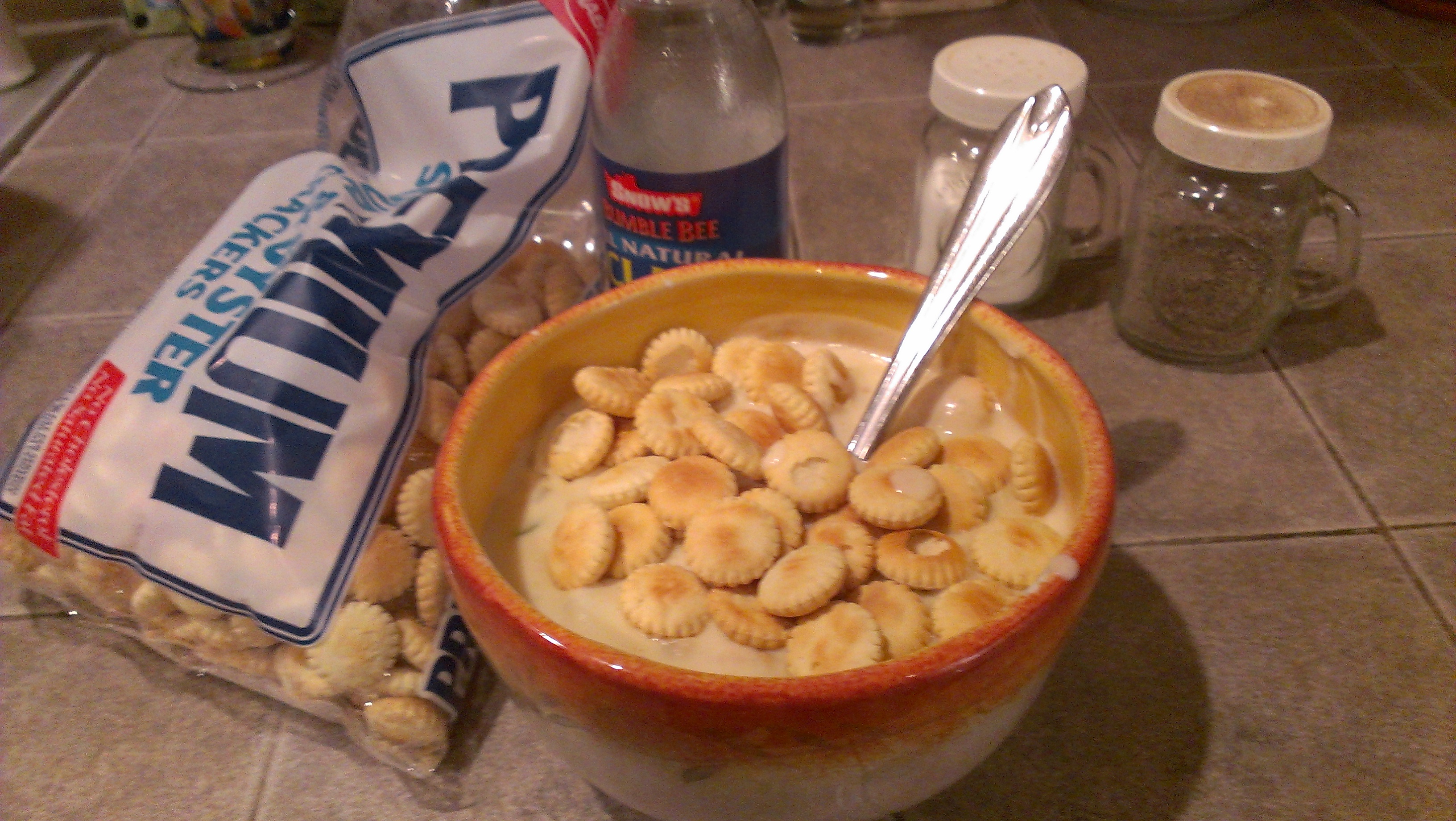
New England clam chowder is usually served with oyster crackers, a nod to the hardtack (sea biscuits) that were typically served on long ocean voyages. Hardtack was cheap and long-lasting, and usually consisted of nothing more than flour and water. Hardtack was sometimes called pilot bread, dog biscuits, tooth dullers, worm castles, and molar breakers. Can’t imagine why they were scorned by sailors!

Clam chowder is often served in restaurants on Fridays. This is to provide a seafood option for Catholics who abstain from meat on Friday. Though the church loosened their rules some years back, the tradition lives on. I love clam chowder, and have been known to time restaurant visits to coincide with when it was being served.

Tara had the day off today while some of us had to work. Not that I’m bitter much. This was great though, because she had never made clam chowder before and was eager to try.

I sure was.  And even though I was offered recipes from Mark and my mom, I also insisted on finding and trying my own recipe.  I’ve learned that sometimes the easiest way to find a good recipe is to click on a website like www.allrecipes.com, type in what you’re searching for, and go with the one with the highest and most reviews.  Today was no exception.

This particular recipe was easy, rich, and delicious.  At the suggestion of some of the reviews, I made a few modifications; I sautéed the onions, carrots and celery in bacon grease.  We bought an extra jar of clam juice to cook the veggies and potatoes instead of water.  There was some leftover heavy whipping cream (from the bittersweet chocolate ganache a couple weeks ago) that helped thicken the base.  And clams.  Lots and lots of clams.

It’s funny how our palettes change as we mature (I was going to say grow older, but Mark tends to take those remarks personally).  I never cared for clam chowder when I was younger, and since I don’t like potatoes, it was too much work to pick around all the spuds for just a few bits of clam.  Thankfully, we now have a recipe that’s really good and my potato to clam ratio is just right!


New England Clam Chowder


P.S.  This is a great song to listen to while making your clam chowder.  Enjoy!

Categories: Seafood, Soup | Tags: , , , , | 8 Comments

20/365: National Cheese Lover’s Day*

January 20th is a trifecta of food holidays: buttercrunch, granola bars, and cheese are all celebrated. With so many sweets being honored this week (and, well, always), we didn’t want to tackle buttercrunch. For the record, it’s a toffee-like candy similar to Almond Roca or peanut brittle. Shout out to buttercrunch! And unwrapping a granola bar seemed too easy. I eat granola bars at least once a week for breakfast. Cheers to the granola bar, but today is not your day to shine. Since Tara and I are both cheese lovers, we’re celebrating in the cheesiest way imaginable.

Fondue.

But more on that in a sec…

Cheese dates back to prerecorded history, and was discovered by accident. Ancient folk seldom got together for Tupperware parties, so they used animal skins and internal organs to store their food. It is believed that an Arab trader stored milk in an animal’s stomach. The rennet from the stomach turned the milk to curds and whey. No, the trader’s name was not Little Miss Muffet. Hieroglyphics in Egyptian tombs dating back to 2000 B.C. depict cheese making, and Homer describes the Cyclops as being a skilled cheese artisan in his epic Odyssey (“We soon reached his cave, but he was out shepherding, so we went inside and took stock of all that we could see. His cheese-racks were loaded with cheeses…”). When even a one-eyed mythological giant digs cheese, you know its popularity is going to explode, and sure enough cheese became a staple throughout Europe and the Middle East. Not so much in Asia, which is why you never see cheese on Chinese menus, but they’ve perfected moo goo gai pan so it’s all a wash anyway.

Cheese is often condemned as being unhealthy and leading to heart disease, but some of the countries best-known for cheesy diets – Greece and France – have low incidences of cardiovascular disease, so the jury is out on that one. It’s okay to love cheese! (Except for Velveeta and Cheez Wiz. Neither one of which is real cheese anyway).

There were dozens of ways we could have celebrated this holiday – mac ‘n cheese, grilled cheese sandwiches, cheese omelets, tacos – and hundreds of varieties to choose from (cheddar, muenster, jack, parmesan, string). Narrowing our options down was tough, but we decided to leave the cooking to Gustav’s, a German restaurant known for their cheese fondue. Theirs is made with swiss, and is amazing. Holes and all.

Cheese Fondue

Hot, bubbly, cheesy goodness.

Categories: Dairy | Tags: , , , , | 13 Comments

19/365: National Popcorn Day

I promise not to pop off any corny jokes today. Let’s just celebrate National Popcorn Day by indulging in the salty, buttery snack favorite!

Of course, you might prefer yours differently. That’s the beauty of popcorn: it’s highly customizable. Some might like it with lots of butter and salt (me) while others prefer it sweet, or cheesy, or with unusual ingredients like dashi or seaweed flakes. Popcorn toppings are limited only to the boundaries of your imagination.

Popcorn was discovered thousands of years ago in Guatemala. One can only imagine the look of surprise on the face of the guy whose ears of corn suddenly started exploding! How does this happen, exactly? I’ll put on my Bill Nye bow tie and give you a science lesson, boys and girls. Corn is a grain with a hard shell that does not allow moisture inside, and a dense, starchy interior with a bit of natural oil trapped inside. When heat is applied, the moisture inside each kernel turns into pressurized steam as the starch inside the kernel softens. When the pressure reaches 135 psi and the temperature hits 356°F the hull ruptures, causing a sudden drop in pressure inside the kerne. This forces the steam to expand  and turns the starch and proteins into an airy, crispy foam that “pops” open. Voila! Your Jiffy Pop is ready, sir.

Popcorn made its way to Mexico and then north. Fossilized kernels have been found in New Mexico dating back thousands of years. English settlers who “discovered” America in the 16th and 17th centuries learned about popcorn from Native Americans. As thanks for turning them onto the tasty snack, they stole their land and wiped out entire tribes through battles and diseases, but that’s political commentary for another time. Popcorn really caught on during the Great Depression, when it sold for 5-10 cents a bag, far cheaper than most other snacks at the time. The movies were a favorite entertainment pastime, and cinema operators wanting to make a quick buck bought portable popcorn machines, set them up in their theaters, and began selling the snack to patrons to enjoy during the film. Popcorn, along with sticky floors and people who forget to turn their damn cell phones off, has been a movie theater staple ever since. During World War II, sugar rationing meant less candy, but more popcorn, and sales tripled. It’s been a favorite snack ever since! The average American consumes 51 quarts of popcorn every year.

IMAG0417Once upon a time, popcorn at home was usually made over the stovetop. This is not as easy as it seems, although with practice you can master it. With the invention of the microwave came microwave popcorn, probably the single reason most people use the bulky appliance in the first place. We have an air popper at home, and that is both convenient and easy to use, and the popcorn turns out uniformly perfect every time. Plus, you don’t have to worry about diacetyl, the toxic chemical that destroyed the lungs of workers in microwave popcorn factories a few years ago. Unless, like MSG, you find diacetyl irresistible.

To celebrate, we went to the movies. Naturally, right? Tara and I took the kids to see The Hobbit in 3D, which we enjoyed along with buckets of popcorn. This particular theater has a “butter bar” where you can choose from various flavored butters, like garlic and jalapeno, and an assortment of toppings. Garlic butter popcorn hit the spot, and everybody enjoyed the film. In fact, now Tara wants to see the Lord of the Rings trilogy. Be still my heart. I think I might have those movies lying around somewhere…

And I’m sure we’ll have popcorn while watching them, no matter which food day it is.

Categories: Snacks | Tags: , , , , | 4 Comments

18/365: National Peking Duck Day

I’ve always been a fan of duck. Rich and succulent, it’s one of those dishes that I’ll frequently order if it’s on the menu. Unfortunately, there’s no McDuck yet, so I’m stuck with fake rib sandwiches most of the time.

I quack myself up.

Fortunately, today is National Peking Duck Day, giving me an excuse to seek out and enjoy duck. Tara and I were worried about this day early on. Peking Duck is a complicated dish to make, and we weren’t sure where to find it. It’s certainly not on the menu of the local Panda Express. But luckily, Portland is a melting pot of cultures, and a Yelp search gave us the name of a Chinese restaurant that serves it. So, game on!

Peking Duck is the national dish of China, and originated in Peking (now Beijing) during the Imperial Era. It was considered an upper class dish, and was a hit with royalty during the Ming Dynasty. In fact, the dish was partially responsible for mending the rift between China and the U.S. in the 1970s. When Secretary of State Henry Kissinger traveled to China to meet with Premier Zhou Enlai, diplomatic talks were at a standstill until lunch was served. Kissinger was so fond of the Peking Duck, he said, “My boss must try this!” So Richard Nixon was invited to China in 1972, and he too raved over the duck. In fact, the second half of his famous speech was inadvertently drowned out by a passing helicopter and lost to history. “I am not a crook,” Nixon famously declared. “But I would lie, cheat, steal, and eavesdrop all over again for another bite of that delicious Peking duck.”

If only we’d paid closer attention…

"Well, coat me in syrup and hang me on a hook!"

“Well, coat me in syrup and hang me on a hook!”

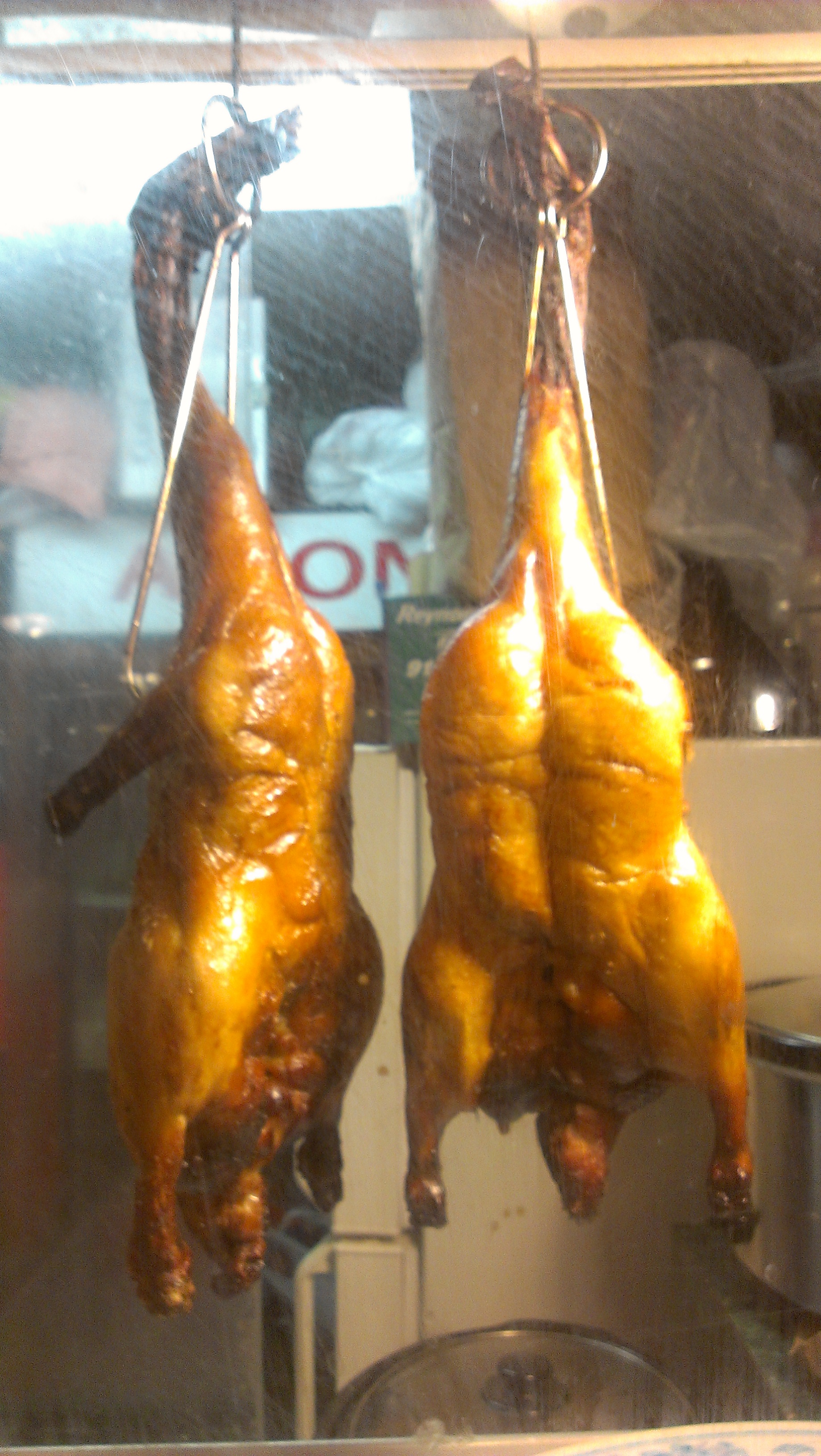
Peking Duck is made from a breed of duck called the Pekin. It’s a white bird with an orange bill and feet, and was the inspiration for Donald Duck. True story. Unlike the cartoon bird, real Pekin ducks do not wear blue sailor suits (but if they did, they would at least have the decency to put on a pair of pants). WARNING: DO NOT READ THIS NEXT PART IF YOU ARE SQUEAMISH OR ON THE FENCE ABOUT BECOMING A VEGETARIAN. Pekin ducks are raised in captivity for exactly 65 days, where they are force-fed 4 meals a day to fatten them up before being slaughtered, plucked, and eviscerated. Air is then pumped beneath the skin to separate it from the fat. The duck is then slathered in syrup and hung on a hook to dry for 24 hours before being roasted. Yummy, huh? Somewhere there is a Sarah McLachlan song waiting to be written.

And for the record, bacon doesn’t just magically appear on your plate, either! Though it would be wonderful if it did…

Authentic Peking Duck in Portland, OR.

Authentic Peking Duck in Portland, OR.

Anyway.

Not in the mood to gut our own bird and hang it from a meat hook (even though there’s a wetlands behind the condo complex and we surely could have pulled this off), we instead drove to a Chinese restaurant in Portland, where we had phoned in an order of Peking Duck to go.

Peking Duck is renowned for its crispy skin and flavorful meat. Sure enough, this place (shout out to Shenzhen) did not disappoint. I thought it was wonderful. Tara, who is not a fan of duck, was unimpressed. Kind of a recurring theme so far, isn’t it? But the tables will be turned on National Watermelon Day. Can’t stand that stuff, and she loves it.

The rest of the meal was good, too. I even made homemade fried rice.

But the duck was, without a doubt, the star of the show.

Categories: Poultry | Tags: , , , , , , , , , | 6 Comments

17/365: National Hot Buttered Rum Day

Jack Sparrow would approve of today’s holiday: January 17th is National Hot Buttered Rum Day. Of all the various liquors, I think rum has the best flavor, so even though we recently celebrated a hot alcoholic beverage and didn’t care for it, I had high hopes for this drink.

In fact, hot buttered rum is closely related to the hot toddy. Both drinks are popular in the winter months (duh). But where the hot toddy is traditionally made with whiskey and honey, hot buttered rum is made with rum and butter (duh again). Plus brown sugar and spices like cinnamon, cloves, and nutmeg. The drink was a big hit in Colonial America, and was created in the 1650s after colonists began importing molasses from Jamaica. They quickly learned this byproduct of sugarcane could be turned into rum, and a series of distilleries opened up across New England. (Similar attempts to turn maple syrup into bourbon, honey into wine, and the tears of Pocahontas into absinthe failed miserably). Soon they were adding rum to everything, including toddies and eggnogs.

Over the holidays, Tara and I saw containers of hot buttered rum mix for sale in area grocery stores. “Perfect,” we said. “We’ll pick some up later.” Only once later rolled around, the product had disappeared from grocer’s shelves. Oops. Had we not learned our own lesson about planning ahead? Fortunately, the internet yielded recipes for making your own hot buttered rum batter. It’s amazingly easy – here’s the one I used:

Recipe for Hot Buttered Rum Batter
Ingredients:

  • 1 cup dark brown sugar
  • 4 oz unsalted butter, room temp
  • 1 1/2 tsp ground cinnamon
  • 1 1/2 tsp nutmeg or mace
  • 1/4 tsp ground cloves
  • 1/8 tsp salt

In a mixing bowl, combine all ingredients thoroughly. Refrigerate in a sealed air-tight container for up to two months. This mixture can also be frozen for up to one year before using. Makes eight servings.

Preparing a Hot Buttered Rum Cocktail
Ingredients:

  • 2 Tbsp refrigerated hot buttered rum batter
  • 6 oz boiling water
  • 1 1/2 oz dark rum
  • 1 Tbsp light cream (optional)
  • nutmeg for garnish

In a hot beverage mug, combine hot buttered rum batter with boiling water, stirring well until dissolved. Add in rum and cream, if using. Garnish with a sprinkle of nutmeg. Serves one.

Remember how we didn’t like those hot toddies? Well, the hot buttered rum was…drumroll, please…DELICIOUS! Really, really good stuff. We were both impressed. I think we’ll have to make these an annual holiday tradition!

Hot buttered awesomeness is more like it!

Hot buttered awesomeness is more like it!

Categories: Alcohol, Beverages | Tags: , , , , , , , | 4 Comments

16/365: National Fig Newton Day*

We had a choice of two holidays to celebrate today. International Hot & Spicy Food Day seemed a bit generic, though I did eat a handful of Spicy Cajun Peanuts this morning (and boy, could I feel the burn). But we settled officially on National Fig Newton Day. It’s been years since I’ve eaten a Fig Newton, and I was curious about the history behind this sorta-healthy-at-least-compared-to-other-cookies cookie.

In the 1800s, doctors believed that most illnesses were the result of digestive problems. Since Tums had yet to be invented, their recommendation was a diet rich in biscuits and fruit.Taking inspiration from this idea, a cookie maker in Ohio named Charles Roser invented a fig-stuffed cookie, killing two birds with one stone. Proverbially speaking, of course. It’s unclear why he chose figs, a fruit native to the Middle East that dates back to ancient times. Yes, the berries are edible and tasty, and the leaves make great genitalia covers. But you’d think he might have gone with something more common, like apples or strawberries. Nevertheless, Roser’s cookie was a hit, and he sold the recipe to the Kennedy Biscuit Company in Cambridge, Massachusetts. They named all their products after surrounding towns – there was a Harvard, a Shrewsbury, and a Beacon Hill – and the fig cookie became the Newton. Inventor James Henry Mitchell developed a machine that could produce an endless length of filled cookies, and in 1891 the Newton was mass-produced. In 1898 Kennedy Biscuits merged with a bunch of other bakeries to form the NAtional BIScuit COmpany, later shortened to – that’s right, boys and girls – NABISCO. Incidentally, the original F.A. Kennedy Steam Bakery was listed on the National Register of Historic Places and turned into high-priced lofts. Call your realtor if you’re in the Boston area and looking for a new home with a historic background. But you’d better be rich. A 592-square foot studio apartment at the Kennedy Biscuit Lofts (real name) rents for $2684-$4105. Per month. Do you know how many Fig Newtons you could buy with that money?!

Newtons were renamed Fig Newtons, and then Nabisco began putting different fillings inside the biscuit. Flavors like strawberry, raspberry, and snozzberry. Wait, no – that was the Oompa-Loompas. Little-known fact: Fig Newtons are Mickey Mouse’s favorite cookie. Better-known fact: Mickey Mouse is a cartoon rodent, so why does that even matter? Early TV commercials featured a cowboy singing, “Yer darn tootin’, I like Fig Newtons.” The most recent advertising slogan is, “The fruit that thinks it’s a cookie.”

Yawn. Bring back the singing cowboy.

For this challenge, I had my eye set on Apricot & Mango Newtons, but as delicious as these sound, they are missing the essential ingredient of figs. So, the original flavor it was!

And you know what? They were tasty. Damn tasty. New fruit flavors aside, I’m glad we stuck with the original fig version!

National Fig Newton Day

Categories: Desserts | Tags: , , , , | 4 Comments

15/365: National Strawberry Ice Cream Day

Here’s the latest scoop: today is National Strawberry Ice Cream Day!

Ha. Get it? Scoop? I kill myself.

Ice cream has been around for a very long time. As far back as 3000 B.C., the Chinese served a mixture of snow or ice and juice to their guests. People in the Persian Empire were so enamored with the frozen treat (theirs contained grape juice concentrate poured over a bowl of snow), in the summertime they would trek to the highest snow-covered peaks to bring back baskets of snow. The phrase “don’t eat the yellow snow” became popular after one poor sap mistakenly tried what he believed to be a lemon sorbet, even though sorbets had yet to be invented.

Nowadays, ice cream is a worldwide favorite, and is made with milk and cream instead of snow. Which is a relief, given the whole global warming thing. I’d hate to see ice cream go the way of the dodo bird. Vanilla and chocolate are the most popular flavors, and strawberry is a distant third, with 5.3% of the vote.

There is a very interesting link between strawberry ice cream and aliens. In 1988, a prime-time special on alien conspiracies aired; during this broadcast, two high-level informants said the government had retrieved a crashed UFO, and that the alien on board was fond of strawberry ice cream.

The natural inclination is to assume these guys are crackpots. BUT. I know a guy who used to work at Area 51. True story. He wouldn’t tell me much about it, but did say that the base cafeteria had a wide variety of ice cream flavors available. Makes sense, considering Area 51 is located in the Nevada desert. Anyway, he insisted they always ran out of strawberry ice cream. {Cue dramatic music}. Whether this was because a captive alien had a jones for the stuff is anybody’s guess – when I pressed him on whether they actually harbor aliens there, he got rather cagey and started throwing out words like “top” and “secret” – but it makes for an interesting story nonetheless.

Hey, one bite counts!

Hey, one bite counts!

ET may like strawberry ice cream, but neither Tara nor I are particularly fond of it. We weren’t looking forward to eating a bowl of the stuff, but then we remembered our official rules stipulate we must merely try a single bite of the celebrated food du jour. Why not just walk into Baskin-Robbins and ask for a taste of their strawberry ice cream? We did, and they were more than happy to scoop some up on a tiny plastic pink spoon and pass it over the counter.

The proprietor looked at us oddly when I started taking pics, and I was ready to mumble my “we’re doing a project” excuse, but he never asked. Just in case, we bought a couple of pints of non-strawberry ice cream in order to appease him.

We’re nothing if not polite.

Categories: Desserts | Tags: , , , , | 7 Comments

14/365: National Hot Pastrami Sandwich Day

It’s National Hot Pastrami Sandwich Day, which is nice because it’s cold out. And it’s snowing. A tasty, hot sandwich at lunchtime is just the ticket! And besides, who doesn’t love pastrami?

Well, other than Tara, who is proving to be a much pickier eater than I’d ever imagined. But she’s being a good sport about it, and dutifully trying at least one bite of everything we have. That’s all I can ask for!

Originating just a stone’s throw from Dracula’s castle and named after the Romanian word a păstra – which means “preserve” – pastrami was created as a method of preserving meat. There were no refrigerators back then, and Transylvanian folk didn’t want all that wonderful pork and mutton to go to waste, so they cured the meat by brining it, drying it, seasoning it with herbs and spices, smoking it, and then steaming it. Pastrami was introduced to the U.S. in the late 19th century following a wave of Romanian Jewish immigration to New York. The original English spelling, pastrama, was changed to pastrami in order to rhyme with salami, making it easier for American consumers to remember (and paving the way for the chart-topping 1892 rap hit, “(You Gotta) Fight For A Bite (Of Pastrami),” which famously paired verses about salami and pastrami with Tommy’s mommy, a Swami who survived a tsunami and married a commie).  Because beef was cheap, they started using that instead.

A butcher named Sussman Volk claimed to have created the first pastrami sandwich in 1887 after inheriting the recipe from a Romanian friend whose luggage he was storing while the man was out of the country. Volk’s pastrami sandwich was so popular he turned his butcher shop into a restaurant. Not so fast, say the folks at Katz’s Delicatessen, which opened in 1888 and is renowned for their pastrami sandwiches (and also Meg Ryan’s famous fake-orgasm “I’ll have what she’s having” scene in When Harry Met Sally). They take credit for the sandwich. No word on whether they duked it out or decided to split the royalties, but pastrami remains a popular sandwich to this day.

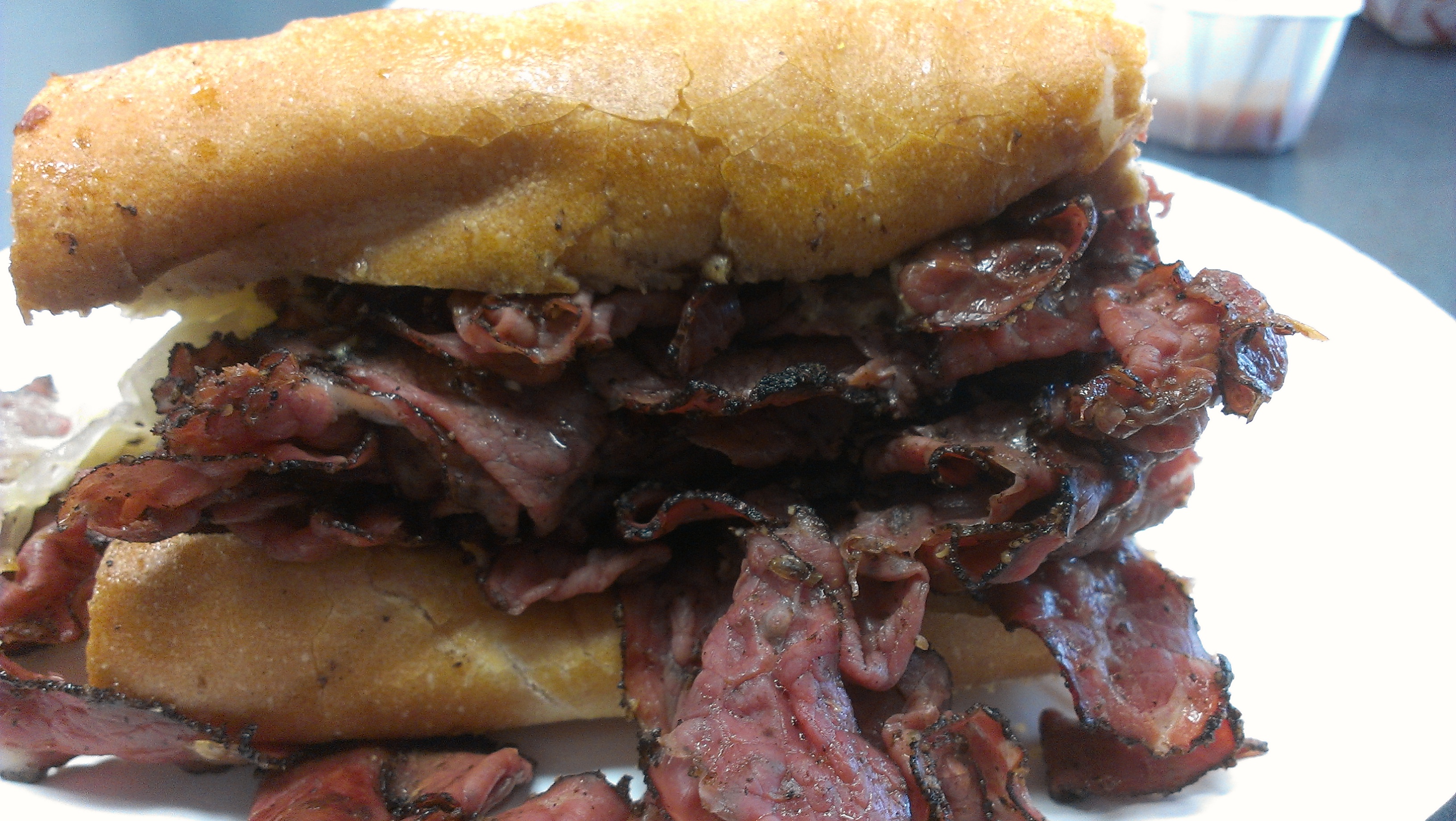
Although, to be honest, it proved a little tricky to find. Neither Subway nor Quizno’s has pastrami on their menu. Luckily, a local cheesesteak joint called Philly Bilmo’s does. Go figure. I ordered the Hot Pastrami and Swiss, with pickles and sauerkraut. What can I say? It was delicious! Hot and salty and flavorful. The pastrami brine is typically made with garlic, coriander, paprika, black pepper, cloves, allspice, and mustard seed, and I swear I could taste each of those ingredients in every bite. Tara took a taste, wrinkled her nose, and went back to her hot dog. That’s okay – I loved the sandwich enough for the both of us.

Hot Pastrami Sandwich


Categories: Beef | Tags: , , , , , , | 10 Comments

Blog at WordPress.com.