Today we celebrate a mixture of fruit that comes in a can. May 13 is National Fruit Cocktail Day!
Fruit cocktail was invented as a way to use up scraps of fruit that were too bruised or damaged to be used in other cans of fruit. So basically, you’re getting the rejects when you pop open a can of fruit cocktail. The exact origin is unknown; fruit salads had been popular since 1893, and contained cherries and other dried fruits. A cookbook from 1902 explains where the name was derived: In these latter days, many American cooks make a mixture of fruit, sugar and alcohol and serve them as ‘salad.’ These are not salads … they are heavy, rather unwholesome, and will never take the place of a salad. I prefer to call them fruit cocktails and serve them as a first course at a luncheon or a twelve o’clock breakfast. The author, Mrs. Rorer, is now regarded as America’s first Food Snob. In 1930 San Jose canner Herbert Gray of Barron-Gray Packing Company began selling fruit cocktail, which grew in popularity over the years. To be labeled an official fruit cocktail by the USDA, it must contain pears, grapes, cherries, peaches, and pineapples. Most are packed in either heavy syrup or a lighter, less sugary mixture.
Tara and I bought a can of fruit cocktail to enjoy as a healthy (?) dessert after dinner. Sure enough, it contained the five requisite ingredients to properly be labeled a fruit cocktail!
May 12 is devoted to a sweet and rich confection that was probably invented accidentally. It’s National Nutty Fudge Day!
The exact origin of fudge – a drier version of fondant, made by boiling sugar in milk until it reaches the soft ball stage and then beating it while it cools until it’s smooth and creamy – is unknown. Most historians believe that fudge, an American invention, was created by accident when a batch of caramels recrystallized, leading to the exclamation “Oh, fudge!” The earliest mention of the treat dates to 1886, when Vasser College student Emelyn Battersby Hartridge wrote a letter discussing how her schoolmate’s cousin made a batch of fudge in Baltimore and sold it for 40 cents a pound. Fudge became popular at women’s colleges because it tasted delicious and was easy to make: students could cook a batch using nothing but a gas light or chafing dish. Wellesley and Smith soon had their own versions of fudge floating around campus in the late 19th and early 20th centuries. This is going to make me sound terrible, but could there be a correlation between the popularity of fudge at women’s colleges, and…well…PMS? I’m just wondering. Some women do seem to crave chocolate during certain times of the month.
Women aren’t the only ones who appreciate fudge, though. And there are no fewer than 3 fudge-related food holidays this year. I wasn’t actually sure where to find it, because fudge is one of those things you see all the time at bake sales, but rarely appears on grocery store shelves. My mom mentioned that a local produce store carries locally-made fudge, so we swung by there last weekend to pick up some fruits and veggies and, sure enough, were rewarded with fudge, too. So we grabbed a hunk of chocolate nut fudge to enjoy. It was creamy, nutty, and tasted great!
This is the holiday we’ve been waiting for. After 128 consecutive today-we-have-to-eat-this-because-it’s-on-the-calendar food holidays, we get a break and can have whatever we want. Talk about a novel concept. May 11 is National Eat What You Want Day!
This holiday was actually created as an intent to give dieters a break, and allow them to set aside one day in which they can indulge in any craving they’ve got and eat whatever they wanted, guilt-free. But it’s not limited to dieters – anybody can use today as an excuse to enjoy whatever their culinary hearts desire. Some people may gorge themselves on junk food, others might choose to splurge on a fancy meal in a restaurant, and others might decide to create from scratch a favorite childhood meal. However you celebrate today’s food holiday, the sky’s the limit. There are no rules: it’s all up to you!
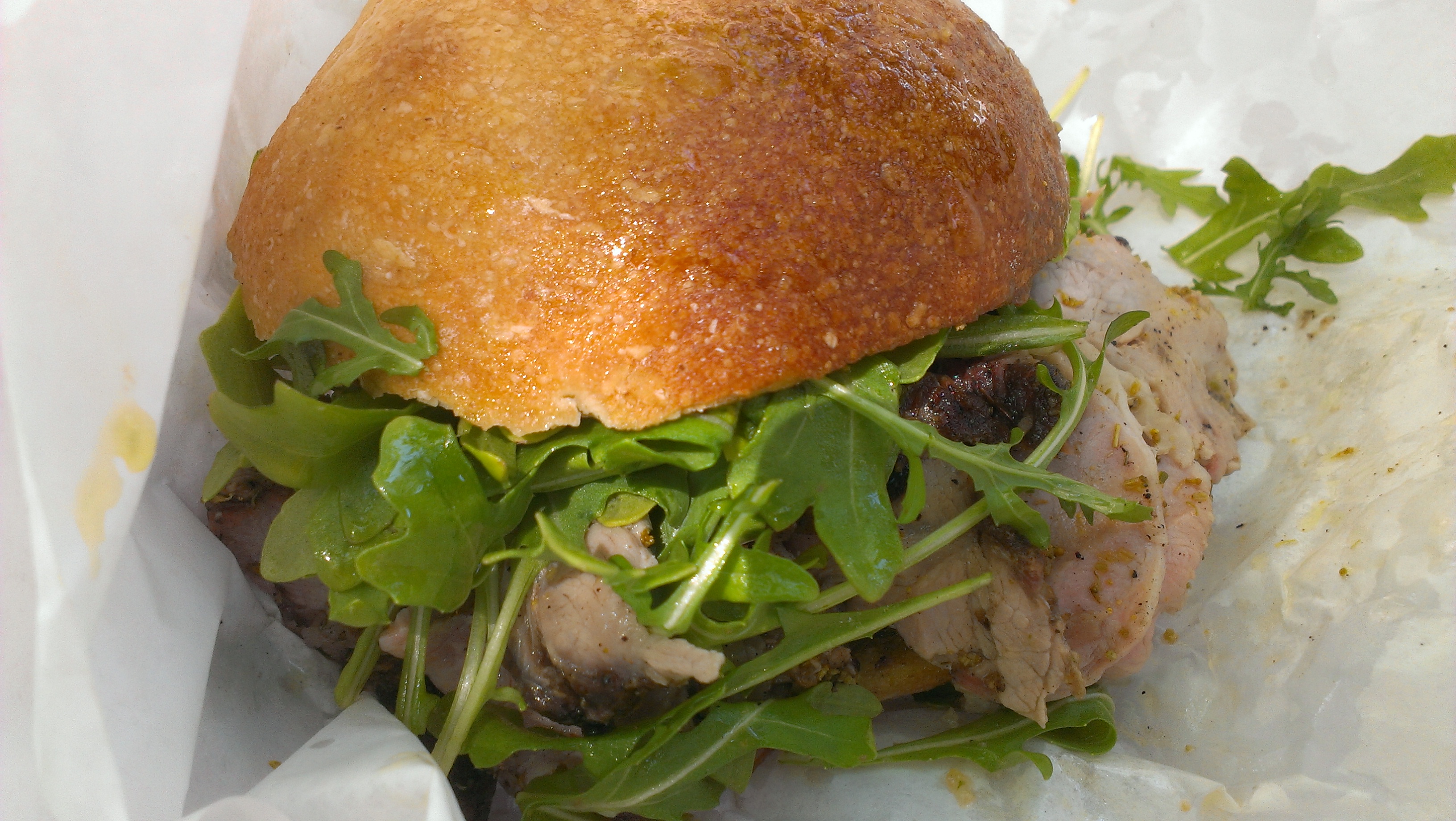
Portland is known for their popular food cart scene. Mobile cuisine is all the rage, with food trucks offering everything from waffles and dumplings to Cuban pork mojo, Vietnamese bhan mi, and Hungarian paprikas. Tara and I were downtown for a trip to the farmer’s market, and decided to swing by our favorite food cart pod at 10th & Alder for lunch…where we proceeded to Eat What We Wanted. That meant fish ‘n chips for her and a porchetta sandwich with lemon arugula for me. We were both pretty pleased with our choices.
There’s nothing tiny or insignificant about today’s food holiday. May 10 is National Shrimp Day!
Shrimp is the #1 seafood in America, ranking ahead of canned tuna and salmon in popularity. And yet, we should be eating even more, according to the USDA, which recommends 8 ounces of seafood every week. Shrimp have long been a popular and tasty food choice; evidence of shrimping off North America dates back to 600 AD. Native Americans caught shrimp in traps made from branches and Spanish moss, while at the same time early European settlers – who had no idea shrimp were so abundant off the coasts – were starving to death because they couldn’t find enough protein. During the California gold rush, Chinese immigrants began catching shrimp in San Francisco Bay, drying them in the sun, and either exporting them to China or selling them locally, officially kicking off the shrimp industry in the U.S. Shrimp trawling, a technique in which a boat drags a big net across the bottom of the ocean floor in order to scoop up shrimp, resulted in large harvests and revolutionized the industry. Shrimping grounds expanded, and the delicate seafood could now be enjoyed year-round. Shrimp got another marketing boon when Bubba from Forrest Gump waxed philosophically over his love for the crustacean. Suddenly, there were real-life Bubba Gump Shrimp Co. restaurants everywhere. Talk about life imitating art.
I love shrimp, and enjoy it in a variety of presentations. For today’s challenge, Tara and I decided to pick up some fresh-caught shrimp from the seafood counter at Fred Meyer. We marinated it in a Mojito Lime sauce, stuck it on skewers, and grilled it for dinner. Mmm!
Today’s food holiday doesn’t really honor a brownie so much as a blondie, despite the name. May 9 is National Butterscotch Brownie Day!
I’d never heard of a butterscotch brownie before. I figured it was a chocolate brownie made with butterscotch chips, but that’s not the case at all. A butterscotch brownie is really just another name for a blondie, or a blonde brownie, which we already celebrated once this year. The butterscotch doesn’t even refer to actual butterscotch chips, but rather, the ingredients that go into making butterscotch: brown sugar and butter. Which are part of what makes up butterscotch brownies. Are you confused yet? I am!
Chocolate brownies may be more popular, but butterscotch brownies have been around about a hundred years longer. They date back to the 19th century, and are based on gingerbread cakes that were popular during the Renaissance period. Those cakes evolved into flatter ones baked in shallow pans that often included nuts and brown sugar. As delicious as they are, they just don’t have the same appeal as their darker cousin, the brownie. I get it. Chocolate is sexy. Butterscotch brownies literally pale in comparison, and are never topped with frosting. But, as I’ve said, they’re still quite good.
Tara made us a batch of butterscotch brownies from scratch. They were fantastic! Very butterscotchy
Today is The Real Thing: May 8th is National Have a Coke Day!
It’s also coconut cream pie day, but with no fewer than a dozen and a half pies being celebrated over the course of the year, we are more than happy to skip that one in favor of the most popular carbonated beverage in the world.
Rarely is a brand name product the recipient of a food holiday. In fact, this might be the only such food holiday of the year devoted to a specific product. I can’t think of any others off the top of my head.
My, what nice handwriting you have, Mr. Robinson.
Coca-Cola was invented in 1886 by Atlanta pharmacist John Pemberton, who wanted to create a distinctive tasting soft drink that could be sold at soda fountains. And also cure his morphine addiction. Two birds, one stone, you know? He mixed up a batch of flavored syrup and carried it in a jug down the street to Jacob’s Pharmacy, where it was mixed with carbonated water, sampled, and deemed “excellent.” It was sold for 5 cents a glass and originally marketed as an elixir believed to cure dyspepsia, headaches, impotence, and other ailments (like the aforementioned morphine addiction). Pemberton’s bookkeeper, Frank M. Robinson, came up with the name and the distinctive logo, which he wrote out in his own unique script – the familiar trademarked logo we’re all familiar with. The original recipe contained coca leaves (from the plant where cocaine is derived) and kola nut extracts for flavor and caffeine. Pemberton died just two years later, but not before selling shares of his business to various Atlanta-area entrepreneurs. The biggest portion went to Asa Candler, who took a 1/3 interest in the company after buying the recipe for $2300; Candler went on to form the Coca-Cola Corporation, and expanded to soda fountains outside of Atlanta with exclusive distribution and bottling deals as the drink’s popularity soared. Candler altered the recipe – at one time Coke contained an estimated 9 milligrams of cocaine per glass, but by 1904 there were only trace amounts left as the company substituted leaves left over from the cocaine extraction process for the fresh leaves it had used previously. To this day, a non-narcotic coca leaf extract is still used in the manufacturing of Coke. Which brings new meaning to the popular slogan, “Have a Coke and a smile.” When competition from other, inferior products (no, I’m not a Pepsi fan, can you tell?) threatened to chip away at Coke’s products, the company countered by creating a unique, contoured bottle in 1916, a design that was eventually trademarked. Popular advertising slogans over the years have included “Coke is It,” “It’s the Real Thing,” “The Pause That Refreshes,” and “I’d Like To Teach the World to Sing.” There’s a lot more fascinating history on this product – if you’re interested in learning more, read here.
The truth is, I’m not a huge soda (or pop, if you’d prefer) fan. But when I am in the mood for a cola beverage, it’s always Coke. There’s simply nothing better, despite Tara’s claims that Pepsi is superior (cough*bullshit*cough). And when I do drink Coke, I prefer it in that distinctive glass bottle. Every year around Christmas Target carries six-packs of those little bottles of Coca-Cola, and I stock up. I think I bought 4 or 5 last year, and I drink them sparingly.
Tara and I met up for lunch today, and we ordered Coke to go along with our Burgerville grub.
There’s no need to feel sheepish about today’s food holiday. May 7 is National Roast Leg of Lamb Day!
A few weeks into the challenge, Tara said we should have been keeping track of how much this little project is costing us. A couple of bucks here, a few dollars there – it all adds up, you know? But it rarely adds up as much as today’s dinner did. For one thing, leg of lamb isn’t the easiest thing in the world to find. For another, it’s expensive. I stopped by my favorite local butcher shop a couple of weeks ago (shout out to Gartner’s!) and was relieved to learn they carried frozen leg of lamb. I was less relieved when the smallest portion they had – a 5 lb. boneless roast – set me back a whopping $44. Ouch. And to think I balked over the $9 Dungeness crab cocktails in Seattle. Even the Peking duck was considerably cheaper. This will probably end up being our most expensive food challenge of the year.
It had better be our most expensive food challenge of the year.
Lamb is to sheep what veal is to cow: a baby. To be classified as lamb, the meat must come from a sheep that is less than a year old, and weighing between 12 and 65 pounds. Too bah-d for the little guy, but it is a pretty tasty meat. I wasn’t even sure I liked lamb until we met up with friends for dinner out one night a couple of months back, and ordered a plate of lamb to share. We all thought it was delicious. Lamb has been considered a good source of both food and clothing for at least 10,000 years, and is particularly popular in Asia, Europe, Australia, and New Zealand. Farmers in the Middle Ages prized sheep for their versatility: they used the meat for food, wool for clothing, skin for parchment, and milk for butter and cheese. Spanish soldiers brought sheep to North America in 1519, but when it was introduced to the western territories in the 1800s cattle ranchers were put out by the new competition. This may be the reason why lamb has never really caught on in the U.S. as it has in other countries; our average per capita consumption is only one pound per year. Which, incidentally, is about a pound more than I have consumed in my first 44 years combined. Nevertheless, I was looking forward to celebrating this holiday because it represents something new and unusual. I was prepared to be a “sacrificial lamb,” if you will.
Fortunately, I was able to enlist the aid of my mom. Since Tara and I both had to work all day, and we had a big 5-lb. lamb (imported from Australia, it turns out, where roast leg of lamb is the national dish), I asked if she would be interested in roasting the lamb for us, and she agreed. So, a big thanks to my mom for helping out! She also made the baked Alaska earlier this year. I’m happy to report, the lamb turned out delicious. We used this recipe, which included dijon mustard, honey, and fresh rosemary. Even the people at the table who didn’t think they liked lamb, liked this lamb. Well done, mom! Thanks again!
Take a big gulp of whatever you’d like today (unless you’re in New York City, of course – sizes limited to 16 ounces). It’s National Beverage Day!
As alluded to previously, it’s also National Crepes Suzette Day. As fond as I am of French pastries and lighting things on fire, we could use a break, so we’re taking the easy way out and celebrating the almighty beverage instead. We’ve had a few drink holidays before – we kicked off this challenge with one on the first day of the year, as a matter of fact – but those have all been in celebration of specific beverages (usually alcohol). Today is wide open to interpretation. And one of those rare food holidays we celebrate continuously throughout the day, with every meal!
Beverages have been around for as long as there were humans. Before there were humans, actually – assuming you believe we all crawled out of the primordial ooze. Companies like Evian make a living filtering and purifying that primordial ooze and selling it in plastic bottles for a couple of bucks a pop. How important are beverages? Experts recommend men drink 3 liters of liquid per day – that’s 13 cups! Women should consume 2.2 liters. Water is more important than food: we can survive 3 days without water, and 3 weeks without food. But beverage day would be boring if we were just drinking water.
We begin a typical day by turning on the Keurig. Tara and I enjoy our morning coffee, and have happily embraced the K-cup revolution. The Keurig is awesome: it’s fast, convenient, and eliminates wasted coffee. It even brews iced tea and lemonade. While we’re at work, we’re usually drinking ice water or booze. OK, that’s not an every day occurrence, but the company I work for has been known to break out alcohol during the workday on occasion. For dinner, it’s usually iced tea or lemonade (see aforementioned Keurig comment). Or milk, or water. I’m not real big on soda, but I enjoy an occasional Sprite or Coke or root beer. Tara likes Pepsi. I know, I know: there’s no accounting for taste. We both enjoy the occasional glass of wine, primarily white; I like sauvignon blanc while she is into riesling. I strongly dislike beer, but Tara digs Bud Light. My go-to alcoholic beverage is gin ‘n tonic, while hers is vodka and 7-Up. And of course, we’re both quite fond of bloody marys.
Today, we celebrated with a little bit of a lot of those beverages. Coffee, water, gin and tonic, iced tea and vodka…you name it, we drank it.
Happy Cinco De Mayo! Break out your sombrero and get ready to whack a few pinatas, because it’s National Hoagie Day!
Wait…what?
OK, so May 5th seems like it would be a day more fitting to celebrate tacos or burritos, not hoagies. But it is what it is. We’ll save our fiesta for next year, I guess. Hoagies are one of many names assigned to a sandwich made with a long Italian or French roll that is split widthwise and filled with meat, cheese, vegetables, and sauces. It is also variously referred to as a submarine, sub, grinder, po’ boy, hero, torpedo, or Italian sandwich. The sandwich originated in Italian-American communities in the Northeast late in the 19th century, created to serve Italian laborers who wanted the same convenient sandwich they had enjoyed back in their native country. New York Herald Tribune wrier Clementine Paddleford (seriously) coined the term “hero” by writing, “you needed to be a hero to finish the gigantic Italian sandwich.” As far as the word “hoagie” goes, there are several different theories about its origin. This particular sandwich comes from the land of Rocky and Tasty Kakes, Philadelphia, and may have referred to a World War I-era shipyard in that city called Hog Island, where Italian workers introduced the “Hog Island” sandwich, later shortened to “hoggies” and then “hoagies.” Or it may be related to Philly street vendors known as “hokey-pokey men” who sold antipasto salad, meat, and cookies. OR it might have been derived from the term “on the hoke,” a slang term for bums in South Philadelphia. Deli owners, taking pity on these guys, would give away scraps of deli meat and cheese in an Italian bread roll known as a “hokie.” Wherever the name came from, former Philadelphia mayor Ed Rendell declared the hoagie the official sandwich of Philadelphia. Kind of a surprising choice given that the city is famed for the cheesesteak, but maybe Ed had an intolerance for dairy. Who knows.
Everybody loves a good hoagie, and by everybody, I mean Tara, too. So we grabbed a couple from Jimmy John’s for dinner. Loved ’em!
Orange you glad today’s food holiday is fresh and fruity? May 4 is National Orange Juice Day!
It’s also National Homebrew Today and National Candied Orange Peel Day. I don’t like beer, and even if I did, it’s doubtful that I’d be brewing my own anyway. And candied orange peels? Do people really eat those?? Choosing to celebrate with a tall, cold glass of orange juice is what we in the biz like to call a “no-brainer.”
Orange juice is one of the most popular juices in the United States. Spanish explorers planted the first orange trees in St. Augustine, Florida in the 16th century. The warm climate and abundant rainfall proved to be the perfect growing environment, and Florida oranges became wildly popular. As delicious as the fresh-squeezed juice was, there was no way to make it available commercially, as it would only last a day before going bad. In 1910, an overabundance of oranges in California (which had also begun growing the citrus fruit) forced growers to destroy 30% of the state’s orange trees, as they had nothing to do with the excess fruit. Soon after, pasteurization was developed, allowing citrus growers to juice the excess fruit and ship it to grocery stores all over the country, where it could be stored for longer periods of time. Growers began touting the health benefits of vitamin C, and by the 1920s orange juice had become a breakfast staple in America, replacing stewed fruit (a popular British breakfast accompaniment) as the go-to choice. Frozen concentrated orange juice was invented in 1948, inspired by the lack of fresh fruit available to soldiers during World War II. The slang term “OJ” popped up around this time, referring to both the juice and, later, a wife-murdering-former-NFL-star-who-took-an-infamous-ride-in-a-white-Ford-Bronco.
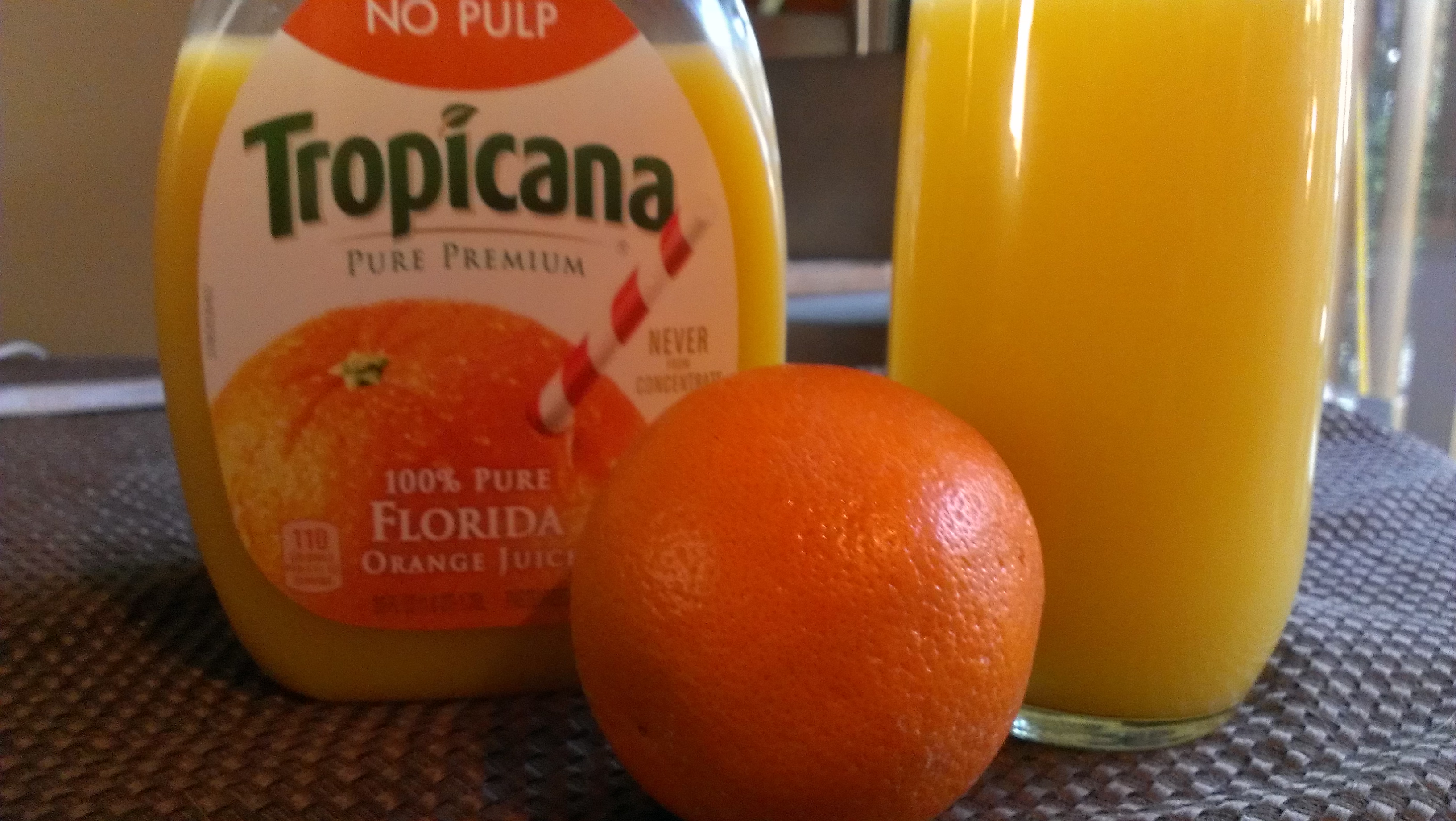
We poured ourselves a tall glass of orange juice in order to celebrate the holiday!





 Eat My Words