113/365: National Cherry Cheesecake Day*

Today we celebrate a dessert that has been around, in one form or another, for thousands of years. I’d call that a pretty gouda run! April 23 is National Cherry Cheesecake Day.

It’s also National Picnic Day, and while the weather is ideal for such an outing, the fact that it’s a workday made the idea of trying to plan a picnic lunch in the city tricky at best. Besides, a picnic doesn’t honor any particular food, so we chose to celebrate the cheesecake instead.

Cheesecake originated in ancient Greece, and – because it was considered a good source of energy – was served to athletes in the very first Olympic games, in 776 B.C. It won rave reviews there (but the East German judges gave it a 4.6). Early recipes were pretty crude: pound some cheese, mix it in a pan with honey and spring wheat flour, heat, cool, and dig in. When Rome conquered Greece they brought the recipe back home and modified it by adding crushed cheese and eggs, and cooking it under a hot brick. As the Roman empire expanded, cheesecake recipes spread throughout Europe, with regional variations popping up in each country. Centuries later, European immigrants introduced cheesecake to America. Our unique spin on the popular dessert was the addition of cream cheese, discovered by accident when a New York dairy farmer was attempting to recreate Neufchatel, a soft French cheese. Meanwhile, Italians make theirs with ricotta, Greeks use mizithra or feta, Germans use cottage cheese, and the Japanese incorporate egg whites and cornstarch into theirs, and sell it in vending machines with a whole bunch of other odd things. In America, it can be served plain (i.e. decadent New York-style cheesecake, made with heavy cream) or with toppings such as fruit, nuts, or chocolate.
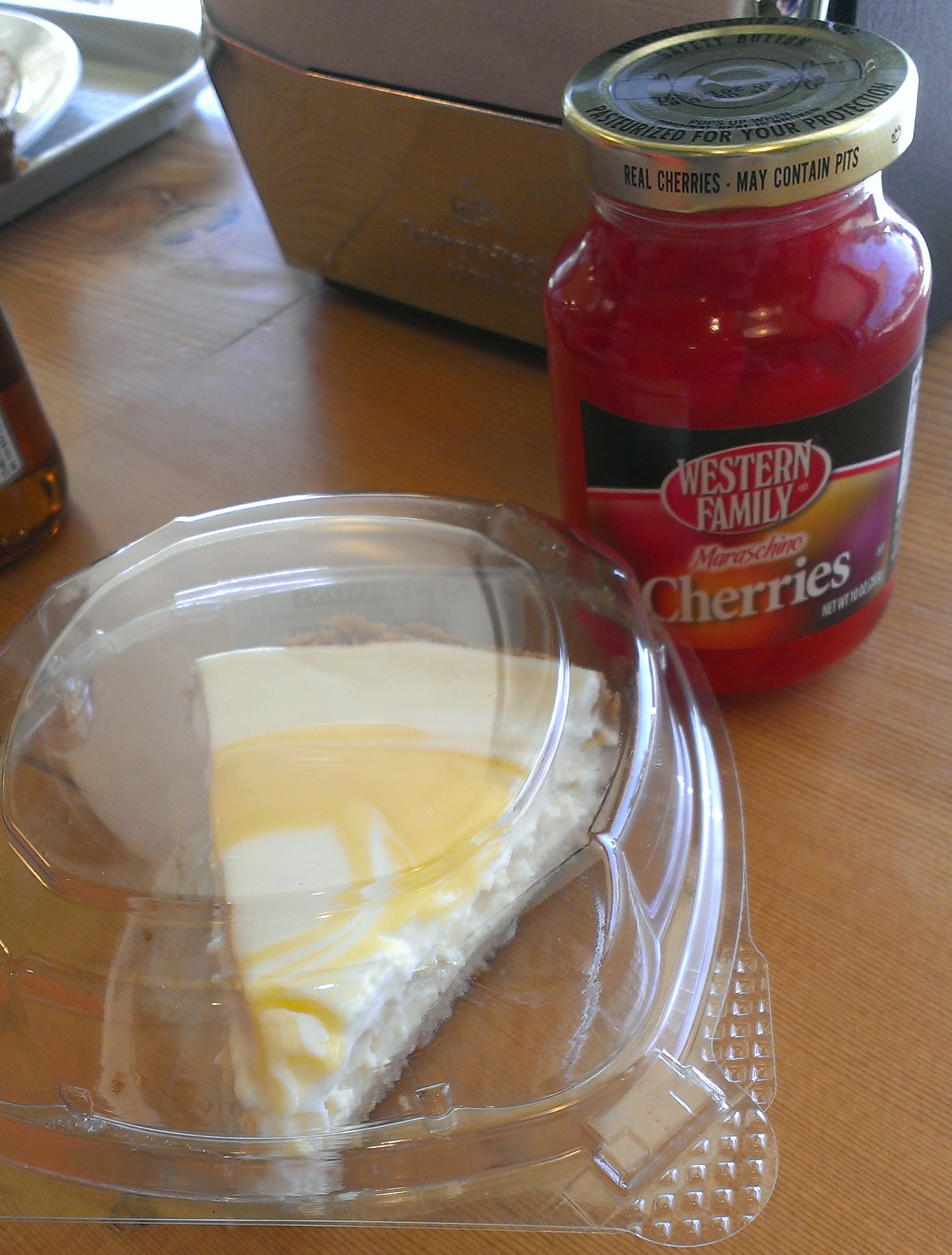
The essential ingredients in cherry cheesecake.

The essential ingredients in cherry cheesecake.

My family has an excellent recipe for cherry cheesecake that has been passed down through the generations. It’s creamy and delicious, and my mom usually makes it once a year – on Christmas day. Alas, we are more than eight months away from seeing the fat guy in the red suit trying to squeeze his ass down the chimney, so we had to go the easy route instead. I had seen individual slices of cheesecake for sale in New Season’s Market, so Tara and I stopped by there for lunch today. Sadly, they didn’t have cherry cheesecake. But they did have lemon cheesecake, and they’re a grocery store, so they also sold jars of maraschino cherries. Thus, we were able to cobble together a pretty decent cherry cheesecake which we shared bites of. It was a lot easier than making a cheesecake from scratch or having to buy a whole one, and was – as cheesecakes usually are – delicious!

Cherry Cheesecake

Categories: Desserts | Tags: , , , , | 8 Comments

112/365: National Jelly Bean Day

April 22nd won’t amount to a hill of beans unless you’ve got a sweet tooth and are ready to celebrate today’s food holiday. We honor a tasty treat that comes in dozens of creative flavors and was adored by a former President. It’s National Jelly Bean Day!

Jelly beans were inspired by a Middle Eastern treat called the Turkish Delight, consisting of soft jelly covered in confectioner’s sugar. Exactly how and when they were reinvented is a mystery, but in America they can be traced back to 1861, when a Boston candy maker by the name of William Schrafft urged his customers to send jelly beans to soldiers during the Civil War. Nice idea, but bullets work better. In 1905 an ad in a Chicago newspaper advertised jelly beans on sale for 9 cents a pound.By the 1910s the slang term “Jelly Bean” was used to describe a young man who would dress stylishly in order to attract women, but had no additional redeeming qualities other than his clothes. Men like this were also called “dandies” or “fops” and were, essentially, famous for being famous. Like Paris Hilton. In the 1930s jelly beans became synonymous with Easter because they were shaped like rabbit turds eggs.

In 1960 Herman Goelitz Rowland, a fourth-generation candy maker in Oakland, was looking to carry on the family business but times were tight; the candy corn they were known for just wasn’t keeping them afloat. Probably because candy corn pretty much only sells during Halloween. He decided to take a chance and expand the product line to include Gummi Bears and jelly beans. Not just any jelly beans, though – gourmet jelly beans using the most expensive, finest ingredients, and flavors cooked into the center (previously only the shells were flavored). These jelly beans caught the attention of California governor Ronald Reagan, who became a big fan and was known for always keeping a jar of jelly beans in the White House. Reagan famously wrote, “we can hardly start a meeting or make a decision without passing around the jar of jelly beans.”

In 1976, David Klein had an idea for jelly beans made with natural flavorings. He contacted Rowland, whose company was now called Jelly Belly, and the two collaborated on a new type of intensely flavored jelly bean made with natural ingredients. They were a hit right from the start, beginning with 8 flavors (Very Cherry, Lemon, Cream Soda, Tangerine, Green Apple, Root Beer, Grape and Licorice) and eventually expanding to more than 50. Some of the more exotic flavors include Chili Mango, Cantaloupe, Cappuccino, Margarita, and my favorite, Buttered Popcorn. Today, Jelly Belly is the #1 seller of gourmet jelly beans.

For this challenge, I was more than happy to pick up some Jelly Belly Buttered Popcorn jelly beans. I love them! Tara is not quite as fond of jelly beans as I am, but she tried a variety of Jelly Belly flavors herself – watermelon, coconut, and ice cream – and declared them “okay” and said they “tasted fine.” Hardly a rousing endorsement, but at least she didn’t spit them out.

Jelly Belly's Buttered Popcorn flavor.

Jelly Belly’s Buttered Popcorn flavor.

Categories: Candy | Tags: , , , , , | 7 Comments

111/365: National Chocolate Covered Cashew Truffle Day*

April 21 is one of those oddly specific food holidays that give us a headache. Cashews? Cool. Chocolate truffles? Love ’em. But do you have any idea how difficult it is to find a chocolate covered cashew truffle? Has anybody in history ever actually made one?! They simply do not exist. Or if they do, they are impossible to find. But we weren’t going to let a little thing like that stop us from successfully completing this challenge!

Cashews are the seeds of a tropical evergreen plant native to Brazil. Related to the mango, pistachio, and poison ivy (yikes!), cashews are kidney-shaped seeds that grow on the outside of their fruit, the cashew apple. Cashew apples are sweet, flavorful, and a highly prized delicacy, but are not marketable because their flesh is extremely perishable, and they begin to ferment the moment they are picked, barely lasting 24 hours. In their immediate growing locale they are often found canned, and are used to make jams and liqueurs. Most of us will never get to try a cashew apple in our lifetimes. Sniff. Cashews, on the other hand, are readily available. They are never sold in the shell, however, because they contain a black substance called cardol, a toxic skin irritant that can only be properly destroyed through roasting. Even then, it must be done outdoors, as the fumes from the smoke can cause life-threatening complications. Again: yikes! Sure seems like a lot of trouble for a mere nut.

Chocolate truffles, on the other hand, won’t kill you. Unless you eat too many in one sitting, of course. They were created in the kitchen of our good friend, renowned French chef Auguste Escoffier (Peach Melba, Pears Helene, Melba toast) in the 1920s – by accident. An apprentice inadvertently poured hot cream into a bowl of chocolate chunks instead of the sugared egg his pastry cream recipe called for. As the mixture hardened, he found he was able to shape it into a ball. He then rolled it in cocoa powder and realized it resembled a truffle, the prized fungus found in France and Italy. Hence the name.

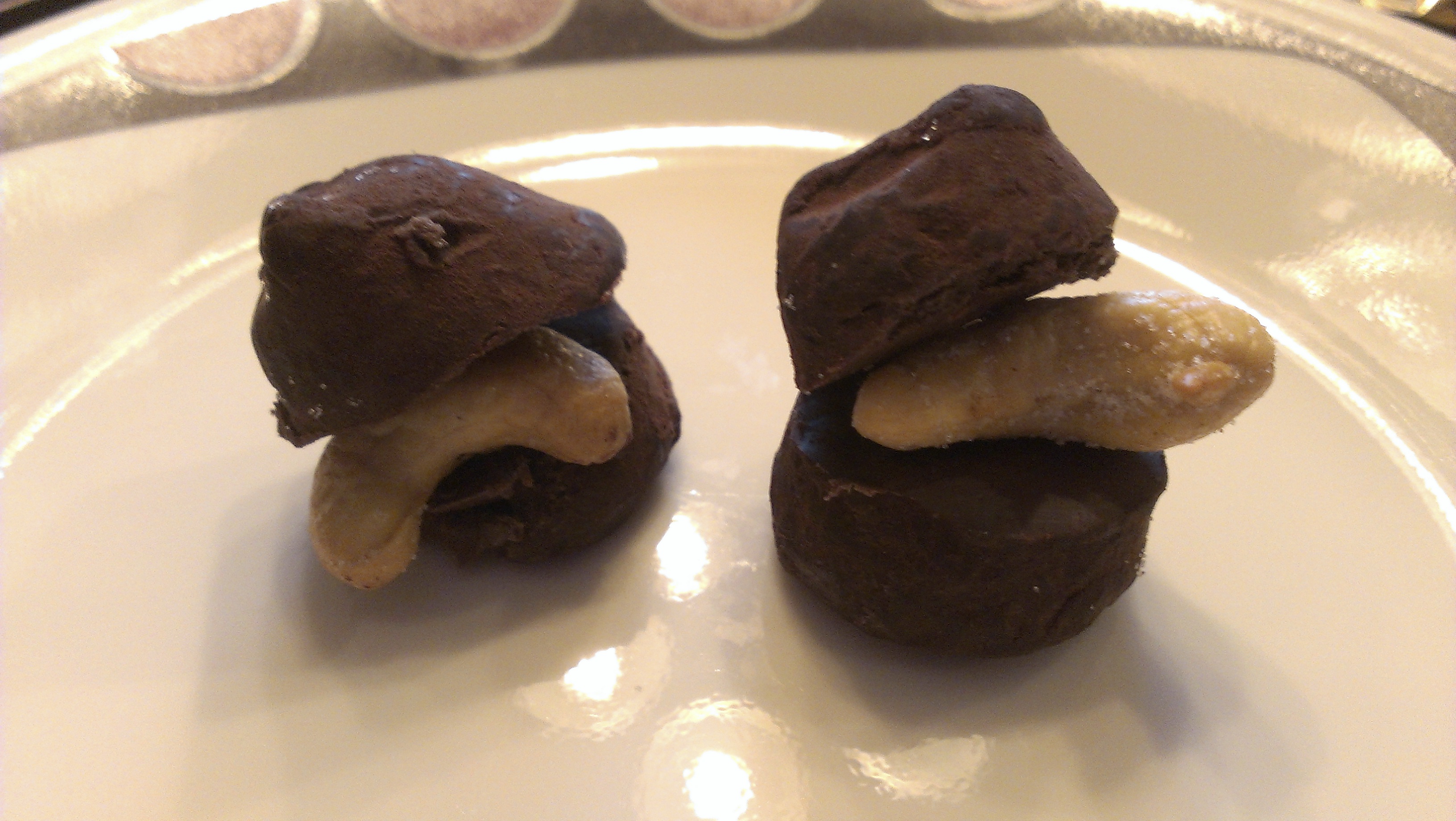
Because we couldn’t find chocolate covered cashew truffles, we had to get creative, much like when we celebrated Heavenly Hash. So we bought cashews, and had some chocolate truffles left over from Christmas. A little knife work, and voila! Instant chocolate covered cashew truffles.

"Homemade" chocolate covered cashew truffles.

“Homemade” chocolate covered cashew truffles.

Categories: Candy | Tags: , , , | 8 Comments

110/365: National Lima Bean Respect Day*

For the record, I like beans. Let me rephrase that: I like most beans. Lima beans, however, are one of the few varieties I can’t stand. Not only do I not like them, but I absolutely do not respect them. So when I learned that April 20 was National Lima Bean Respect Day, I thought, no way is that happening. Especially since it’s also National Pineapple Upside Down Cake Day. P.U.D. Cake is something I most certainly do respect. But then, the more I thought about it, I started to realize that the whole point of this food blog is to embrace the challenges and try new things. It would be easy to celebrate P.U.D. Cake, but there’s nothing adventurous in that. I thought it would be fun instead to celebrate a food both Tara and I despise. It took some convincing for her to agree, but in the end she was on board.

Lima beans, also known as butter beans, were first cultivated in Peru around 6000 B.C. They were discovered by European explorers in the capital city of Lima, which they were named after. They were discovered to have a long shelf life – rivaling even Twinkies! – and became a popular food item for ships setting out on long ocean voyages. They arrived on America’s shores sometime in the 19th century. Lima beans have excellent health benefits: they are high in fiber, which lowers cholesterol and prevents blood sugar levels from rising too quickly following a meal, making them an excellent protein source for diabetics; and contain a variety of vitamins and minerals, including iron, manganese, and molybdenum. Beans, beans, good for the heart? In this case, very true.

Too bad they taste like crap.

Oops. That wasn’t very charitable of me. I’m not helping the cause at all, am I?

We bought a bag of frozen vegetables advertised as an “Italian mix.” It contained carrots, cauliflower, green beans, and lima beans. We picked those out and ate them separately. I found them very starchy, and Tara said they had little flavor. However, we both agreed that they weren’t as bad as we’d thought.

“Not as bad as we’d thought.” Does that count as newfound respect?

We weren't happy that we had to eat lima beans.

We weren’t happy that we had to eat lima beans.

Categories: Vegetables | Tags: , , , , , | 16 Comments

109/365: National Amaretto Day*

I go a little nuts whenever I’m served a drink featuring today’s honored ingredient. April 19 is National Amaretto Day!

It’s also National Garlic Day. Though we didn’t specifically celebrate garlic, the Mexican food we had for dinner contained the strongly-scented herb, so mission accomplished there! For us, it’s a rare dinner that doesn’t feature garlic in one form or another, anyway. Vampires do not like us.

I was happy to celebrate an alcoholic beverage again, truth be told. It’s been awhile since we’ve been able to officially imbibe. (Unofficially it’s only been 24 hours, but whatever). Amaretto is an almond-flavored liqueur made from apricot pits or almonds, sometimes both. We can thank a young, widowed, horny innkeeper for this particular invention. In 1545, artist Bernardino Luini, a pupil of Leonardo da Vinci’s, was commissioned to paint the sanctuary of a church in Saronno, Italy. He needed a model to portray the church’s patron saint, the Madonna, who was like a virgin. Literally. She’s the Virgin Mary, and her face was in vogue back in those days. He found his muse in a young, widowed innkeeper, who is rumored to have become his lover. Virgin, my ass! Wanting to thank Luini for giving her the opportunity – and allegedly, for giving her a whole lot more than just that – she decided to give him a gift, but money was tight. She took a handful of apricot kernels, steeped them in brandy, and presented them to the painter as a token of her gratitude and affection. And thus, amaretto was born.

A few years ago I was reading Tara’s blog, and she mentioned going out with her friends and drinking chocolate cake shots. I had never heard of such a concoction, and thought they sounded like a terrible idea. Until we started dating and she made me one. Wow! They’re delicious. They really do taste like chocolate cake in a glass, if you can believe that. Tara can talk about how they’re made.

I have two of my best friends to thank for getting me hooked on chocolate cake shots.  Robin, Betsy, and I have spent many a night bar hopping in Ely and turning other people onto these tasty treats.  I’ve lost track of how many times I’ve heard “This really does taste like chocolate cake!”

A chocolate cake shot is made with equal parts Frangelico and vanilla vodka and finished with a splash of amaretto.  It’s served with a lemon wedge dipped in sugar (or the shot glass has a sugared rim).  Like a tequila shot you’re supposed to lick the sugar, take the shot, and then suck the lemon.  Variations include a birthday cake shot (splash of Grand Marnier) and german chocolate cake shot (splash of Malibu rum).  Yum!

Nowadays, anytime we’re in the mood for a little celebration, we’ll order a round of chocolate cake shots. Like the night we were engaged. Coincidentally enough, this evening we are headed back to the same place for some live music. We plan to order the same thing when we get there. However, because some versions of chocolate cake shots omit the amaretto, we’re bringing our own in a flask to add to our shots. Better safe than sorry. I suppose we could request it from the bartender, but where’s the fun in that? Shh!

This is one of the few challenges that we’re posting before we’ve actually completed it. If anything changes tonight, we’ll come back and update the post. Otherwise, knock on wood, let’s just assume everything will go as planned.

Shh. We're sneaking it in!

Shh. We’re sneaking it in!

Oh, and I wanted to mention, if you’re unaware we have a Facebook page and would love more followers. Feel free to look us up here!

Categories: Alcohol | Tags: , , , , , | 3 Comments

108/365: National Animal Crackers Day

It’s a real zoo around here today. We’re busy celebrating National Animal Crackers Day!

Animal crackers were first developed in England in the late 19th century. They were called animal biscuits, or simply “animals.” When they were imported to the United States they became an instant success. People couldn’t get enough of the sweet and crunchy elephants, giraffes, and manatees, so in order to fill the demand Stauffer’s Biscuit Company in Pennsylvania began making their own version right around the turn of the century. In 1902 the National Biscuit Company (now Nabisco) introduced “Barnum’s Animals,” animal crackers sold in a colorful train-themed box decorated with pictures of circus animals. They attached a string so the box could be used as a Christmas ornament and hung on the tree. Prior to that, crackers were usually sold in bulk or in large tins. The box, which sold for a nickel, became a huge hit, and is still manufactured today. (Sadly, it does not still sell for a nickel).

Originally, the animals were stamped out of a sheet of dough with a cutter, and had little detail. In 1948 Nabisco began using a rotary die cutter, allowing bakers to add detail to each cracker. Meaning, if they ever come out with a great white shark cracker, you’ll see the gleam of malevolent evil in its eye and the sharp razor points of each individual tooth. Come to think of it, that might be too scary for kids! But the animals do change over the years. Since 1902, there have been 54 different animals featured on the crackers. The newest addition, the koala bear, was added in 2002. Each box contains 22 crackers of a different variety, and part of the fun is the fact that you never know what you’re going to get, much like when you buy a pack of baseball cards or pick a hooker at random from the phone book.

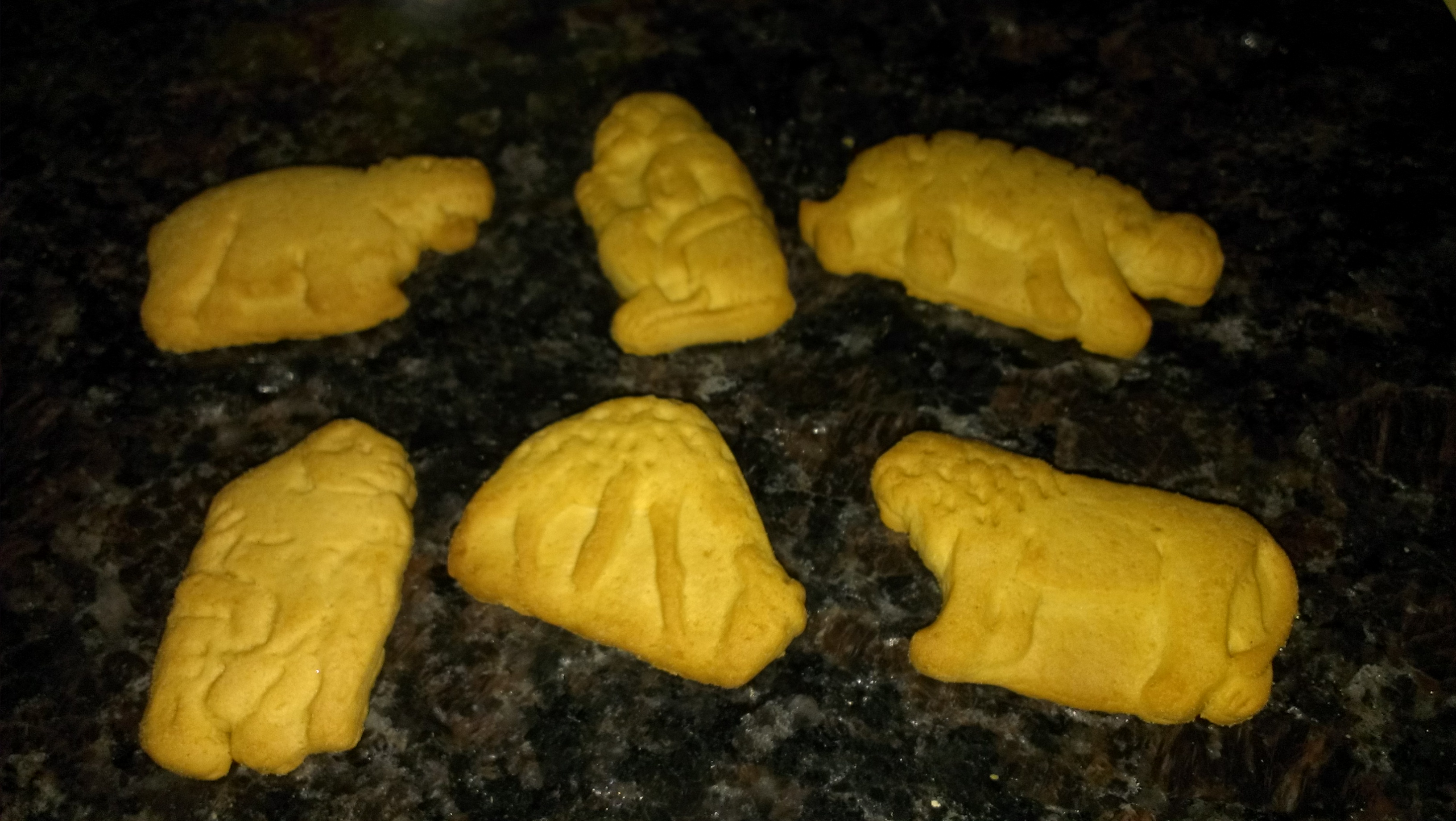
I had a nice variety of animals in my box, including a camel, hippo, giraffe, lion, rhino, buffalo, a monkey eating a banana (great detail, thanks to those die cutters!), and – yes!! A koala bear!!

Best of all, they were every bit as good as I remembered.

Animal Crackers

Categories: Uncategorized | Tags: , , , , | 6 Comments

107/365: National Cheeseball Day

Much like fruitcake and Rodney Dangerfield, the food we are honoring today gets no respect. April 17 is National Cheeseball Day!

This kitschy party favorite has gotten a bad rap for years. New York Times food writer Amanda Hesser once wrote, “Cheese balls tend to be associated with shag rugs and tinsel, symbols of the middle-class middlebrow.” But wait. I happen to be a fan of all things ’70s – including shag rugs and tinsel! In fact, I received a box of tinsel as a Christmas gift last year, after complaining that I could no longer find it in stores. (Thanks, future mother-in-law!). Which probably explains why I was looking forward to celebrating the cheeseball.

Nobody knows its exact origins, but Virginia Safford’s 1944 cookbook Food of my Friends contains the first known recipe for a cheeseball. Typically made with a blend of cream cheese and another softened cheese, cheeseballs are popular party dips that, over the years, have fallen out of favor with the American public. This article has some great information as to why, and the explanation is right there in the opening paragraph: cheeseballs are viewed as “an orange softball filled with garish industrial cheeses, smacking of an untraceable sweetness, and coated with stale, often soggy, nuts.” But they don’t have to be this way! Recipes for gourmet versions are abundant. Even Martha freakin’ Stewart has come up with ways to class up the lowly cheeseball. So get on the bandwagon, folks! Let’s bring cheeseballs back into vogue!

Tara and I bought one from WinCo. Kaukauna brand. It was…well, it was a cheeseball. Maybe there’s a reason these things receive so much derision. It made an “okay” appetizer for dinner, anyway.

Cheeseball

Categories: Appetizers, Dairy | Tags: , , , , , | 3 Comments

106/365: National Eggs Benedict Day*

We’ll consider you a traitor if you don’t help us celebrate today’s food holiday. April 16 is National Eggs Benedict Day! (It’s also National Day of the Mushroom. We love mushrooms, but Eggs Benedict feels more exotic. Besides, National Mushroom Day also occurs on October 15. We’ll revisit the fungus then).

Eggs Benedict is one of those dishes that is delicious and feels upscale despite its relative simplicity. Take an English muffin, split it in half, top with ham or Canadian bacon, poached eggs, and Hollandaise sauce. Voila! Breakfast is served.

There are two separate origin stories for Eggs Benedict. According to one claim, a patron of Delmonico’s in New York – the first restaurant ever opened in the U.S. –  by the name of Mrs. LeGrand Benedict was bored with the same old menu choices, and wanted to try something new for lunch. So she conferred with the chef, Charles Ranhofer, who created Eggs a’ la Benedick in her honor. He published a cookbook in 1894 that included his recipe: Cut some muffins in halves crosswise, toast them without allowing to brown, thn place a round of cooked ham an eighth of an inch thick and of the same diameter as the muffins on each half. Heat in a moderate oven and put a poached egg on each toast. Cover the whole with Hollandaise sauce.    

Version #2 appeared in the December 19, 1942 issue of New Yorker MagazineIt must be true, because it’s in print! According to the article, Wall Street broker Lemuel Benedict, suffering from the mother of all hangovers after a late-night bender, ordered “some buttered toast, crisp bacon, two poached eggs, and a hooker of Hollandaise sauce.” It’s unclear just how drunk he still was, ordering a hooker in public like that, but the Waldorf Hotel’s chef, Oscar Tschirky, complied, and was so impressed with the results he added Eggs Benedict to the menu after making a few substitutions (English muffin instead of toast, Canadian bacon instead of crisp bacon, no hooker).

Whipping up a little homemade Hollandaise sauce.

Whipping up a little homemade Hollandaise sauce.

It’s unclear which of those stories is true. Or if either of them is true, as there are other theories pertaining to its origin that include Popes and French Commodores, but it really doesn’t matter how the dish came to be. What’s important is, the dish came to be!

There are many variations on Eggs Benedict. At least twenty different varieties exist, with inventive chefs constantly adding new takes. We recently went out to breakfast at a place in Portland that served a version of Eggs Benedict with pepper bacon and tomatoes, and it was wonderful. But I prefer the original version best, and when it came time to celebrate today’s challenge, we decided to make the dish from scratch. A feat we had never before attempted. Slicing the English muffin was a cinch, and the leftover ham from yesterday’s challenge made the perfect topping. But neither of us were familiar with poaching an egg or making Hollandaise sauce. That’s why they invented cookbooks (my inspiration for the Hollandaise was Martha Holmberg’s Modern Sauces) and the internet (thank you, Allrecipes, for the egg poaching instructions). We tag teamed this dinner effort: I made the sauce, Tara poached the eggs, and together we created Eggs Benedict. The result? Absolutely delicious! The leftover HoneyBaked ham was the perfect base, too. This was one of our favorite Eat My Words challenges to date!

Eggs Benedict

Categories: Breakfast | Tags: , , , , , | 2 Comments

105/365: National Glazed Spiral Ham Day

April 15th shouldn’t be an overly taxing day, not when you’ve got the perfect excuse to pig out. It’s National Glazed Spiral Ham Day! Or, another in our list of very specific and odd food holidays.

Ham is a cut of meat that comes from the thigh of the pig. Pork was traditionally cured in the fall and would be ready to eat in the springtime. Ham is closely associated with Easter because it is considered a symbol of luck, and since Easter often lands in April, the middle of the month is an ideal time to celebrate this tasty porcine product. In 1937, a Detroit resident named Harry J. Hoenselaar, working in his basement, invented a special way of cooking, slicing, and glazing ham. He patented his spiral slicing machine and tried to market it to various companies, but nobody went for the idea whole hog. Undaunted, Harry decided to open his own ham store, and formed the HoneyBaked Ham company in 1957. The machine is attached to a ham on the top and bottom and a rotating base is gradually lowered as a blade is applied to the meat, resulting in perfectly uniform spiral slices of ham cut through to the bone. HoneyBaked ham became a sensation, winning over legions of fans who love their signature tender and juicy ham with a crunchy honey glaze.

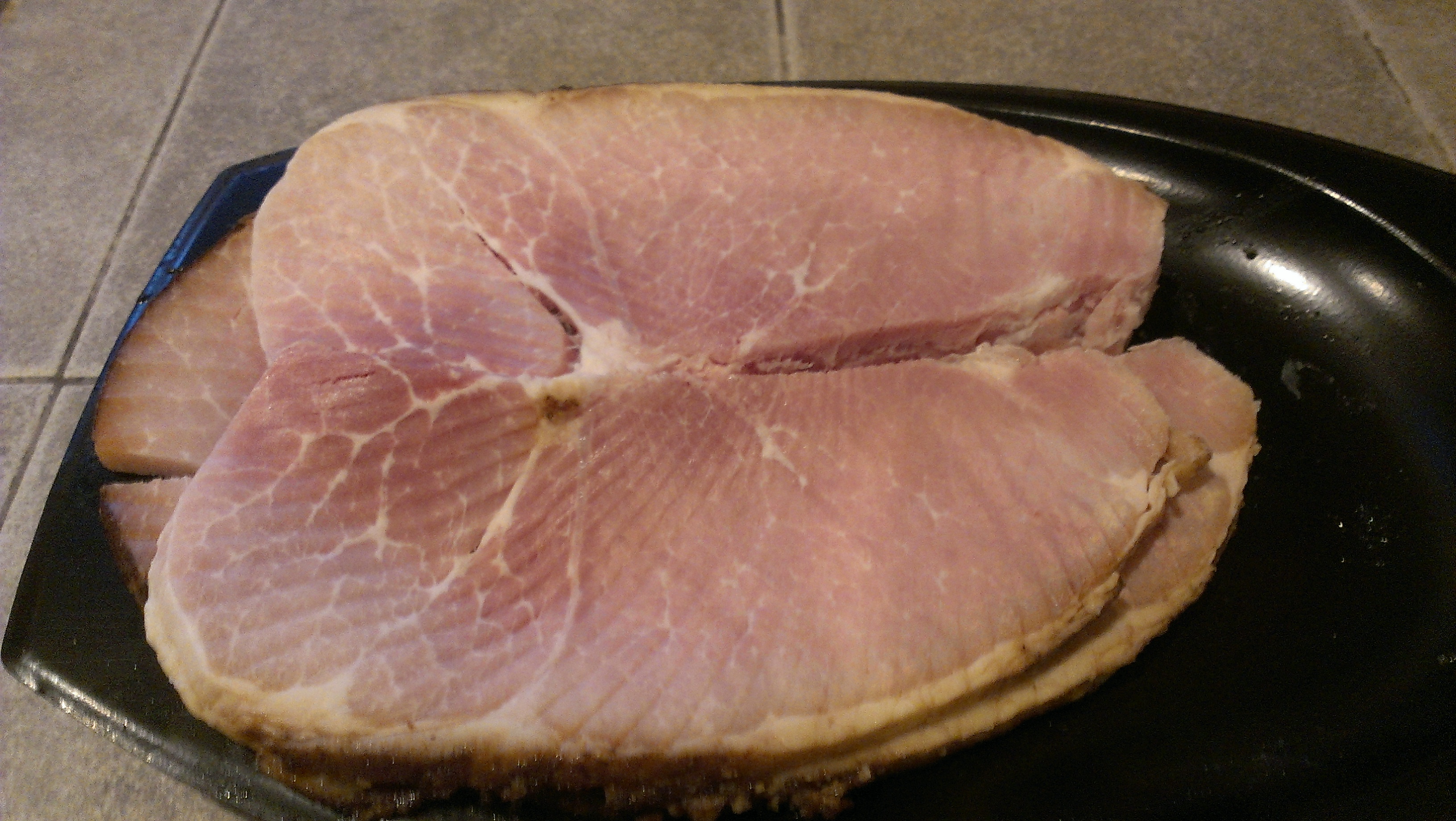
I too am a big fan of HoneyBaked ham, and immediately thought of them when this holiday rolled around. So Tara and I drove out to Clackamas Town Center on Saturday to stop by the HoneyBaked Ham store in the mall. As delicious as HoneyBaked ham is, it’s also expensive; the smallest “mini” ham still cost $32, and would have been a lot of pig for the two of us to tackle. Fortunately, they sell their glazed spiral ham already sliced by the pound, so we picked up a package of that. HoneyBaked ham is so good, it seemed a waste to just slap it between two slices of bread and call it good, so we made ham and eggs for breakfast instead. Delicious!

HoneyBaked Ham

Categories: Pork | Tags: , , , , , | 2 Comments

104/365: National Pecan Day

Today is Groundhog Day! Well, not really, but it sure feels like it. Because we celebrate National Pecan Day. Even though we already celebrated National Pecan Day on March 25. Early on, we were warned there were a few duplicate holidays. Several are devoted to potatoes. There’s even a second Coq au Vin Day. Honoring a food more than once seems like overkill, especially when there are plenty of deserving foods that do not have their own holiday yet. Like Spam.Deja Vu

And it also presents a dilemma. I’ve already cracked my jokes and shared the history of the food. I don’t want to repeat myself, so if you are interested in the background of pecans, click on the link above.

In the meantime, I guess we’ll just keep this post really short and let you know how we indulged in the tasty nut this time around. A few weeks ago, we celebrated joint holidays and made pecan waffles. Had I known then that pecans had another day coming up, I’d have just gone with the waffles. Instead of enjoying them for breakfast, this time around we indulged in dessert. Tillamook Caramel Butter Pecan ice cream, to be exact. If you’re not from around these parts, you are missing out. Tillamook is an Oregon creamery known for their cheese and other wonderful dairy products. The ice cream is no exception. I believe this was the first flavor I ever tried, and remains one of my favorites.

Caramel Butter Pecan Ice Cream

Categories: Nuts | Tags: , , , , | 4 Comments

Create a free website or blog at WordPress.com.