Beverages

218/365: National Root Beer Float Day

Don’t have a black cow, man! Today’s food holiday is perfectly refreshing. August 6 is National Root Beer Float Day!

National Root Beer Float DayRoot beer actually did, once upon a time, contain alcohol. 18th century farmers used to brew their own lightly alcoholic beverage to share during family gatherings. Originally made from the root or bark of the sassafras tree, the drink naturally contained small amounts of alcohol, and resembled beer (or Michael Moore) with its distinctive thick and foamy head. During the Philadelphia Centennial Exhibition in 1876, pharmacist Charles Hires introduced a commercial version of root beer that he wanted to call “root tea” because, when it came to booze, he chose to abstain. Fearing the coal miners, who were his key demographic, would want nothing to do with such a dainty sounding beverage – these were dirty men who cursed, spit, and braved the threat of Black Lung day in and day out, after all – he christened the drink “root beer” instead. By 1893 it was being sold as a bottled soft drink. That same year, Frank J. Wisner – owner of the Cripple Creek Cow Mountain Gold Mining Company in Colorado – was struck by inspiration one night. The entrepreneur, who’d been selling soda water to thirsty miners, was looking for a special drink for the children of Cripple Creek. He glanced outside one moonlit night and noticed that the snow-capped peak of Cow Mountain looked like a scoop of vanilla ice cream. Inspired by this vision, the next day he added a scoop of vanilla ice cream to the soda water that was most popular with the kids, Myers Avenue Red root beer. The beverage was a smash hit. Originally called a “Black Cow Mountain,” the name was later shortened to “black cow.” Nowadays, it is most often referred to, more simply, as a root beer float.

There are few things tastier than a root beer float on a warm summer day. To celebrate, we met up for lunch at Burgerville and split a root beer float. The perfect antidote for a 90-degree afternoon!

Categories: Beverages | Tags: , , , , , | 6 Comments

181/365: National Ice Cream Soda Day

You just may float on a happy haze when you celebrate today’s perfectly summery food holiday. June 30 is National Ice Cream Soda Day!

June 20 was also National Ice Cream Soda Day, so I suppose if you didn’t get your fill back then, today’s your encore. We chose to celebrate the vanilla milkshake on that day instead so as not to repeat ourselves. Just to keep us on our toes, there’s also a National Root Beer Float Day coming up in August. Knowing that, we should have opted for something a little more unique today, but laziness got the better of us.

Ice cream sodas, or floats, go by the name “snowballs” in the U.K. and “spiders” in the land Down Under, where women work and men plunder. They are exactly what their name implies: ice cream served in a soft drink. Ice cream sodas were invented in 1874 by Robert McCay Green in Philadelphia. According to legend, during that city’s sesquicentennial celebration, Robert ran out of cream for the flavored sodas he was selling on a particularly hot day, and substituted ice cream instead. But Robert explained in an interview that his creation was no accident: he wanted to invent a new treat to draw customers away from a competitor who had a bigger, fancier soda fountain. He experimented by mixing vanilla ice cream with soda water and a choice of 16 different flavored syrups. This new treat was a big hit, and Green was so proud of his invention, his will stipulated that “Originator of the Ice Cream Soda” be carved on his tombstone when he died.

While teens loved the tasty treat, many adults did not, and the drink was actually banned by some conservative local governments who believed that soda, which was marketed as a “miracle cure” (for what – skinniness?), was a controlled substance that should not be served or purchased on Sundays. In an effort to boost business, soda fountains came up with a treat that contained ice cream but no soda. They coined the new dessert a “sundae” that they could serve on “soda’s day of rest.”

Now, that’s clever!

To celebrate, Tara and I made root beer floats. I mean, what other type of soda-and-ice-cream combination can ever top the classic?

National Ice Cream Soda Day

Categories: Beverages, Desserts | Tags: , , , , , , , , , | 15 Comments

161/365: National Iced Tea Day*

Tea-totallers of the world unite: the 10th of June pays homage to a refreshing beverage that can be either sweet or tart. It’s National Iced Tea Day!

It is also Herbs & Spices Day and Black Cow Day. Technically we also celebrated the former since we cooked dinner using herbs and spices, but that’s hardly unusual. And with so many desserts in the month of June, the Black Cow just didn’t moo-ve us. So, iced tea it was!

There’s a myth that a plantation owner named Richard Blechynden invented iced tea in 1904 at the St. Louis World’s Fair. According to legend, the weather was hot, and Blechynden’s tea wasn’t selling. So he added ice to the drink, and – voila! History was made. The only problem with this story is that recipes for iced tea date as far back as 1876 (Estelle Wilcox’s Buckeye Cookbook), plus the fact that iced tea was being sold at hotels and railroad stations during the latter half of the 19th century. Most likely Blechynden’s iced beverage merely helped to popularize the drink, especially when people realized how refreshing it tasted on a hot day. During Prohibition (1920-1933), iced tea’s popularity grew when liquor, beer, and wine were no longer available. Folks found it a decent enough substitute, but stumbled over the revised lyrics to the old ditty “99 Bottles of Iced Tea on the wall.”

Iced tea was originally made with green tea, but over the years black tea became the preferred choice thanks to inexpensive imports from India, Ceylon, South America, and Africa. Iced tea is most commonly served with a slice of lemon as garnish, and is often sweetened with sugar. In the South, “sweet tea” (a very strong brew with lots of sugar) is especially popular, helping Southerners deal with the heat and humidity. Bottled iced teas are available across the country, manufactured by brands such as Snapple, Lipton, and Nestea. In recent years, the Arnold Palmer (aka “Half and Half”) – a mixture of 1/2 iced tea and 1/2 lemonade, named after the legendary golfer who liked to combine the two at home – has become increasingly popular.

Iced tea is one of my favorite beverages, and I’m not alone: 85% of the tea consumed in America is iced. I’m not a big soda drinker, so 9 times out of 10 when I’m eating out I’ll order iced tea (assuming that alcohol is not in the mix, of course). (And sometimes when it is in the mix: vodka and iced tea ala Jeremiah Weed is a pretty tasty drink). So, I was more than happy to indulge! Tara and I love our Keurig coffeemaker, and have recently discovered Snapple Iced Tea k-cups. They come in both lemon and peach flavors, and each is delicious. We brewed some up tonight to go along with our dinner!

National Iced Tea Day

Categories: Beverages | Tags: , , , , , , , | Leave a comment

128/365: National Have a Coke Day*

Today is The Real Thing: May 8th is National Have a Coke Day!

It’s also coconut cream pie day, but with no fewer than a dozen and a half pies being celebrated over the course of the year, we are more than happy to skip that one in favor of the most popular carbonated beverage in the world.

Rarely is a brand name product the recipient of a food holiday. In fact, this might be the only such food holiday of the year devoted to a specific product. I can’t think of any others off the top of my head.

My, what nice handwriting you have, Mr. Robinson.

My, what nice handwriting you have, Mr. Robinson.

Coca-Cola was invented in 1886 by Atlanta pharmacist John Pemberton, who wanted to create a distinctive tasting soft drink that could be sold at soda fountains. And also cure his morphine addiction. Two birds, one stone, you know? He mixed up a batch of flavored syrup and carried it in a jug down the street to Jacob’s Pharmacy, where it was mixed with carbonated water, sampled, and deemed “excellent.” It was sold for 5 cents a glass and originally marketed as an elixir believed to cure dyspepsia, headaches, impotence, and other ailments (like the aforementioned morphine addiction). Pemberton’s bookkeeper, Frank M. Robinson, came up with the name and the distinctive logo, which he wrote out in his own unique script – the familiar trademarked logo we’re all familiar with. The original recipe contained coca leaves (from the plant where cocaine is derived) and kola nut extracts for flavor and caffeine. Pemberton died just two years later, but not before selling shares of his business to various Atlanta-area entrepreneurs. The biggest portion went to Asa Candler, who took a 1/3 interest in the company after buying the recipe for $2300; Candler went on to form the Coca-Cola Corporation, and expanded to soda fountains outside of Atlanta with exclusive distribution and bottling deals as the drink’s popularity soared. Candler altered the recipe – at one time Coke contained an estimated 9 milligrams of cocaine per glass, but by 1904 there were only trace amounts left as the company substituted leaves left over from the cocaine extraction process for the fresh leaves it had used previously. To this day, a non-narcotic coca leaf extract is still used in the manufacturing of Coke. Which brings new meaning to the popular slogan, “Have a Coke and a smile.” When competition from other, inferior products (no, I’m not a Pepsi fan, can you tell?) threatened to chip away at Coke’s products, the company countered by creating a unique, contoured bottle in 1916, a design that was eventually trademarked. Popular advertising slogans over the years have included “Coke is It,” “It’s the Real Thing,” “The Pause That Refreshes,” and “I’d Like To Teach the World to Sing.” There’s a lot more fascinating history on this product – if you’re interested in learning more, read here.

National Have a Coke DayThe truth is, I’m not a huge soda (or pop, if you’d prefer) fan. But when I am in the mood for a cola beverage, it’s always Coke. There’s simply nothing better, despite Tara’s claims that Pepsi is superior (cough*bullshit*cough). And when I do drink Coke, I prefer it in that distinctive glass bottle. Every year around Christmas Target carries six-packs of those little bottles of Coca-Cola, and I stock up. I think I bought 4 or 5 last year, and I drink them sparingly.

Tara and I met up for lunch today, and we ordered Coke to go along with our Burgerville grub.

I have to admit, it was a pause that refreshed.

Categories: Beverages | Tags: , , , , | 6 Comments

126/365: National Beverage Day*

Take a big gulp of whatever you’d like today (unless you’re in New York City, of course – sizes limited to 16 ounces). It’s National Beverage Day!

As alluded to previously, it’s also National Crepes Suzette Day. As fond as I am of French pastries and lighting things on fire, we could use a break, so we’re taking the easy way out and celebrating the almighty beverage instead. We’ve had a few drink holidays before – we kicked off this challenge with one on the first day of the year, as a matter of fact – but those have all been in celebration of specific beverages (usually alcohol). Today is wide open to interpretation. And one of those rare food holidays we celebrate continuously throughout the day, with every meal!

Beverages have been around for as long as there were humans. Before there were humans, actually – assuming you believe we all crawled out of the primordial ooze. Companies like Evian make a living filtering and purifying that primordial ooze and selling it in plastic bottles for a couple of bucks a pop. How important are beverages? Experts recommend men drink 3 liters of liquid per day – that’s 13 cups! Women should consume 2.2 liters. Water is more important than food: we can survive 3 days without water, and 3 weeks without food. But beverage day would be boring if we were just drinking water.

We begin a typical day by turning on the Keurig. Tara and I enjoy our morning coffee, and have happily embraced the K-cup revolution. The Keurig is awesome: it’s fast, convenient, and eliminates wasted coffee. It even brews iced tea and lemonade. While we’re at work, we’re usually drinking ice water or booze. OK, that’s not an every day occurrence, but the company I work for has been known to break out alcohol during the workday on occasion. For dinner, it’s usually iced tea or lemonade (see aforementioned Keurig comment). Or milk, or water. I’m not real big on soda, but I enjoy an occasional Sprite or Coke or root beer. Tara likes Pepsi. I know, I know: there’s no accounting for taste. We both enjoy the occasional glass of wine, primarily white; I like sauvignon blanc while she is into riesling. I strongly dislike beer, but Tara digs Bud Light. My go-to alcoholic beverage is gin ‘n tonic, while hers is vodka and 7-Up. And of course, we’re both quite fond of bloody marys.

Today, we celebrated with a little bit of a lot of those beverages. Coffee, water, gin and tonic, iced tea and vodka…you name it, we drank it.

Beverages

Categories: Beverages | Tags: , , , | 5 Comments

124/365: National Orange Juice Day*

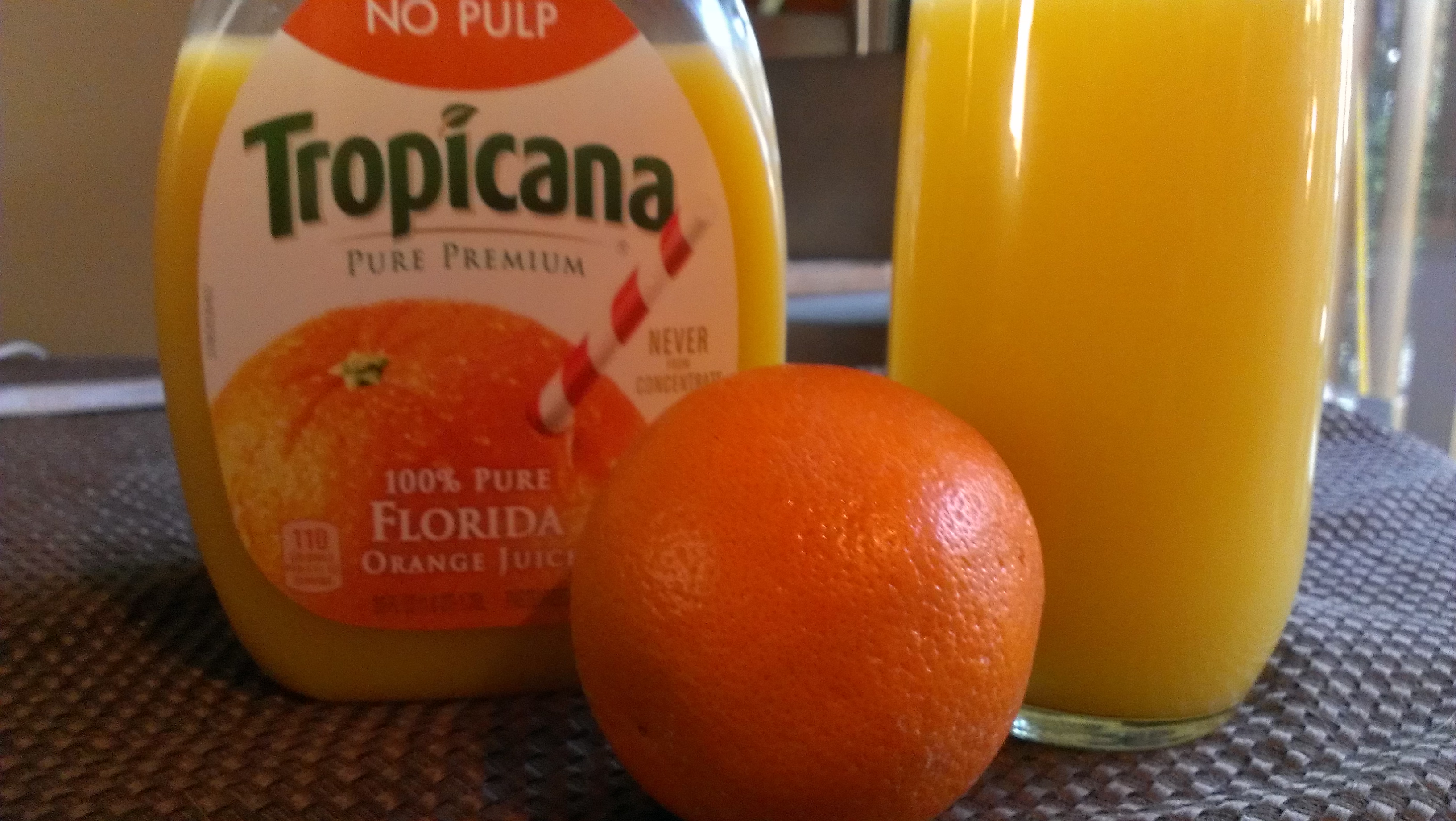
Orange you glad today’s food holiday is fresh and fruity? May 4 is National Orange Juice Day!

It’s also National Homebrew Today and National Candied Orange Peel Day. I don’t like beer, and even if I did, it’s doubtful that I’d be brewing my own anyway. And candied orange peels? Do people really eat those?? Choosing to celebrate with a tall, cold glass of orange juice is what we in the biz like to call a “no-brainer.”

Orange juice is one of the most popular juices in the United States. Spanish explorers planted the first orange trees in St. Augustine, Florida in the 16th century. The warm climate and abundant rainfall proved to be the perfect growing environment, and Florida oranges became wildly popular. As delicious as the fresh-squeezed juice was, there was no way to make it available commercially, as it would only last a day before going bad. In 1910, an overabundance of oranges in California (which had also begun growing the citrus fruit) forced growers to destroy 30% of the state’s orange trees, as they had nothing to do with the excess fruit. Soon after, pasteurization was developed, allowing citrus growers to juice the excess fruit and ship it to grocery stores all over the country, where it could be stored for longer periods of time. Growers began touting the health benefits of vitamin C, and by the 1920s orange juice had become a breakfast staple in America, replacing stewed fruit (a popular British breakfast accompaniment) as the go-to choice. Frozen concentrated orange juice was invented in 1948, inspired by the lack of fresh fruit available to soldiers during World War II. The slang term “OJ” popped up around this time, referring to both the juice and, later,  a wife-murdering-former-NFL-star-who-took-an-infamous-ride-in-a-white-Ford-Bronco.

We poured ourselves a tall glass of orange juice in order to celebrate the holiday!

IMAG0794

Categories: Beverages, Fruit | Tags: , , , , , | 4 Comments

31/365: National Brandy Alexander Day

All we are saying is give today’s food holiday a chance: we celebrate the Brandy Alexander, which happened to be John Lennon’s favorite drink! (He referred to it as his “milkshake”).

Also, today marks the successful conclusion of our first month of food challenges! We still have a long way to go, and while the task seems daunting, taking it one day at a time is the key to success. While also planning ahead, of course. For January, our favorites were curried chicken and New England clam chowder. The ones we liked least? The hot toddy and the Irish coffee. I think we’ll do a brief recap like this every month.

The Brandy Alexander was supposedly created in honor of Princess Mary’s wedding to Viscount Lascelles in London in 1922, but there is some dispute over this because Lascelles’ name is Henry, not Alexander. SOME dispute? How exactly do you get Alexander from Henry?? (And for that matter, how do you get Dick from Richard? I’ve always wondered). Others say it was named after Russian czar Alexander II. Regardless of who it was really named after (I vote for Alexander Graham Bell, even though he’s not in the running), it replaced another cocktail called the Alexander, which was made with gin. It became quite popular after numerous pop culture references, and is featured prominently movies (Days of Wine and Roses, Too Much Too Soon), television shows (Cheers, Mad Men, The Rockford Files, The Big Bang Theory), books (Brideshead Revisited, Invisible Monsters), and music (Feist released a song called “Brandy Alexander”). As ubiquitous as this drink is, I’m surprised I’d never had one before!

It’s really quite simple to make.

1.5 oz. brandy
1 oz. creme de cacao
1 oz. half-and-half (or cream)
Dash of nutmeg

Combine the first three ingredients in a shaker half filled with ice, strain into a glass, and sprinkle with nutmeg. It’s a very dessert-like drink – and really good!

I don’t know that I’d call it “really good”, but definitely better than the hot toddy, buttered rum, and Irish coffee.  Funny that we started this challenge with a cocktail and ended our first month with one as well.  Too bad all the cocktail holidays can’t be as good as my beloved Bloody Mary!

Tara’s exact words were “still quite stout.” Which sums up the Brandy Alexander well!

Now, on to February…

Brandy Alexander

Categories: Alcohol, Beverages | Tags: , , , | 2 Comments

25/365: National Irish Coffee Day

January 25th is National Irish Coffee Day. I was initially thinking we could knock this one out early – coffee is a breakfast drink, after all – but the whiskey (a key ingredient in Irish coffee) made this more of an after-work splurge. Which was fine, as we were going out anyway. On Friday evenings, we like to be in close proximity to a bar. Some bar. Any bar. Getting an Irish coffee would not be a problem.

Irish coffee was invented in 1942 by Joe Sheridan, a bartender at Foynes Air Base in Ireland. A Pan Am flight landed there one miserably cold winter evening, after a long eighteen-hour journey across the Atlantic Ocean. The passengers disembarked and headed for the bar. In an effort to warm them up, Sheridan brewed hot coffee, added a splash of whiskey, and topped it with a dollop of  cream. One of the passengers asked, “Is this Brazilian coffee?” Sheridan laughed and replied, “No, it’s Irish coffee.” A decade later Stanton Delaplane, a travel writer for the San Francisco Chronicle, brought Irish coffee to the U.S. after tasting it at the same airport during a trip abroad. Sadly, customs agents confiscated the pair of leprechauns he tried to sneak through. Delaplane nearly drank himself into a coma trying to figure out how to get the cream to float on top of the coffee over the next few months; finally a dairy farmer came to the rescue by suggesting the cream would be more likely to float if it were aged 48 hours first. Voila! Delaplane then introduced the drink to the Buena Vista Cafe in San Francisco, and popularized it in the U.S. by mentioning it frequently in his column.

I can see how this drink warmed up an airplane full of people in 1942!

I can see how this drink warmed up an airplane full of people in 1942!

When asked for the original recipe, Sheridan replied, “Cream as rich as an Irish brogue; coffee as strong as a friendly hand; sugar sweet as the tongue of a rogue; and whiskey smooth as the wit of the land.”

Oh, those wacky Irish. Faith and begorrah, you’ve gotta love ’em. Clearly, Sheridan missed his calling as a poet.

Tara and I met up at Cactus Ya Ya in Vancouver after work for cocktails and dinner. Interesting fusion of Mexican and Asian food here. They’ve been around for at least 15 years, so it must be working for ’em! The important thing was, they had Irish coffee. Remember those hot toddies we weren’t so fond of a couple of weeks ago? Let’s just say the Irish coffee was STRONG. And hot. We could only manage a few sips each. But hey…mission accomplished!

Categories: Alcohol, Beverages | Tags: , , , , | 4 Comments

17/365: National Hot Buttered Rum Day

Jack Sparrow would approve of today’s holiday: January 17th is National Hot Buttered Rum Day. Of all the various liquors, I think rum has the best flavor, so even though we recently celebrated a hot alcoholic beverage and didn’t care for it, I had high hopes for this drink.

In fact, hot buttered rum is closely related to the hot toddy. Both drinks are popular in the winter months (duh). But where the hot toddy is traditionally made with whiskey and honey, hot buttered rum is made with rum and butter (duh again). Plus brown sugar and spices like cinnamon, cloves, and nutmeg. The drink was a big hit in Colonial America, and was created in the 1650s after colonists began importing molasses from Jamaica. They quickly learned this byproduct of sugarcane could be turned into rum, and a series of distilleries opened up across New England. (Similar attempts to turn maple syrup into bourbon, honey into wine, and the tears of Pocahontas into absinthe failed miserably). Soon they were adding rum to everything, including toddies and eggnogs.

Over the holidays, Tara and I saw containers of hot buttered rum mix for sale in area grocery stores. “Perfect,” we said. “We’ll pick some up later.” Only once later rolled around, the product had disappeared from grocer’s shelves. Oops. Had we not learned our own lesson about planning ahead? Fortunately, the internet yielded recipes for making your own hot buttered rum batter. It’s amazingly easy – here’s the one I used:

Recipe for Hot Buttered Rum Batter
Ingredients:

  • 1 cup dark brown sugar
  • 4 oz unsalted butter, room temp
  • 1 1/2 tsp ground cinnamon
  • 1 1/2 tsp nutmeg or mace
  • 1/4 tsp ground cloves
  • 1/8 tsp salt

In a mixing bowl, combine all ingredients thoroughly. Refrigerate in a sealed air-tight container for up to two months. This mixture can also be frozen for up to one year before using. Makes eight servings.

Preparing a Hot Buttered Rum Cocktail
Ingredients:

  • 2 Tbsp refrigerated hot buttered rum batter
  • 6 oz boiling water
  • 1 1/2 oz dark rum
  • 1 Tbsp light cream (optional)
  • nutmeg for garnish

In a hot beverage mug, combine hot buttered rum batter with boiling water, stirring well until dissolved. Add in rum and cream, if using. Garnish with a sprinkle of nutmeg. Serves one.

Remember how we didn’t like those hot toddies? Well, the hot buttered rum was…drumroll, please…DELICIOUS! Really, really good stuff. We were both impressed. I think we’ll have to make these an annual holiday tradition!

Hot buttered awesomeness is more like it!

Hot buttered awesomeness is more like it!

Categories: Alcohol, Beverages | Tags: , , , , , , , | 4 Comments

11/365: National Hot Toddy Day*

January 11th is devoted to two food holidays. Or actually, two beverage holidays. It’s National Milk Day and National Hot Toddy Day. Milk may do a body good, but it’s boring and requires no special effort. I downed my morning pills with a glass of milk, and then ate a bowl of cereal for breakfast, while Tara took a few swigs to wash down her leftover brownie. Technically we could have considered this challenge complete and in the books by 6:45 AM, but the lure of the hot toddy was too strong to resist.

I can’t think of a more perfect time of year to celebrate a hot toddy. Winter is in full swing, and cold and flu season is upon us. In fact, the hot toddy was once prescribed by medical professionals as an ailment to treat the symptoms associated with colds and flu. The train of thought was that the vitamin C was useful for overall health, the honey to soothe the throat, and the alcohol to numb. Hey, it sure beats Nyquil! The exact origin of the hot toddy is unclear, but it is believed to have come from India, where a drink made from fermented palm sap (yum!) called the toddy was popular. Scottish members of the East India Trading Company returned to their native land and introduced a version of the drink to their country mates. Rumor has it sweet and citrusy ingredients were added to cut down on the harsh taste of Scottish whiskey. Odd, considering these are the same people whose national dish is made with sheep’s heart, liver, and lungs, and served in the animal’s stomach casing. But who am I to judge?

Although there are many variations, a traditional hot toddy is a mix of liquor (usually whiskey), boiling water, honey, lemon, and spices such as cloves, cinnamon, and nutmeg. In other words, potpourri in a mug! Midwestern folk add ginger ale, while Wisconsinites substitute brandy. People in southern California make theirs using the tears of their fired agents. Err…tequila. They use tequila! Traditionalists that we are, Tara and I stuck with a recipe honoring the original presentation. (Not the palm sap version, the whiskey version). Here it is:

Ingredients

1 teaspoon honey
2 fluid ounces boiling water
1 ½ fluid ounces whiskey
3 whole cloves
1 cinnamon stick
1 slice lemon
1 pinch ground nutmeg

Pour the honey, boiling water, and whiskey into a mug. Spice it with the cloves and cinnamon, and put in the slice of lemon. Let the mixture stand for 5 minutes so the flavors can mingle, then sprinkle with a pinch of nutmeg before serving.

The verdict?

IMAG0385 IMAG0384

Let’s just say, the Scottish should have added MORE ingredients to mask the whiskey.

And, I learned a valuable lesson on the economics of buying in bulk. We didn’t have cinnamon sticks or cloves, and when I went to the grocery store this evening to buy them, I almost choked over the prices. A jar of cinnamon sticks cost $5.89, ant the cloves were $4.99. I dutifully put them in my cart, and then stumbled across the organic foods section, where they were selling bulk spices. I grabbed a couple of bags, filled them with the amount necessary for the hot toddies, and ditched the jars. The cinnamon sticks cost me 30 cents and the cloves, 38 cents. I saved over $10 by purchasing in bulk. Whew! Who knew it was that cost effective?

Categories: Alcohol, Beverages | Tags: , , , , , , , | 6 Comments

Create a free website or blog at WordPress.com.